Preah Vihear Temple Cambodia: History, Architecture & Border Dispute
Preah Vihear had been sitting in my notes as one of the places for a future trip to Cambodia.
I first heard about it from a local guide in Siem Reap after a long day around Angkor. We were discussing where to go once the main temples were already covered, and she suggested Preah Vihear: a remote Khmer sanctuary in the Dangrek Mountains, far from the standard Siem Reap circuits and completely different in the way it uses the landscape.
I did not manage to visit it on that trip, so this is not a personal trip report. I researched the route for a future journey and originally planned to combine Preah Vihear with Koh Ker and an overnight stay in northern Cambodia.
That trip is now on hold because of the current situation along the Cambodia-Thailand border.
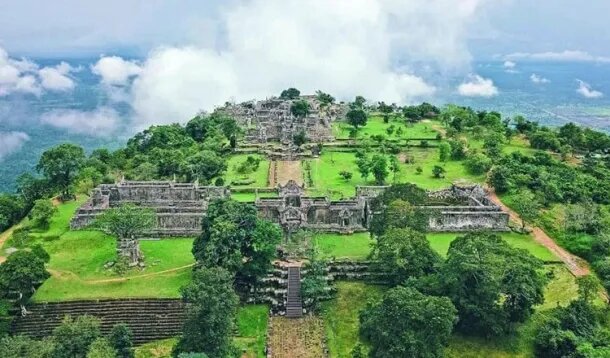
The temple itself, however, remains one of the most interesting Khmer monuments outside Angkor. It was built for Shiva over several centuries, stretches for roughly 800 metres along a mountain axis and sits at the edge of a dramatic escarpment overlooking the Cambodian plain.
For anyone trying to understand the Khmer Empire beyond Angkor Wat, Preah Vihear adds an entirely different piece to the picture.
Preah Vihear Temple Quick Guide
| Location | Dangrek Mountains, Preah Vihear Province |
| Country | Cambodia |
| Religion | Hindu |
| Main deity | Shiva |
| Origins | Religious activity from the 9th century |
| Main surviving architecture | Primarily 11th century |
| Temple layout | Linear complex about 800 metres long |
| Orientation | North to south |
| UNESCO status | World Heritage Site since 2008 |
| Known for | Mountain setting, monumental gopuras and Khmer stone carving |
| Current travel status | Border area affected by security restrictions; not a trip I recommend planning at present |
Current Travel Status: October 2026
Preah Vihear should currently be treated as a future-trip destination rather than an active itinerary recommendation.
The temple lies directly beside the Cambodia-Thailand frontier, in an area affected by the armed clashes of 2025. International travel advisories continue to warn against travel close to this section of the border, land border crossings remain suspended, and Preah Vihear has been listed among the border tourist sites affected by closures.
The temple and surrounding heritage area were also damaged during the 2025 fighting.
Older blogs still contain detailed instructions for driving north, staying near the mountain and taking local transport for the final ascent. That information describes how the trip worked under normal conditions, but it should not be used as current travel advice.
For now, I would keep Preah Vihear on the list for a later Cambodia trip and concentrate on currently accessible Khmer sites around Siem Reap.
Why Preah Vihear Is So Different from Angkor
Preah Vihear belongs to the same wider Khmer architectural world as the great monuments around Siem Reap, but its design feels completely different.
Angkor developed across an enormous plain. Even its temple-mountains were built inside a broader landscape of cities, reservoirs, roads and agricultural land.
At Preah Vihear, the mountain itself determines the architecture.
The sanctuary sits high in the Dangrek range and develops along a long north-south axis rather than around a compact central plan.
Visitors historically approached the sacred centre through a succession of staircases, stone causeways, courtyards and monumental gateways known as gopuras.
The farther you moved along the route, the closer you came to the principal sanctuary and the edge of the escarpment.
Instead of creating an artificial sacred mountain, as many Khmer temples do, Preah Vihear takes advantage of one that already existed.
A Temple Dedicated to Shiva
Preah Vihear was dedicated to Shiva.
Religious activity on the mountain can be traced back to the 9th century, while most of the surviving monumental complex was developed during the 11th century.
Several Khmer rulers contributed to the sanctuary over time, so Preah Vihear should not be imagined as a project completed during one reign.
The temple became particularly important under kings including Suryavarman I and Suryavarman II, whose reigns were also crucial periods in the development of Khmer monumental architecture elsewhere.
The sacred identity of the mountain was connected with Shiva as the lord of the summit.
That relationship helps explain the unusual processional design. Reaching the principal sanctuary required a physical ascent through progressively more important spaces rather than simply passing through an outer enclosure and arriving at the centre.
The 800-Metre Processional Route
The plan of Preah Vihear is one of its defining features.
The main architectural sequence extends for roughly 800 metres.
It begins lower on the northern side and progresses south toward the sanctuary near the cliff.
Along the route are several major gopuras connected by stairways and paved causeways.
This creates a temple designed around movement.
Each architectural stage marks another step in the approach to the sacred centre. Instead of seeing the entire complex at once, the visitor experiences it gradually.
The mountains, vegetation, changing elevation and increasingly restricted spaces all become part of the same composition.
This is one reason Preah Vihear cannot really be reduced to “another Angkor temple.”
Its architecture depends on the landscape in a way that is unusually direct even by Khmer standards.
The Gopuras of Preah Vihear
The monumental gateways are among the most recognisable parts of the temple.
Their sandstone architecture includes columns, galleries, carved lintels and elaborate pediments decorated with scenes from Hindu mythology.
Some of the best-known carvings depict episodes associated with Shiva and Vishnu.
The surviving structures also show the gradual development of Khmer architectural styles across the centuries in which the sanctuary was expanded.
One particular gopura, with its distinctive profile against the mountain sky, has become an icon of Preah Vihear and appears on Cambodia’s 2,000 riel banknote.
Seen in isolation, these gateways are beautiful examples of Khmer stone architecture. Their real importance, however, is in the way they divide and structure the long pilgrimage route.
The Cliff and the View Across Cambodia
Near the southern end of the complex, the mountain drops dramatically toward the Cambodian plain.
This is the landscape that dominates modern photographs of Preah Vihear.
The escarpment rises hundreds of metres above the lowlands below, giving the sanctuary a position that feels completely different from the forested plains around Angkor.
On a clear day, the view extends across a vast area of northern Cambodia.
The setting was not chosen simply because it was spectacular.
Mountains already carried powerful religious associations in Hindu cosmology, particularly through the concept of Mount Meru as the sacred centre of the universe.
At Preah Vihear, geography and religion reinforced each other.
Preah Vihear and the Khmer Empire Beyond Angkor
One reason I originally wanted to visit Preah Vihear after several days around Siem Reap was that it expands the geographical picture of the Khmer Empire.
After visiting Angkor Wat, Angkor Thom, Ta Prohm and the surrounding temples, it is easy to start thinking of Angkor as the entire civilisation.
It was not.
Khmer political power, religious networks, roads and monumental architecture extended far beyond the modern archaeological park.
Preah Vihear stood at the northern edge of that wider world.
The same broader perspective becomes clear at Koh Ker, another site that completely changes the story once you move away from the main Angkor circuits.
Koh Ker briefly became a royal capital in the 10th century, while Preah Vihear shows how important religious foundations could develop at great distances from the principal capital.
Why Cambodia and Thailand Disputed the Temple
Preah Vihear’s modern history cannot be separated from its location.
The temple stands immediately beside the present Cambodia-Thailand border.
The dispute developed from the delimitation of the frontier during the period when Cambodia was under French colonial rule and Thailand was known internationally as Siam.
Early 20th-century agreements attempted to define the border along the Dangrek Mountains. Maps produced during that process placed the temple on the Cambodian side.
After Cambodia became independent, Thailand challenged Cambodian sovereignty over Preah Vihear.
The dispute eventually went to the International Court of Justice.
The 1962 International Court of Justice Decision
In 1962, the International Court of Justice ruled that the Temple of Preah Vihear was situated in territory under Cambodian sovereignty.
Thailand was required to withdraw military or police forces stationed at the temple or in its vicinity on Cambodian territory.
The judgment settled ownership of the temple itself, but disagreements over the surrounding border area continued.
The geography contributed to the political problem.
The temple belongs to Cambodia, but historically the easiest physical approach to the mountain was from the northern, Thai side of the escarpment.
That practical access never determined legal ownership, but it helped make the site unusually sensitive.
UNESCO and the Return of the Border Dispute
Preah Vihear was inscribed on the UNESCO World Heritage List in 2008.
Its inscription recognised the exceptional relationship between Khmer architecture and the dramatic mountain landscape.
Instead of calming the political situation, the period surrounding the UNESCO inscription coincided with renewed tensions between Cambodia and Thailand.
Armed clashes occurred in the border area in the following years.
The dispute returned to the International Court of Justice, this time over the interpretation of the original 1962 ruling.
The 2013 Judgment
In 2013, the International Court of Justice clarified its earlier decision.
The Court confirmed that the 1962 judgment had recognised Cambodian sovereignty over the whole promontory of Preah Vihear as defined in the case.
Thailand was required to withdraw personnel from that area.
The judgment resolved an important question surrounding the immediate temple zone.
It did not, however, settle every territorial disagreement along the much longer Cambodia-Thailand frontier.
That distinction became important again more than a decade later.
What Happened in 2025?
Armed conflict returned to sections of the Cambodia-Thailand border in 2025.
The fighting involved artillery, rockets, air attacks and ground forces at several points along the frontier.
The Preah Vihear World Heritage property was among the affected areas.
In March 2026, a joint UNESCO World Heritage Centre and ICOMOS mission travelled to the site to assess its condition and document damage associated with the conflict.
For travellers, this means the military history around Preah Vihear is no longer simply something represented by old bunkers, bullet scars or stories from previous decades.
It is part of a very recent conflict.
That is why I would not treat current access as an adventure-travel question. The issue is not whether the road is difficult or whether the final climb is steep. The issue is whether the border region is currently appropriate for tourism at all.
Preah Vihear as a World Heritage Site
UNESCO inscribed Preah Vihear because of the quality of its Khmer architecture and its exceptional adaptation to the natural environment.
The site is particularly valuable because the buildings cannot really be separated from the mountain.
The staircases use the slope.
The gopuras divide the ascent.
The long axis directs movement toward the sanctuary.
The cliff opens the landscape at the culmination of that journey.
This interaction between architecture and terrain is what distinguishes Preah Vihear from many other major Khmer monuments.
It is not simply a collection of beautiful stone buildings placed on top of a mountain.
The mountain is part of the design.
The Route I Had Planned Before the Border Conflict
Before the security situation changed, I had planned to combine Preah Vihear with Koh Ker rather than attempt an exhausting return trip from Siem Reap in one day.
The idea was simple: leave Siem Reap in the morning, spend several hours at Koh Ker, continue north and stay overnight before visiting Preah Vihear the following morning.
That route made historical sense as well as practical sense. Koh Ker and Preah Vihear show two very different expressions of Khmer architecture beyond central Angkor.
I am keeping the idea in my notes, but I would rebuild the logistics completely if and when the border region becomes suitable for normal tourism again.
Old information about access, accommodation, ticketing and local transport should be rechecked rather than reused automatically.
Why Preah Vihear Is Still on My List
The current situation has changed the timing, not my interest in the temple.
I still want to walk the long processional route, see how the successive gopuras frame the mountain and understand the complex as an architectural journey rather than through isolated photographs.
I also want to see it after Angkor, because that is probably when Preah Vihear makes the most sense.
Once you have already seen the great temple-mountains, reservoirs and walled cities around Siem Reap, a sanctuary built along a mountain ridge shows how flexible Khmer architecture could be.
The same religious and political civilisation was capable of producing Angkor Wat on a plain, Koh Ker around a short-lived capital and Preah Vihear on the edge of an escarpment.
What to Visit Instead for Now
If you are travelling around Siem Reap in 2026, there are plenty of Khmer sites that add depth beyond the standard Angkor Wat-Bayon-Ta Prohm route without taking you into the current border warning area.
For an early temple-mountain, see Bakong.
For a later state temple with a completely different brick-and-laterite appearance, visit Pre Rup.
For a more remote jungle atmosphere, Beng Mealea works well as a longer excursion from Siem Reap.
And for a hilltop landscape without travelling to the northern border, Phnom Krom combines an early Angkorian temple with wide views toward Tonle Sap.
If this is your first Cambodia temple trip, my Angkor one-day itinerary is the better place to start.Is Preah Vihear Worth Visiting?
As a Khmer monument, yes.
Preah Vihear combines architectural importance, a remarkable mountain setting and a history that reaches far beyond the familiar boundaries of Angkor.
Its long linear plan, succession of gopuras and integration with the Dangrek escarpment make it one of the most distinctive temple complexes in Cambodia.
As an actual travel recommendation in October 2026, however, I would wait.
There are enough extraordinary Khmer sites in currently accessible parts of Cambodia that there is no reason to force a visit to a sensitive border region.
Preah Vihear has stood on this mountain for around a thousand years. It can stay on my list until the political and security situation makes the journey sensible again.
Useful Travel Resources
These are the services I use or check when planning trips and comparing travel options.
Flights
Compare routes and fares for Cambodia and Southeast Asia.
Hotels
Compare accommodation in Siem Reap and other established Cambodia destinations.
Tours & Activities
Search activities, transfers and organised sightseeing in Cambodia.
Tours & Experiences
Compare guided experiences around Siem Reap and Angkor.
Airport Transfers
Pre-book airport transfers for your Cambodia itinerary.
eSIM
Arrange mobile data before arriving in Cambodia.
Car Rental
Compare rental options for parts of your route where self-driving makes sense.
Travel Insurance
Check travel insurance before your trip and make sure you understand exclusions for areas covered by official travel warnings.
This post contains affiliate links. If you book or purchase through one of these links, I may earn a commission at no extra cost to you.