Kampot Pepper Cambodia: Why It’s Famous, Types & Plantation Guide
Kampot is known for its slow riverfront, old buildings and easy access to the mountains and coast, but one product is more closely associated with the region than almost anything else: Kampot Pepper.
This is not simply black pepper grown near a Cambodian town.
Kampot Pepper is a protected geographical product with defined production areas, cultivation rules, traceability requirements and a reputation built over centuries. Its identity depends on both the environment of southern Cambodia and the farming knowledge developed around it.
That distinction becomes much easier to understand once you visit a pepper plantation.
Instead of seeing pepper as something that appears already ground inside a supermarket jar, you see climbing vines, shade structures, hand-picked berries and several completely different products created from the same crop depending on when the fruit is harvested and how it is processed.
I visited the Kampot region while travelling through southern Cambodia, and pepper quickly became part of the way I understood the area rather than simply something to bring home as a souvenir.
If you are travelling through Kampot as part of a wider Cambodia route, you can see how I included the region in my Phnom Penh to Phu Quoc overland itinerary.
Kampot Pepper Quick Guide
| Product | Piper nigrum |
| Production area | Approved areas of Kampot and Kep provinces |
| Main colours | Green, black, red and white |
| Cambodian GI registration | 2010 |
| EU geographical protection | 2016 |
| Main authorised vine types | Kamchay and Lampong/Belantoeung |
| Best place to try it | Kampot and Kep |
| Best experience | Pepper plantation tour and tasting |
| What to buy | Whole black, red or white peppercorns |
| Local speciality | Fresh green pepper |
Where to Stay in Kampot
Kampot makes the easiest base for visiting pepper farms, Bokor Mountain and the surrounding countryside. Staying in town also gives you restaurants and riverfront life in the evening without needing to stay at a plantation.
Where Is Kampot Pepper Actually Grown?
Despite the name, protected Kampot Pepper is not limited to the immediate surroundings of Kampot city.
The official production zone covers designated areas in both Kampot Province and neighbouring Kep Province.
This matters because geographical indication is about much more than putting a regional name on the packaging. Producers have to operate inside the approved geographical area and follow the rules established for Kampot Pepper.
The landscape combines coastal influence, hills, seasonal rainfall and well-draining soils.
Around the Phnom Voar area in particular, porous soil helps excess rain drain away during Cambodia’s wet season, while pepper vines require regular irrigation during the long dry months.
But the concept of terroir here includes people as well as soil.
Traditional cultivation methods, planting material, irrigation, fertilisation, harvesting and processing are all part of what defines the protected product.
Kampot Pepper Has a Much Longer History Than the French Colonial Period
Pepper cultivation in Cambodia predates French rule by centuries.
References to pepper from the region extend back to at least the medieval period, although the scale and commercial importance changed enormously over time.
The French colonial period transformed Kampot Pepper into an international export product.
By the late 19th and early 20th centuries, pepper from southern Cambodia was being exported to France and became particularly associated with French cuisine and colonial trade.
This is where the modern international reputation began to take shape.
The industry was then severely disrupted by decades of war and political upheaval in Cambodia. Commercial pepper production declined dramatically, and many agricultural traditions across the country were interrupted during the Khmer Rouge period and the conflicts surrounding it.
Pepper cultivation began recovering after the civil-war years, particularly during the 1990s.
The modern revival therefore was not simply the continuation of an uninterrupted export industry. Farmers and organisations had to rebuild production, reconnect traditional knowledge and create a system capable of protecting the Kampot name from imitation.
For more context on the Khmer Rouge period and its wider consequences in Cambodia, see my guide to the Tuol Sleng Genocide Museum in Phnom Penh.
How Kampot Pepper Became a Protected Product
Protection of the name changed the industry significantly.
Cambodia registered Kampot Pepper as a geographical indication in 2010, together with Kampong Speu palm sugar.
In 2016, Kampot Pepper became the first Cambodian geographical indication registered in the European Union.
That protection is important because it means a packet labelled Kampot Pepper is supposed to represent something specific rather than simply pepper that was packed or sold in Kampot.
The system defines:
- where the pepper can be grown;
- which plant varieties can be used;
- cultivation methods;
- fertilisation and pest-control requirements;
- harvesting and processing standards;
- traceability;
- quality control.
The Kampot Pepper Promotion Association, or KPPA, manages and protects the geographical indication together with producers and processors.
This is why the comparison with products such as Champagne or Parmigiano Reggiano is useful. The point is not that they taste similar or occupy the same market. The similarity is that the geographical name itself is protected and linked to production rules.
Is Kampot Pepper Organic?
This needs a little nuance.
The Kampot Pepper GI specification prohibits chemical fertilisers and relies heavily on traditional fertilisation methods such as cow manure and bat guano.
Natural pest-control methods are also widely used.
That does not automatically mean that every product carrying the Kampot Pepper geographical indication should be treated as identical to every independent international organic certification.
GI and organic certification are different systems.
For a traveller buying pepper, the more useful question is whether the producer is registered, the product is traceable and the packaging carries the appropriate Kampot Pepper identification.
Green, Black, Red and White Kampot Pepper
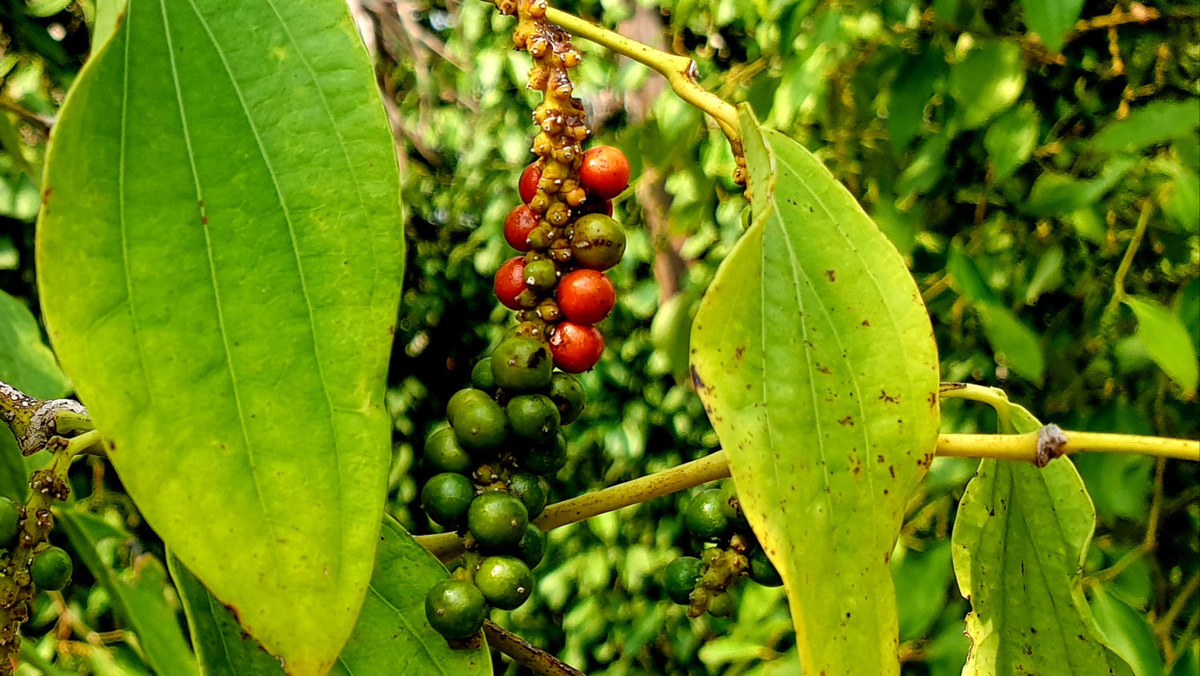
All four colours come from pepper vines of the same species, Piper nigrum.
The colour does not mean that farmers are planting separate black, red, white and green pepper plants.
What changes is primarily when the berries are harvested and what happens to them afterwards.
There is another distinction worth understanding: the Kampot GI allows specific local vine varieties, including Kamchay and Lampong, also called Belantoeung. So the colours are not different botanical varieties, but the protected crop itself does include defined planting material.
Green Kampot Pepper
Green pepper is harvested while the berries are still young and unripe.
Fresh green pepper has a much softer character than dried black pepper. The flavour is aromatic and vegetal with relatively gentle heat.
This is the pepper I would make a point of trying while you are actually in Kampot or Kep.
Fresh berries deteriorate quickly, which makes them much less convenient to transport than dried peppercorns. Green Kampot Pepper is therefore also sold preserved in brine, salt or other preparations.
In southern Cambodia, fresh green pepper is especially associated with seafood.
The classic combination is Kep crab with green Kampot Pepper, where whole clusters of peppercorns are cooked with the crab rather than ground over the finished dish.
Black Kampot Pepper
Black pepper begins as green berries that are harvested before full maturity and then processed and dried.
It is the easiest type to use at home and the one I would recommend if you want to buy only one packet.
Kampot black pepper is known for a strong aroma with floral, eucalyptus and mint-like notes, followed by pepper heat that remains on the palate.
It works with an enormous range of foods, from grilled vegetables and eggs to meat, soups and sauces.
A good black Kampot Pepper is also the easiest way to understand why freshly ground whole peppercorns are so different from the pre-ground pepper many people are used to.
Red Kampot Pepper
Red pepper berries are allowed to ripen fully on the vine before harvesting.
That additional ripening produces a noticeably different profile.
Red Kampot Pepper is still spicy, but the aroma is fruitier and the flavour can seem slightly sweet.
It is excellent with foods where pepper would normally sound unusual, including fruit and dark chocolate.
This is probably the most interesting type if you already use good black pepper and want something that feels distinctly different.
White Kampot Pepper
White Kampot Pepper begins with fully ripe red berries.
The outer skin is removed after soaking, leaving the pale seed inside.
The result has a different aroma again, with grassy and citrus-like notes alongside a pronounced pepper heat.
White pepper is traditionally useful in pale sauces, soups, fish and other dishes where black flecks would be visually distracting, but there is no reason to limit it to those uses.
It is also relatively labour-intensive to produce, which helps explain why it is usually more expensive.
What Does Kampot Pepper Actually Taste Like?
The biggest mistake is expecting the difference to be simply “more spicy.”
Kampot Pepper is valued primarily for aroma and complexity.
The experience also depends on which type you taste.
Black can bring floral, mint and eucalyptus notes. Red becomes fruitier and slightly sweeter. White can have fresh grassy and citrus characteristics. Green is fresh, mild and distinctly vegetal.
None of these descriptions means every peppercorn will taste like perfume or lime.
They are tasting notes, much like the vocabulary used for coffee, wine or chocolate.
The easiest way to notice the difference is through a comparative tasting.
Try the peppers individually rather than putting all of them immediately into food. Smell freshly crushed pepper first, then taste a very small amount.
That is usually the point where pepper stops feeling like a generic source of heat and starts making sense as a spice with different aromatic profiles.
Why Whole Peppercorns Are Better
If you are buying Kampot Pepper to take home, buy whole peppercorns.
Pepper begins losing aromatic compounds after grinding, so a pre-ground packet sacrifices much of the reason for buying a high-quality pepper in the first place.
A small grinder is enough.
You also do not need to use large quantities. Kampot Pepper is strongly aromatic, and freshly grinding a modest amount immediately before eating usually produces a much better result than adding large amounts of old ground pepper.
Keep the peppercorns dry, away from direct sunlight and in a sealed container.
How Kampot Pepper Is Grown
Pepper is a climbing vine rather than a bush or tree.
On plantations, the vines grow vertically around tall supports. Shade is important because intense tropical sun can damage the plants, so farms often use natural materials or shade structures above the vines.
Irrigation is another major part of the work.
Cambodia has a pronounced wet and dry season. Too much standing water can damage pepper roots during heavy rain, while the vines need regular watering during dry months.
Under the GI specification, farmers use defined cultivation practices, including natural fertilisation and approved plant varieties.
Harvesting is also selective.
Berries intended for different types of pepper are picked at different stages of ripeness rather than collecting the entire crop at once and deciding the colour later.
This is one reason the finished products can vary so much even though they originate from the same species.
Kampot Pepper Is Not Necessarily a Tiny Artisan Industry
One idea from the romantic version of the Kampot Pepper story needs correcting.
It is often described as though a few farmers deliberately keep production extremely small and refuse to expand.
The reality is more interesting.
Protected production has grown substantially since geographical indication status was introduced. The registered cultivation area expanded considerably, and hundreds of producers now participate in the system.
What prevents Kampot Pepper from becoming an unlimited industrial commodity is not a philosophical refusal to grow.
The constraints are geography, production standards, traceability and quality requirements.
You cannot simply open a huge pepper plantation elsewhere in Cambodia and sell the result as Kampot Pepper.
That controlled expansion is one of the reasons GI status matters.
Visiting a Kampot Pepper Plantation
A plantation visit is one of the easiest ways to turn all of this from abstract information into something understandable.
Several farms around Kampot and Kep welcome visitors.
A typical visit can include:
- walking through the pepper vines;
- seeing the support and shade systems;
- learning how the vines are propagated;
- explanations of irrigation and fertilisation;
- seeing processing and sorting;
- tasting green, black, red and white pepper;
- trying other Cambodian spices.
You do not need to be particularly interested in agriculture beforehand.
The tasting alone makes the visit worthwhile because the differences between the peppers are much easier to understand side by side.
Pepper-farm visits also combine naturally with countryside routes around Kampot, Kep, caves and rural villages.
La Plantation: More Than a Pepper Farm
One of the best-known places to learn about Kampot Pepper is La Plantation, in the countryside outside Kampot.
It is a working farm as well as an agrotourism project.
Visitors can join guided farm visits and tastings that explain how Kampot Pepper and other Cambodian spices are cultivated and processed.
For me, this is the useful part of a farm visit: you do not simply stand beside pepper vines and take a photograph. You can taste different peppers immediately after learning how harvesting and processing create those differences.
La Plantation has also developed a significant social programme around the surrounding rural community.
The project employs local residents and supports education through Les Écoles de La Plantation, including assistance for the local primary school and programmes helping students continue into secondary and higher education.
The farm has expanded its visitor facilities over time, so I would check the current tour and booking arrangements before travelling rather than relying on an old schedule.

Is La Plantation the Only Place to Buy Real Kampot Pepper?
No.
Kampot Pepper is a protected regional product, not a La Plantation brand.
There are many registered producers and processors.
La Plantation is convenient for visitors because it combines production, tours, tastings and retail in one place, but you can buy genuine Kampot Pepper from other registered farms and specialist shops as well.
That distinction is important.
Visiting one famous plantation should not give the impression that it somehow owns the Kampot Pepper tradition.
The protected name belongs to the regional producer system.
How to Buy Genuine Kampot Pepper
Tourist markets in Cambodia are full of packets labelled “Kampot pepper.”
Not all pepper sold in Kampot is protected Kampot Pepper.
The easiest approach is to buy directly from a registered producer or a reputable specialist shop and look for proper geographical-indication labelling and traceability.
I would prioritise:
- whole peppercorns rather than ground pepper;
- sealed packaging;
- clear producer information;
- Kampot Pepper GI identification;
- a producer or processor connected to the official system.
If a large bag is surprisingly cheap and has almost no information about its origin, there is little reason to assume that the pepper inside follows the protected specification.
Which Kampot Pepper Should You Buy?
If you want only one, buy black.
It is the most versatile and easiest to use every day.
If you want two, I would add red because it gives you the greatest contrast and works particularly well with dishes where you would not normally think of using pepper.
White is worth buying if you already know you like white pepper or regularly cook delicate sauces, soups and seafood.
Fresh green pepper is the one I would concentrate on eating in Cambodia rather than treating primarily as a souvenir.
Preserved green pepper travels much better, but fresh green pepper with seafood is part of the experience of being in Kampot and Kep.
What to Eat With Kampot Pepper
There is no single correct pairing, but the four types make a useful starting point.
| Type | Good With |
|---|---|
| Green | Crab, squid, fish, stir-fries |
| Black | Grilled food, meat, vegetables, eggs, soups |
| Red | Dark chocolate, mango, strawberries, salads, meat |
| White | Fish, seafood, soups, creamy sauces |
The most famous local dish is probably Kep crab with fresh green pepper.
Even if seafood is not your thing, pepper appears in enough sauces, meats, vegetables and other dishes around Kampot that you can still taste it locally without ordering crab.
Kampot Pepper and Kep
Kep and Kampot are often treated as separate travel destinations, but the pepper story connects them.
Part of the protected production area is actually in Kep Province, and fresh green Kampot Pepper is closely associated with the seafood cooking for which Kep is famous.
That makes a combined Kampot and Kep trip particularly logical if food is part of the reason you travel.
You can visit plantations in the countryside, try fresh pepper in local dishes and then compare that with the dried products sold to take home.
What Else to Do Around Kampot
A pepper plantation does not need an entire day.
It works particularly well as part of a countryside route, leaving another day for Bokor Mountain.
Bokor is almost the opposite experience: cooler temperatures, forest, colonial ruins, religious sites and rapidly changing mountain weather.
If you have enough time in Kampot, I would do both rather than choosing between them.
See my full guide to Bokor Mountain, its colonial hill station, ruins and main sights.
Is a Kampot Pepper Farm Worth Visiting?
Yes, particularly if you already enjoy food, coffee, wine, spices or anything where origin affects flavour.
The farm itself is not a spectacular attraction in the conventional sense. You are looking at rows of climbing plants rather than an ancient temple or dramatic waterfall.
What makes it worthwhile is understanding a product you probably use almost every day.
You see where pepper grows, why the vines need shade, how the same crop becomes green, black, red or white pepper and why geographical protection exists in the first place.
After a proper tasting, ordinary pre-ground pepper suddenly feels like a very different product.
Why Kampot Pepper Matters to Kampot
Kampot Pepper is more than a souvenir attached to the town’s name.
Its history connects the region’s agriculture, colonial trade, Cambodia’s decades of conflict and the modern attempt to rebuild rural industries around protected local products.
The GI system also gives the geographical name economic value.
Farmers and producers can charge for a traceable regional product instead of competing only on volume with industrial pepper grown elsewhere.
That is probably the most interesting part of the story.
Kampot Pepper survived not because it remained frozen in an old farming tradition, but because traditional knowledge was combined with modern certification, quality control and international protection.
And once you have tasted the different peppers on the farm, the label on the packet starts to mean something much more specific than “pepper from Cambodia.”
Useful Travel Resources
These are the services I use or check when planning trips and comparing travel options.
Flights
Compare routes and fares for Cambodia and Southeast Asia.
Hotels
Compare accommodation in Kampot and other stops around southern Cambodia.
Tours & Activities
Search tours, transfers and activities around Kampot.
Tours & Experiences
Compare Kampot countryside and food-focused experiences.
Airport Transfers
Pre-book transfers where available for your Cambodia itinerary.
eSIM
Arrange mobile data before arriving in Cambodia.
Car Rental
Compare rental options if self-driving suits your route.
Travel Insurance
Check travel insurance before your trip.
This post contains affiliate links. If you book or purchase through one of these links, I may earn a commission at no extra cost to you.