Bakong Temple near Siem Reap: The First Great Temple-Mountain of Angkor
Angkor Wat may be the monument everyone comes to Cambodia to see, but the architectural idea behind it began developing centuries earlier. About 15 kilometres southeast of Siem Reap, in the Roluos area, Bakong preserves one of the most important stages in that story.
Consecrated in 881 during the reign of Indravarman I, Bakong was the royal temple of Hariharalaya, an early capital of the Khmer Empire. It is considered the first fully developed large-scale Khmer temple-mountain: a stepped pyramid designed as an architectural representation of sacred Mount Meru.
Bakong is also much quieter than the headline temples around Angkor Wat and Angkor Thom. That makes it a particularly good place to understand the architecture rather than simply move through another crowded monument.
I visited Bakong as part of a longer route outside the main Angkor circuits. You can see how it fits into my three-day Siem Reap and Angkor itinerary.
Bakong Temple Quick Guide
| Location | Roluos, about 15 km southeast of Siem Reap |
| Date | Consecrated in 881 |
| King | Indravarman I |
| Religion | Hindu, dedicated to Shiva |
| Architectural style | Preah Ko |
| Temple type | State temple / temple-mountain |
| Opening hours | 7:30 AM–5:30 PM |
| Typical visit | Around 45–60 minutes |
| Ticket | Angkor Pass |
| Best time to visit | Morning or late afternoon |
| Good to combine with | Preah Ko, Lolei, Beng Mealea or a longer eastern route |
APSARA currently lists Bakong’s opening hours as 7:30 AM to 5:30 PM and suggests approximately 45 minutes for a standard visit. Access to the top of the pyramid is not permitted for children under 12 or pregnant visitors.
Where to Stay in Siem Reap
There is no need to stay near Roluos specifically to visit Bakong. Central Siem Reap remains the most convenient base if you are combining the Roluos temples with Angkor Wat, Angkor Thom and other sites over several days.

Why Bakong Matters
The importance of Bakong is not simply that it is old. Several Khmer religious monuments existed before it, including earlier structures in the same region.
What makes Bakong significant is the scale and maturity of its design.
APSARA describes it as the first fully developed pyramid-shaped temple in Cambodia to achieve what scholars call the temple-mountain form. The idea had appeared earlier, but at Bakong it became a monumental royal composition that would influence Khmer architecture for centuries.
The temple rises in five tiers from the surrounding enclosures toward a sanctuary at the summit. Its architecture transformed the Hindu concept of Mount Meru, the sacred mountain at the centre of the universe, into a physical structure that worshippers could approach and ascend.
This basic idea would be reworked repeatedly by later Khmer kings. Phnom Bakheng, Pre Rup, Baphuon and other temple-mountains all belong to an architectural tradition that Bakong helped establish.
Calling Bakong the “first Angkor” is therefore useful as shorthand, but not literally accurate. Angkor was the result of a long political and architectural development. Bakong is better understood as one of the places where the monumental language later associated with Angkor became clearly established.
Hariharalaya: The Capital Before Angkor
Before the royal centre moved toward what we now call Angkor, an important Khmer capital existed at Hariharalaya, in the area known today as Roluos.
Indravarman I came to power in 877 and developed the capital on a large scale. His building programme included Preah Ko, dedicated to royal ancestors, and Bakong, which became his principal royal temple. He also created a major reservoir north of the city.
Bakong was consecrated in 881, two years after Preah Ko.
The temple was dedicated to Shiva, and its central sacred image was a linga known as Sri Indresvara, whose name combined that of the king with the deity. This relationship between kingship, Shiva and the royal linga was an important part of Khmer political and religious ideology. UNESCO World Heritage Centre
Only in the following reign did the political centre move northwest. Indravarman’s son Yasovarman I established Yasodharapura around Phnom Bakheng, beginning the development of the monumental landscape most visitors now associate with Angkor.
Visiting Roluos before or after the main Angkor temples therefore helps put the chronology into perspective.
How Bakong Is Designed
Bakong is much larger than the central pyramid alone suggests.
APSARA describes an outer enclosure measuring approximately 900 by 700 metres, with the remains of at least 22 smaller sanctuaries scattered within it. Closer to the central monument is another enclosure of roughly 400 by 300 metres, surrounded by a wall and moat.
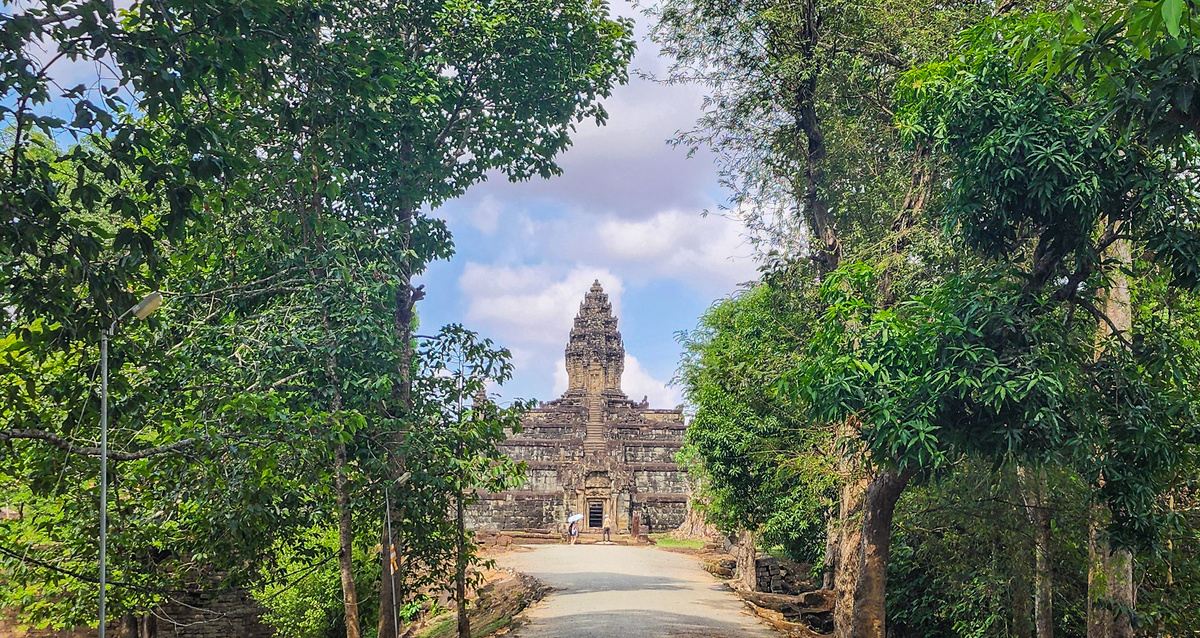
The central pyramid dominates the site. It consists of five progressively smaller tiers reached by stairways aligned with the cardinal directions.
From a distance, the structure looks relatively simple. Once you start walking through the complex, the relationship between the moat, causeways, brick sanctuaries, pyramid and summit becomes much clearer.
The experience is intentionally vertical. The sacred centre is separated from ordinary ground level and elevated above the surrounding landscape.
The Naga Balustrades: An Early Khmer Innovation
One of the details worth noticing appears before you even reach the pyramid.
Seven-headed naga sculptures flank the entrance causeway. APSARA identifies these as an important early stage in the development of the long naga balustrades that later became one of the most recognisable features of Khmer architecture.
Anyone who has already visited Angkor Wat or crossed the monumental causeways of Angkor Thom will recognise the basic visual idea.
At Bakong, however, you are seeing it in a much earlier form.
This is one of the reasons the temple is useful for understanding Angkor as an architectural sequence rather than a collection of unrelated monuments.
Brick Sanctuaries Around the Pyramid
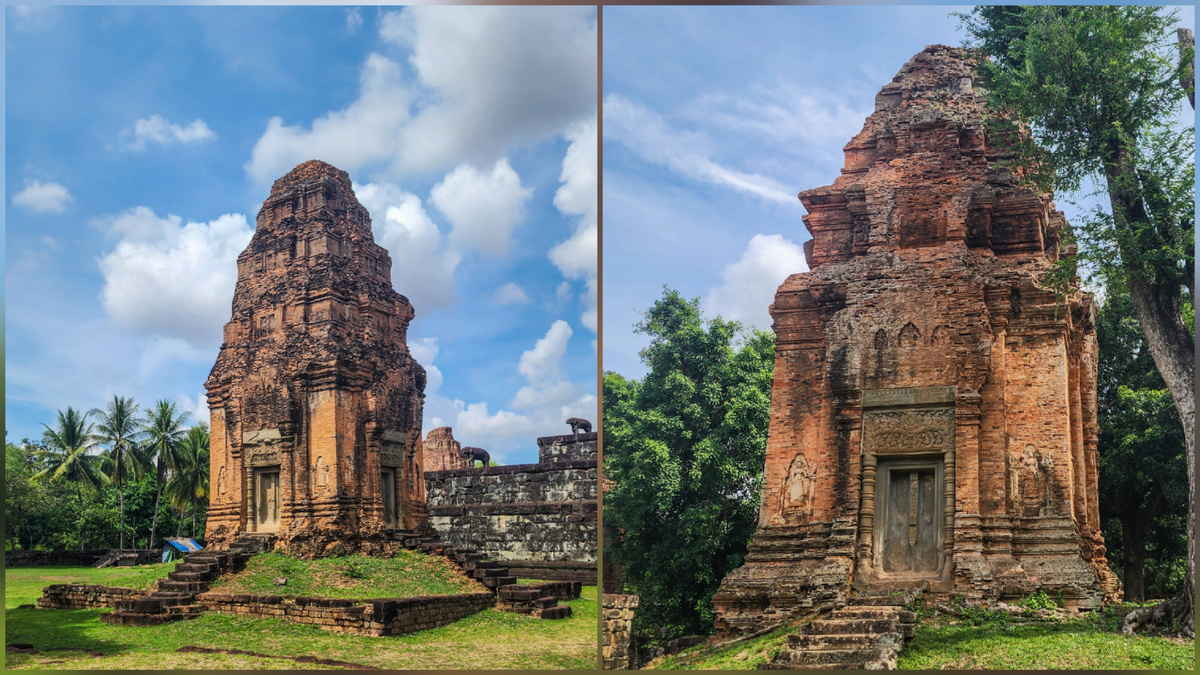
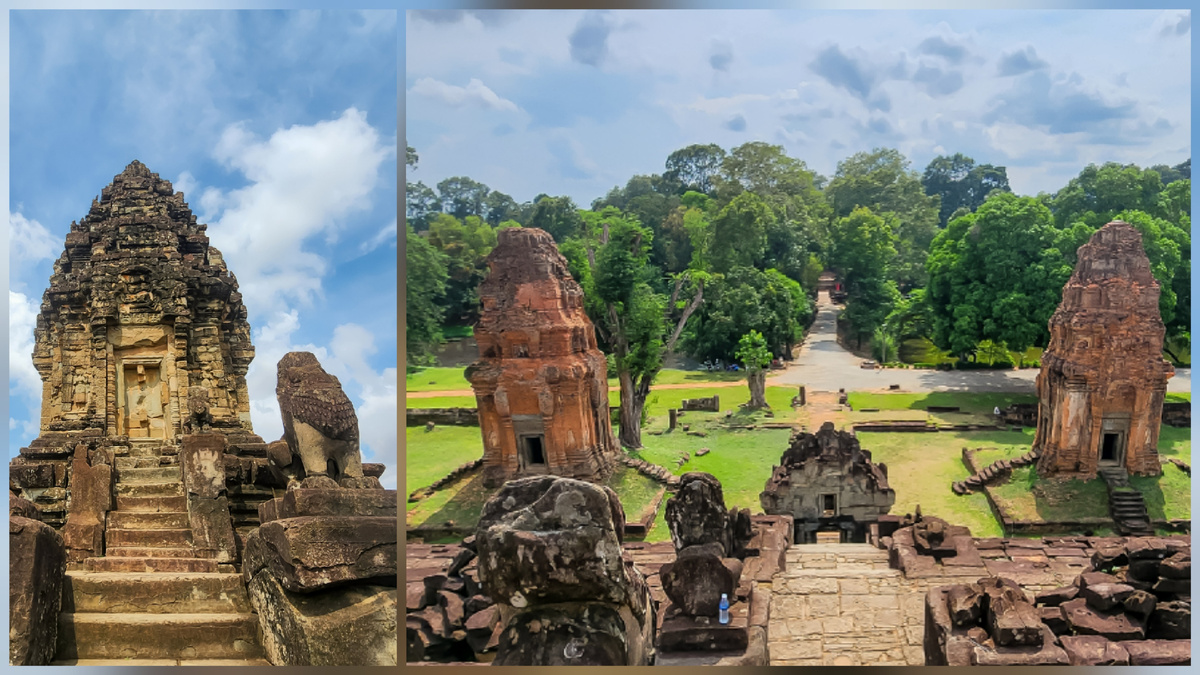
The central pyramid is constructed primarily from laterite and sandstone, but several brick sanctuary towers survive around its lower levels and wider enclosure.
Some retain traces of carved decoration and even evidence of original wooden structural elements. APSARA notes that wooden beams survive in several of the brick towers, providing rare evidence of construction techniques that normally disappear completely over time.
Brick preservation is a continuing challenge in the Roluos group. APSARA reported in 2025 that restoration teams had completed conservation work on several Bakong towers and were continuing work on others because deteriorating brick is considerably harder to reconstruct once the original material has disintegrated.
This is worth remembering when comparing Bakong with later sandstone monuments. What survives today is only part of the original architectural environment.
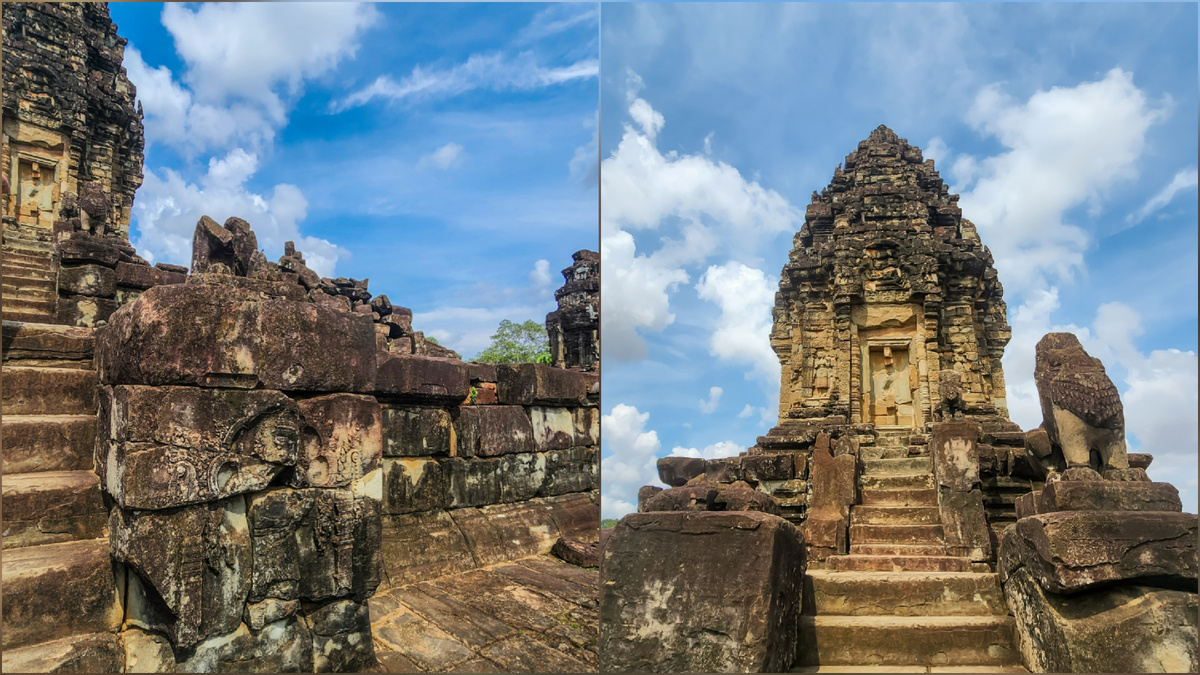
Elephants, Lions and Surviving Reliefs
As you climb the pyramid, look at the corners of the terraces.
Elephant sculptures once occupied prominent positions around the upper levels, while guardian lions flank the steep stairways. These figures were not simply decoration: they formed part of the symbolic architecture surrounding the sacred mountain.
The walls of the upper levels also once contained reliefs depicting religious and mythological scenes. Very little survives today, although APSARA notes that one fragment on the southern side may represent an Asura army from the Mahabharata.
Bakong is therefore not a temple where you should expect the density of narrative carving found at Angkor Wat or Bayon. Its importance lies much more in its overall form, planning and surviving early architectural details.
The Central Tower Is Not the Original One
The tower at the summit looks like the obvious climax of Indravarman’s 9th-century temple, but there is an important complication.
The original central sanctuary has disappeared.
According to APSARA, the tower standing at the highest point today was constructed in the 12th century, several centuries after Bakong was consecrated. The exact appearance of Indravarman’s original summit sanctuary is unknown.
This later addition explains why the upper tower can look stylistically different from the lower architecture.
The original sacred centre would have contained the Shiva linga associated with Indravarman I. Even though that sanctuary no longer survives in its original form, the hierarchy of the temple remains easy to read: each level leads toward the summit and the principal sacred space.
Climbing Bakong
Bakong’s pyramid is approximately 15 metres high, but the steep stairways make the climb feel more substantial than that number suggests. Cambodia’s Ministry of Tourism describes the temple as a five-tiered pyramid and one of the earliest monumental applications of the temple-mountain formula.
The climb is manageable for most visitors who are comfortable with stairs, but the descent deserves more attention. The stone steps are steep and can be slippery after rain.
Wear shoes with reasonable grip rather than loose sandals, and do not rush simply because someone is waiting behind you.
There is also an official restriction worth knowing before planning the visit: APSARA does not allow children under 12 or pregnant visitors to climb to the top of the pyramid.
Bakong and the Birth of the Temple-Mountain
It is tempting to look at Bakong as a rough prototype of Angkor Wat, but the comparison can become misleading.
Angkor Wat was built more than two centuries later and belongs to a very different architectural period. Bakong was not an unfinished experiment waiting for later builders to improve it. It was a major royal monument in its own right.
What connects the two is the development of architectural ideas.
At Bakong, we already see a carefully organised sacred landscape, axial approaches, enclosures, water, guardian figures, a monumental rise toward the central sanctuary and architecture designed to represent cosmic order.
Later Khmer rulers repeatedly transformed these concepts.
Seeing Bakong therefore gives useful context for what happened next without reducing the temple to a “primitive Angkor Wat.”
A Buddhist Monastery Beside a Hindu Temple
Bakong was built as a Hindu temple dedicated to Shiva, but the religious history of the site did not end in the 9th century.
A Theravada Buddhist monastery stands within the wider temple area today. APSARA’s 2026 account of Bakong notes that a Buddhist monastery has existed beside the ancient monument since the medieval period and uses this continuity as evidence that the Angkor region was never simply abandoned after the classical Khmer period.
For visitors, this creates an interesting contrast between the ancient temple-mountain and a living religious community.
It also makes Bakong feel less like an isolated archaeological ruin. The surrounding area contains homes, religious buildings and everyday community life alongside the monument.
Bakong, Preah Ko and Lolei: The Roluos Group
The most logical way to visit Bakong is as part of the Roluos Group.
The three best-known monuments are:
- Preah Ko, consecrated before Bakong and dedicated to royal ancestors;
- Bakong, the great state temple of Indravarman I;
- Lolei, built slightly later during the reign of Yasovarman I.
Together they provide a compact introduction to late 9th-century Khmer architecture.
You do not need an entire day for the group unless you want to explore very slowly. Bakong itself takes around 45 minutes to an hour for most visitors, and the other main Roluos temples are relatively close by.
If you have already spent several days around the large Angkor monuments, the Roluos group is also a useful change of pace.
Combining Bakong with Beng Mealea or Koh Ker
Bakong also works well as the first historical stop on a longer route east from Siem Reap.
Beng Mealea and Koh Ker can both be combined with Roluos if you have private transport and are comfortable with a longer day. The sequence is particularly interesting historically because it takes you from an early Angkorian capital toward later and more remote Khmer monuments.
There is an important ticket difference, however. Bakong is covered by the standard Angkor Pass, while Angkor Enterprise currently sells separate admission for Beng Mealea at $10 and Koh Ker at $15.
That is worth including when calculating the cost of a longer temple day.
Angkor Pass for Bakong
Bakong is included in the standard Angkor Pass, so there is no separate admission ticket for the Roluos temple.
Current official prices are:
| Angkor Pass | Price | Validity |
|---|---|---|
| 1 Day | $37 | 1 day |
| 3 Days | $62 | Any 3 days within 7 days |
| 7 Days | $72 | Any 7 days within 30 days |
If your itinerary includes the main Angkor temples, Grand Circuit and Roluos on separate days, the three-day pass is considerably easier to work with than trying to fit everything into one day.
Tickets can now be purchased officially online as well as at authorised counters, and digital tickets can be shown on a phone.
Best Time to Visit Bakong
Morning is probably the easiest time to visit Bakong. Temperatures are lower, the stone terraces have not yet absorbed the full heat of the day and visitor numbers are usually modest.
Late afternoon also works well, particularly for photography. Lower light gives more definition to the terraces, brick towers and guardian figures.
The middle of the day is less comfortable because much of the pyramid is exposed to direct sun.
Bakong is not primarily a sunset destination in the way Phnom Bakheng or Phnom Krom is, so I would choose the time based on comfortable conditions and how it fits into the rest of the route rather than planning the entire day around sunset.
How Much Time Do You Need at Bakong?
APSARA recommends approximately 45 minutes, which is enough for a straightforward visit.
I would allow around an hour if you want to explore the lower brick sanctuaries, climb the pyramid and spend some time looking at the architecture rather than simply reaching the top and leaving.
If you are visiting the whole Roluos group, a relaxed half-day is usually sufficient.
Is Bakong Worth Visiting?
Bakong would not replace Angkor Wat, Bayon or Ta Prohm if you have only a single day in Siem Reap. Those temples provide a much broader introduction to the monumental Angkor most first-time visitors have travelled to Cambodia to see.
With two or three temple days, the decision becomes different.
Bakong shows a much earlier stage of Khmer monumental architecture, but it is already sophisticated enough that many ideas associated with later Angkor are clearly visible. The five-tiered pyramid, moat, naga-lined approach, brick sanctuaries and elevated sacred centre make the temple’s cosmological plan unusually easy to understand.
It is also one of the best places around Siem Reap to see the history of Angkor as a progression rather than starting the story abruptly with Angkor Wat.
If you are interested in architecture or simply want a quieter temple day outside the busiest circuits, Bakong is worth adding.
Useful Travel Resources
These are the services I use or check when planning trips and comparing travel options.
Flights
Compare routes and fares for Cambodia and the rest of Southeast Asia.
Hotels
Search accommodation in Siem Reap and compare locations, prices and guest ratings.
Tours & Activities
Useful for attraction tickets, local activities and organised sightseeing.
Tours & Experiences
Compare guided Angkor tours, private day trips and other experiences around Siem Reap.
Airport Transfers
Pre-book a transfer between Siem Reap Angkor International Airport and your hotel.
eSIM
Get mobile data before arriving in Cambodia without looking for a physical SIM card.
Car Rental
Compare local car rental options for destinations where self-driving makes sense.
Travel Insurance
Check travel insurance options before your trip.
This post contains affiliate links. If you book or purchase through one of these links, I may earn a commission at no extra cost to you.