Koh Ker Cambodia: Visiting the Ancient Khmer Capital from Siem Reap
If Angkor is the monumental centre of the Khmer world most travellers come to Cambodia to see, Koh Ker feels like discovering another chapter of the same history deep in the forest.
For a brief period in the tenth century, this was not a remote provincial temple complex. It was one of the capitals of the Khmer Empire and, from 928 to 944, its sole political centre.
That history is part of what makes Koh Ker so different from simply adding another temple to an Angkor itinerary.
We arrived in the second half of the day after visiting Beng Mealea. It was hot, we did not have much daylight left, and we moved through some of the smaller temples faster than I would choose to now. At several of them, however, there was nobody else around.
By the time we reached the great stepped pyramid of Prang, a few small groups had appeared for the late-afternoon light. Then came the less romantic part: almost three hours back toward Siem Reap in darkness and rain.
I would absolutely visit Koh Ker again.
I would just plan the day differently.
Koh Ker Quick Guide
| Location | Preah Vihear Province, northeast of Siem Reap |
| Distance from Siem Reap | Roughly 120 km by road |
| Travel time | Usually around 2.5–3 hours each way, depending on transport and conditions |
| Current ticket | $15 for a 1-day Koh Ker pass |
| Angkor Pass | Not valid for Koh Ker |
| UNESCO status | World Heritage Site since 2023 |
| Main highlight | Prang, the seven-tiered pyramid at Prasat Thom |
| Time to allow | Best treated as a full-day trip from Siem Reap |
| Good combination | Beng Mealea + Koh Ker |
| Best for | Khmer history, archaeology, quieter temples and travellers who have already seen Angkor |
Why Koh Ker Matters: Cambodia’s Short-Lived Khmer Capital
Koh Ker is sometimes described as a remote temple complex, but that understates what was here.
King Jayavarman IV established his new centre at Koh Ker in 921. For several years, Koh Ker and Angkor existed as competing political centres, and from 928 to 944 Koh Ker became the sole capital of the Khmer Empire.
That period was short, but extraordinarily productive.
Temples, sanctuaries, reservoirs, religious monuments and an urban landscape were created within a relatively compressed period. Koh Ker also developed its own distinctive artistic language, now known as the Koh Ker Style, with monumental sculpture and unusually ambitious construction.
UNESCO added the archaeological site to the World Heritage List in 2023, recognizing not only individual temples but Koh Ker as an entire sacred urban landscape.
This distinction matters when you visit.
The famous pyramid is the obvious visual highlight, but Koh Ker was never just one temple surrounded by forest. It was a planned capital with religious architecture, hydraulic structures, roads, reservoirs and numerous sanctuaries spread across a large area.
That is why the site becomes much more interesting once you stop treating it as a detour to see a strange pyramid.
Koh Ker Is Not a Twelfth-Century Angkor Temple
The chronology is useful because it changes how you look at the architecture.
Koh Ker belongs primarily to the first half of the tenth century, almost two centuries before Angkor Wat was built in the twelfth century.
It represents a very different moment in Khmer history.
The political centre later moved back to the Angkor region, where Khmer architecture continued to develop on an even larger scale. Koh Ker therefore feels less like a smaller version of Angkor and more like a concentrated period of experimentation.
Some monuments use brick, others laterite and sandstone, while major structures demonstrate the use of very large stone blocks. The differences are part of the point.
This was a capital developing its own monumental language.

How to Get to Koh Ker from Siem Reap
Koh Ker is roughly 120 kilometres from Siem Reap by road, so this is not a casual morning tuk-tuk ride before lunch.
For most travellers, the simplest options are:
- private car with a driver;
- minivan;
- organized tour;
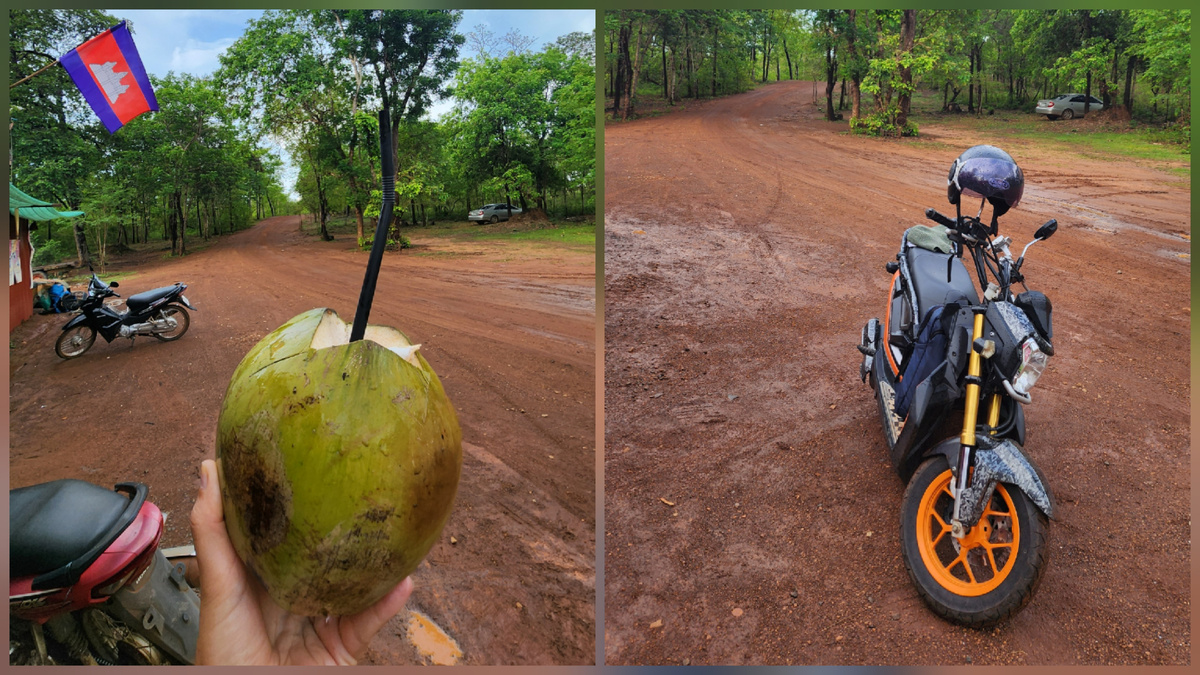
- motorbike or scooter if you are comfortable with a long day on the road.
Allow roughly 2.5 to 3 hours each way, depending on your route, stops, weather and transport.
The road distance is one reason Koh Ker still receives fewer casual visitors than the main Angkor temples. You have to choose to come here.
Can You Combine Koh Ker with Beng Mealea?
Yes, and that is exactly what we did.
Geographically, Beng Mealea and Koh Ker make sense as part of the same longer excursion from Siem Reap.
The problem was not the combination itself. The problem was our timing.
We reached Koh Ker in the second half of the day and stayed until the late-afternoon light around Prang. By the time we left, darkness was approaching. Rain turned the ride back into a much harder journey than the temples themselves.
If I repeated the route, I would still combine Beng Mealea and Koh Ker, but I would leave Siem Reap early and protect enough daylight for the return journey.
If your priority is Koh Ker rather than fitting as much as possible into one day, visiting it without Beng Mealea will naturally give you more time at the smaller temples.
Koh Ker Tickets and Angkor Pass
One important thing to know before setting out is that Koh Ker is not covered by the Angkor Pass.
The current Koh Ker one-day ticket for international visitors is $15.
There is a dedicated ticket counter at the entrance to the archaeological site, and the official ticket system also lists Koh Ker separately from Angkor Archaeological Park.
Because prices and ticket procedures can change over time, this is one practical detail I would check again shortly before travelling.
Do not arrive assuming that a three-day or seven-day Angkor ticket will also get you into Koh Ker.
What to See at Koh Ker
You could spend a long time exploring every archaeological remain around Koh Ker, but most visitors will naturally concentrate on a selection of the main temples and sanctuaries.
The important thing is not to drive directly to the pyramid, take a photograph and leave.
Some of my strongest memories are from the smaller temples we saw before reaching Prang.

1. Prasat Thom and the Prang Pyramid
The monumental centre of Koh Ker is Prasat Thom, a large temple complex that includes the famous stepped pyramid known as Prang.
The distinction is useful: Prasat Thom is the broader complex, while Prang is the dramatic pyramid most people immediately associate with Koh Ker.
Prang rises in seven tiers to roughly 35 metres and looks unlike the classic image many travellers have of a Khmer temple.
Its stepped profile is sometimes compared visually with Mesoamerican pyramids. That resemblance is only visual, of course, but it explains why photographs of Koh Ker can initially look almost surprising in a Cambodian context.
If access to the upper viewpoint is open during your visit, the climb gives you a completely different sense of the location.
Instead of looking across an urban skyline or a dense field of monuments, you see forest stretching away around the former capital.
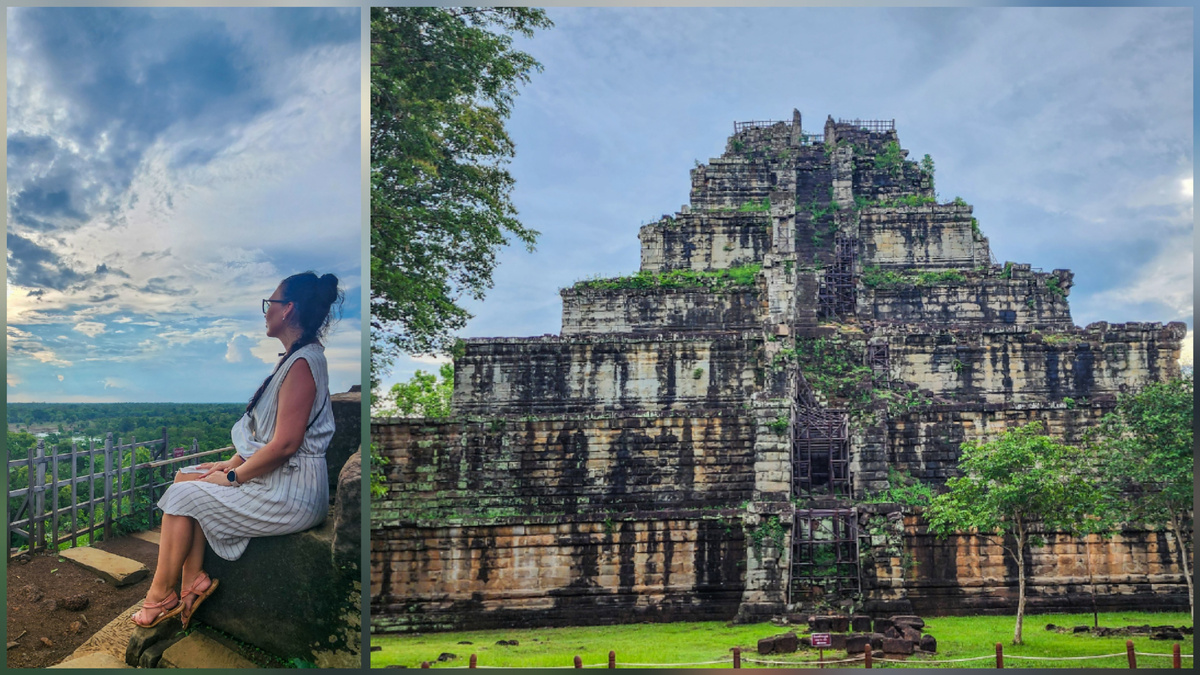
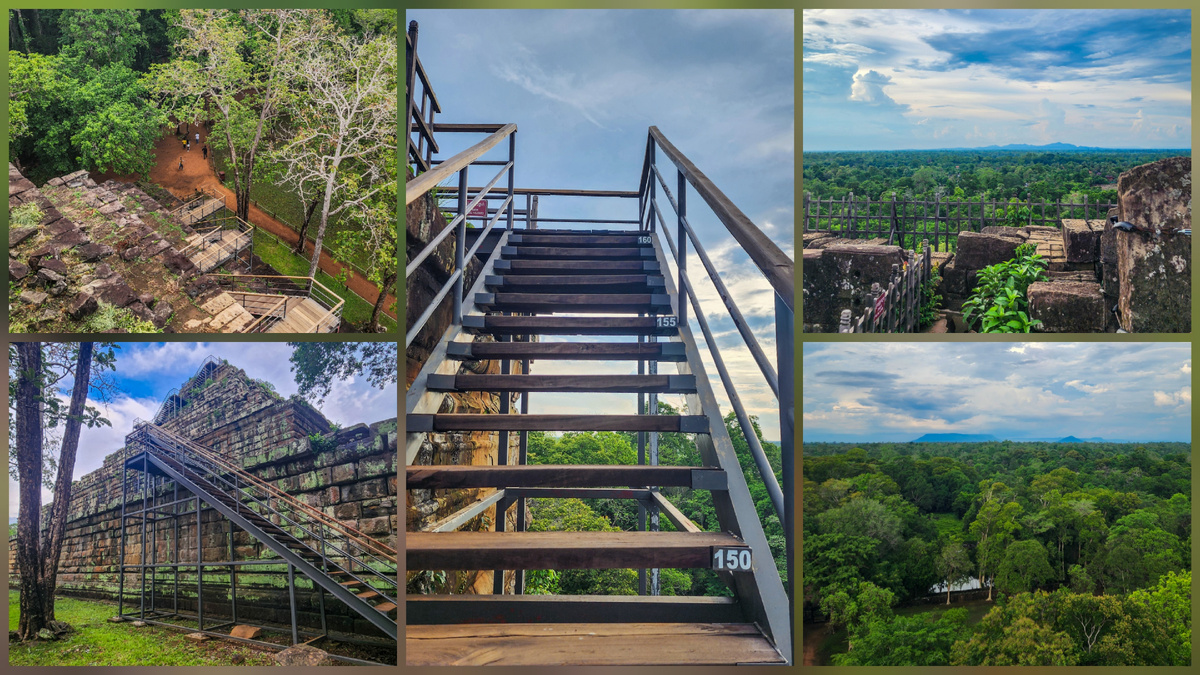
That was the moment when Koh Ker’s isolation made the most sense to me.
The climb is exposed and can be hot, so water, sun protection and decent footwear matter. Anyone with knee, back or mobility problems should judge the stairs carefully rather than assuming the ascent is an essential part of the visit.
You do not need to climb to understand the monument.
2. Prasat Pram: The Temple I Remember Most
The famous pyramid is Koh Ker’s landmark, but Prasat Pram produced one of my strongest reactions of the entire visit.
When we arrived, we were alone.
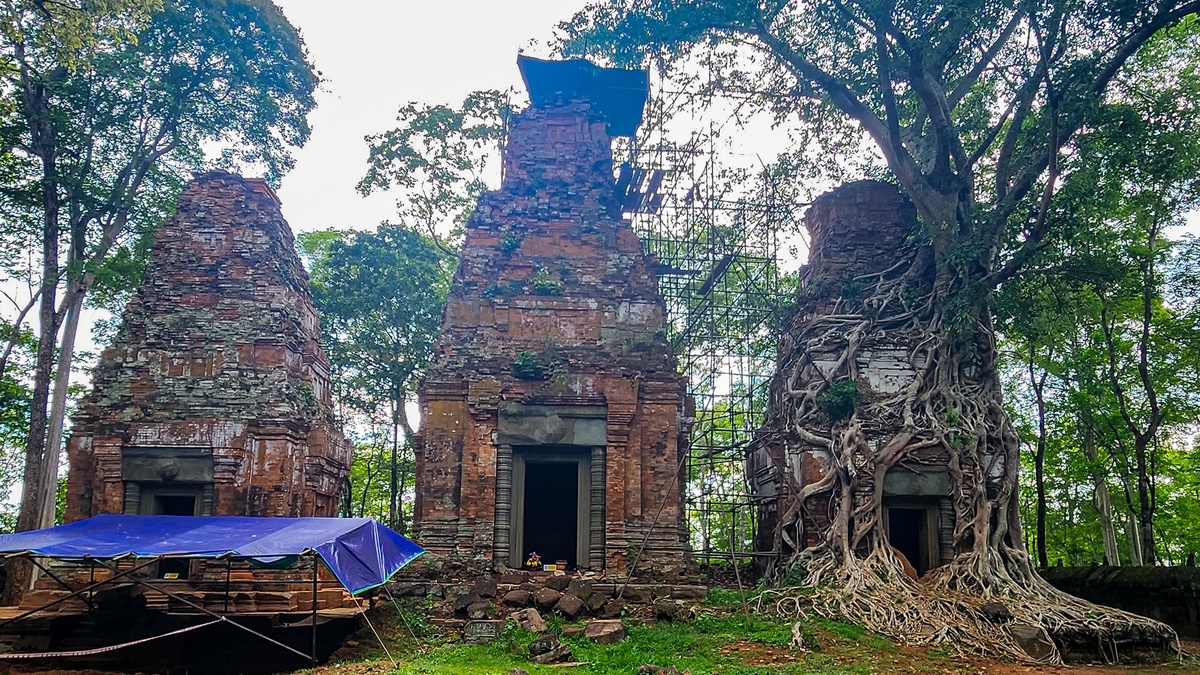
The small brick towers stand among the trees, and roots have wrapped themselves around parts of the structures so tightly that stone, brick and forest seem to have become one object.
It is exactly the kind of image travellers often associate with Cambodia’s jungle temples, but without the crowds that can surround the most famous examples near Siem Reap.
What made it memorable was not simply the roots.
It was the silence.
There was nobody waiting behind us for a photograph and no group moving through the site. For a few minutes, it felt much closer to entering an archaeological ruin in the forest than visiting a major tourist attraction.
Visitor numbers change, of course, and I would never promise that you will have Prasat Pram to yourself.
But if you are going to Koh Ker for atmosphere as much as architecture, I would not skip it.
3. Prasat Krahom: The Red-Brick Temple
Prasat Krahom, or the Red Temple, is part of the Prasat Thom area.
Its name relates to its reddish brick construction, not to red sandstone.
This matters because Koh Ker is a good place to notice how different materials appear across Khmer architecture. Brick, laterite and sandstone were all used in different ways, and not every monument was conceived like the monumental stone temples travellers later associate with Angkor.
Prasat Krahom is less visually overwhelming than Prang, but it helps make the central complex easier to understand as a sequence of religious spaces rather than one isolated pyramid.
4. Prasat Chen: The Mahabharata and the Missing Sculptures
Prasat Chen is one of the most interesting places at Koh Ker once you know what used to stand there.
The complex was associated with an extraordinary sculptural group depicting figures from the Mahabharata, including the warriors Bhima and Duryodhana confronting one another.
The sculptures did not simply deteriorate over ten centuries.
They were looted.
In 1972, during Cambodia’s civil-war era, statues including Duryodhana and Bhima were removed from Prasat Chen and entered the international antiquities market.
The Duryodhana eventually appeared at Sotheby’s in New York. After a legal battle over its provenance, it was returned to Cambodia in 2014.
Koh Ker has since become closely connected with the wider story of Cambodian antiquities that were removed from temples, entered museums and private collections abroad, and have gradually been identified and repatriated.
Knowing this changes the experience of places like Prasat Chen.
Empty pedestals and missing figures stop looking like simple archaeological gaps. They become evidence of a much more recent history of looting, collecting and restitution.
For me, this is one of the strongest reasons to read a little about Koh Ker before visiting.
The architecture tells only part of the story.

Lingas, Sanctuaries and a Sacred Landscape
Koh Ker was also deeply associated with the worship of Shiva.
Large lingas survive at several sanctuaries around the site, some mounted on substantial pedestals. The ancient name Lingapura, meaning roughly the City of Lingas, reflects how important this religious landscape was.
These smaller sanctuaries are easy to overlook after seeing Prang.
I would still stop at one or two.
A huge linga inside an otherwise relatively austere structure can tell you more about what the site was used for than another ornate façade. It reminds you that these temples were not built as archaeological monuments. They belonged to active ritual systems.
That distinction is easy to forget when visiting ruins.

The Rahal and the City Beyond the Temples
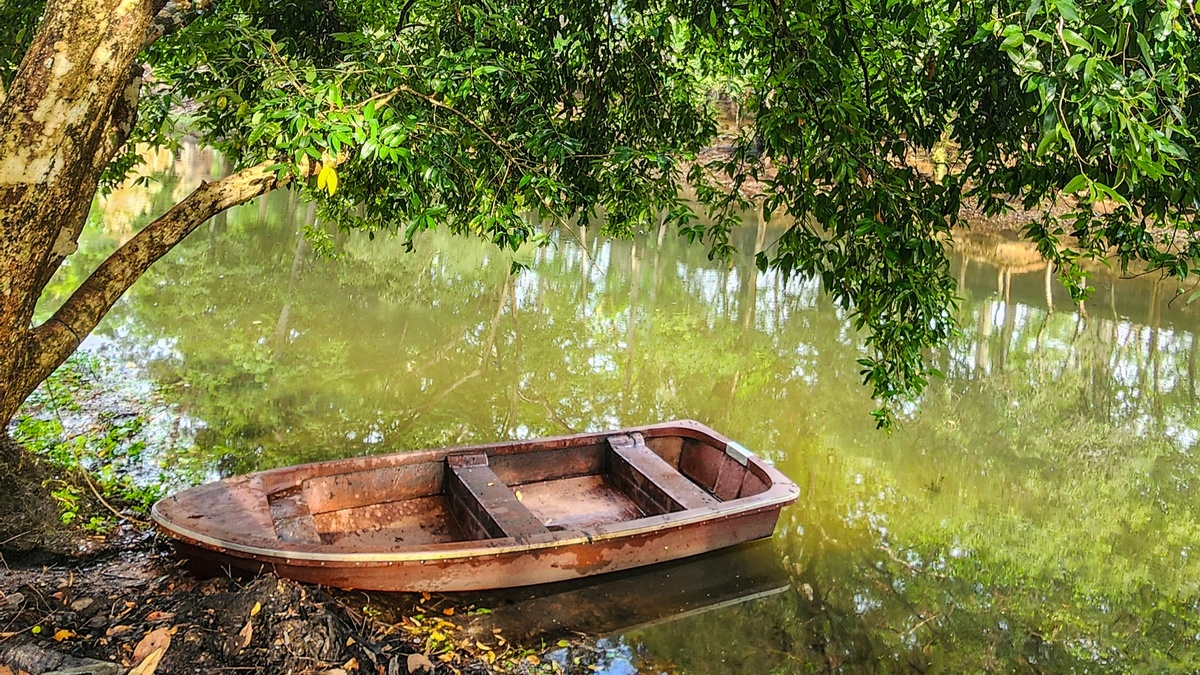
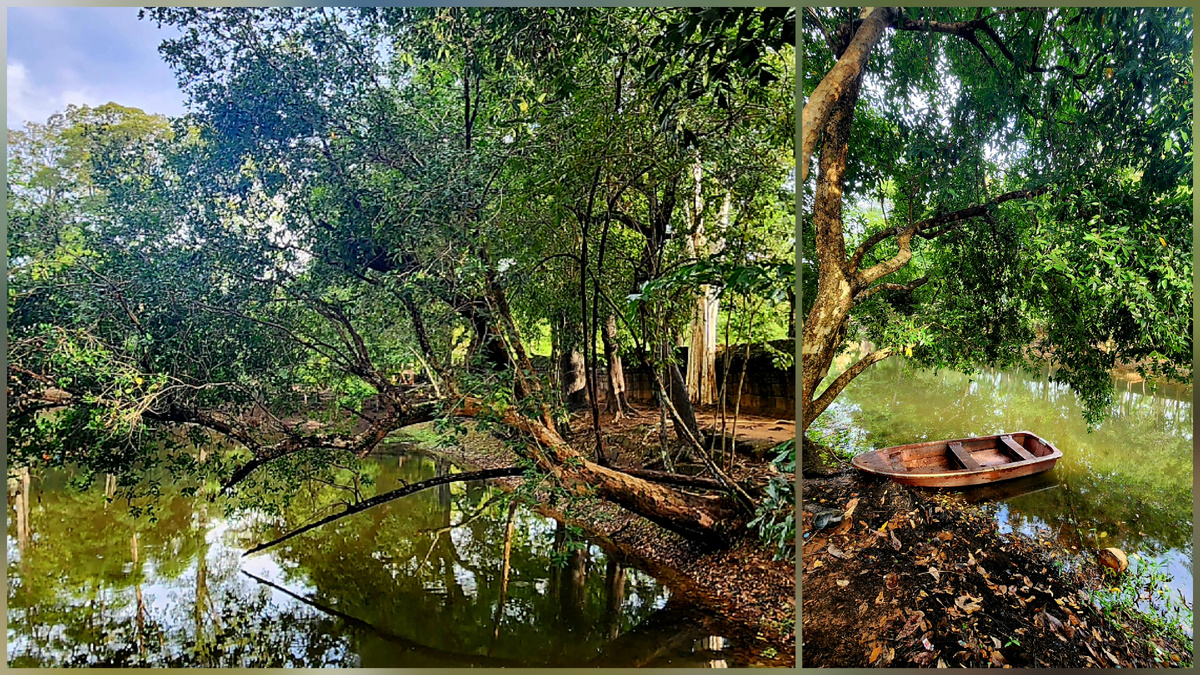
Another reason not to reduce Koh Ker to the pyramid is its hydraulic landscape.
The site included a large reservoir known as the Rahal, along with other water-management features.
As you move through Koh Ker, smaller towers, ruined sanctuaries and traces of this wider landscape appear between the better-known stops.
Individually, some can seem modest.
Together, they make it easier to understand Koh Ker as a city.
The temples were connected to water, roads, settlement, political power and ritual space. Prang was a monumental centre within that system, not a lone pyramid randomly constructed in the jungle.

Our Beng Mealea and Koh Ker Route
We reached Koh Ker after Beng Mealea, already well into the second half of the day.
Our first stops included smaller temples such as Prasat Pram, where the lack of other visitors created the strongest sense of discovery.
We continued through several smaller sanctuaries and stopped at one of the temples containing a large linga. There were very few people around these parts of the site during our visit.
Only later did we reach Prasat Thom and Prang.
By then the light had softened and a few visitors had gathered around the pyramid. Some were climbing, others were waiting for the late-afternoon light, but it still felt restrained compared with the busiest Angkor sites.
The timing was beautiful for Koh Ker.
It was much less beautiful for the journey home.
Our return took around three hours in darkness and rain, and by the end it felt physically and mentally exhausting.
That experience changed my recommendation for anyone planning the same route.
Do the combination, but start early.
Koh Ker is much better when you have time to stop at the smaller temples rather than racing between them because sunset is approaching.
Best Time to Visit Koh Ker
The easiest months for a long road trip and walking around exposed temples are generally during Cambodia’s drier and cooler season, roughly November through February.
That does not mean Koh Ker should be avoided outside those months.
It does mean conditions change.
In hotter months, exposed areas around Prang can feel punishing in the middle of the day. During the rainy season, vegetation can be beautiful and intensely green, but wet stone, roots and soil can become slippery.
Rain also matters more here than at a city attraction because you still have a long return journey to Siem Reap.
Whatever the season, an early departure gives you more flexibility.
What to Bring to Koh Ker
This is not an expedition into completely undeveloped jungle, but I would still come more prepared than I would for a short visit to a temple close to Siem Reap.
Bring:
- enough drinking water;
- sun protection and a hat;
- comfortable closed shoes with decent grip;
- a small snack;
- rain protection if the forecast is unstable;
- a charged phone and power bank.
Services exist around the main visitor areas, but you should not assume that food, drinks or shops will be available exactly when you want them at every smaller stop.
The more independent your transport, the more useful it is to carry what you need for the day.
Should You Drive a Motorbike to Koh Ker?
It is possible, and the long ride can be part of the experience if you enjoy travelling that way.
But I would not choose a motorbike simply because it is cheaper.
The distance matters much more on the return journey than it does when you set out enthusiastically in the morning.
After several hours walking through temples, another long ride becomes tiring. Add darkness or heavy rain and the equation changes quickly.
If you are very comfortable riding long distances in Cambodia, a motorbike gives you freedom to stop where you want.
If you are not, a car with driver, minivan or organized tour is the more sensible option.
Our wet night ride back made that distinction very clear.
Who Should Visit Koh Ker?
I would put Koh Ker high on the list if you have already seen the major Angkor temples and want to understand Khmer history beyond the most famous monuments.
It is particularly worthwhile if you:
- enjoy archaeology and architectural history;
- want to see a very different Khmer capital;
- are interested in quieter ruins rather than only major landmarks;
- have enough time in Siem Reap for a full-day excursion;
- do not mind spending several hours on the road.
The combination of monumental architecture, forest, smaller sanctuaries and the history of looted sculpture makes Koh Ker much richer than a simple pyramid stop.
Who Should Probably Skip Koh Ker?
I would not prioritize it on a first trip if you have only one or two days in Siem Reap and have not yet seen the main Angkor sites.
Angkor Wat, Angkor Thom, Bayon and the other major temples deserve that time first.
Koh Ker also may not be the right excursion if you strongly dislike long road journeys, struggle with intense heat or want a day with plenty of restaurants, cafés and easy infrastructure.
Part of its appeal comes from being farther away.
That same distance is also its main inconvenience.
Want to Compare Guided Cambodia Experiences?
If you like the idea of Koh Ker but do not want to organize the long road day yourself, an organized excursion can remove the hardest part of the logistics.
It is especially worth comparing options that combine Koh Ker and Beng Mealea, include transport from Siem Reap and leave enough time for the smaller temples rather than treating Prang as a quick photo stop.
When comparing tours, I would check the itinerary rather than choosing by price alone. Look at how much time is actually allocated to Koh Ker, whether Beng Mealea is included, group size, ticket inclusions and the planned return time to Siem Reap.
Is Koh Ker Worth the Trip from Siem Reap?
Yes, provided you have enough time.
I would not describe Koh Ker as a substitute for Angkor, because that comparison makes both places less interesting.
Angkor shows what the Khmer Empire became across centuries of monumental building.
Koh Ker captures a much shorter and unusually ambitious moment: a king establishing a new capital, experimenting with architecture and sculpture, and creating a sacred urban landscape that would remain politically dominant for only a few decades.
Then the centre moved back to Angkor.
The forest stayed.
Centuries later, some sculptures were hacked away and carried into the international art market. Others survived in place. The temples were studied, cleared and conserved, and in 2023 the former capital finally entered the UNESCO World Heritage List.
When we visited, some of its smaller temples were so quiet that we stood there alone.
That is the Koh Ker I remember most clearly: not just the famous pyramid, but the strange feeling of moving through a former imperial capital where the monumental and the abandoned still exist side by side.
If I went again, I would leave Siem Reap earlier, give the site more time and make sure I was back on the road before dark.
I would not skip it.
Useful Travel Resources for Cambodia
Flights
Search flights
Hotels
Find hotels
Tours & Experiences
Browse Cambodia Tours & Experiences
eSIM
Get a Yesim eSIM
Transfers
Book a private transfer
Car Rental
Compare rental cars on Localrent
Travel Insurance
Check travel insurance with EKTA
Some links in this article are affiliate links. If you book through them, I may earn a small commission at no extra cost to you.