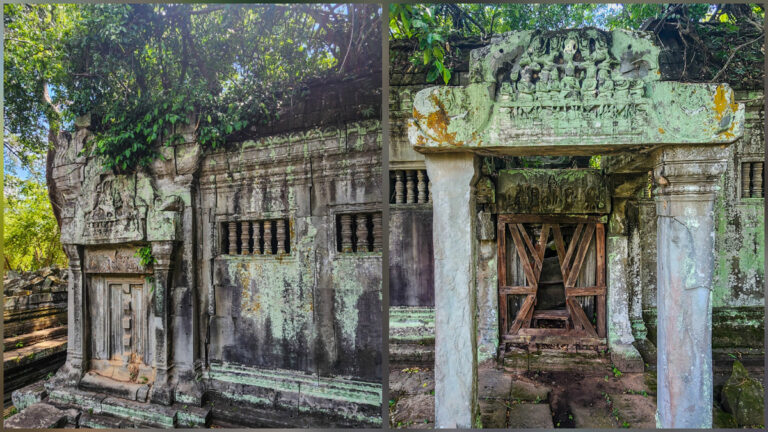
Terrace of the Leper King: Who Was Angkor’s “Leper King”?
The Terrace of the Leper King has one of the strangest names in Angkor, but the name itself is probably based on a misunderstanding. The monument stands in the royal heart of Angkor Thom, immediately north of the Terrace of the Elephants, and sounds as though it commemorates a Khmer ruler who suffered from leprosy.
That is not what the archaeology suggests. The seated figure that gave the terrace its modern name was probably not a diseased king at all. It is generally associated with Yama, the god of death and judgement, while the terrace itself may have been connected with royal funerary ceremonies.
The site hides another surprise. Behind the visible outer wall, archaeologists found an earlier carved wall preserved inside the later construction. Today you can walk through the narrow space between them and see two phases of Angkorian building almost side by side.
So the real mystery is not simply “Which king had leprosy?” It is how a monument connected with death, royal ceremony and several phases of construction ended up with one of Angkor’s most memorable names.
If you are visiting the royal terraces as part of the main temple circuit, my Angkor One-Day Itinerary: Sunrise at Angkor Wat, Angkor Thom & Ta Prohm shows where this stop fits into the wider route.

Terrace of the Leper King at a Glance
| Location | Royal Square, Angkor Thom |
| Date | 12th century |
| Major remodelling | Jayavarman VII period |
| Next to | Terrace of the Elephants |
| Modern name | Derived from the mysterious seated statue |
| Statue interpretation | Usually associated with Yama or Dharmaraja |
| Possible function | Royal funerary or cremation ceremonies |
| Hidden feature | Earlier carved wall preserved behind a later outer wall |
| Original statue today | National Museum of Cambodia, Phnom Penh |
Where Is the Terrace of the Leper King?
The terrace stands inside Angkor Thom, beside the great open Royal Square and immediately north of the Terrace of the Elephants. This was one of the most important ceremonial areas of the city, close to the royal palace and surrounded by architecture associated with court life and public display.
The neighbouring Terrace of the Elephants formed a long viewing platform from which the king and court could observe processions, ceremonies and military displays in the square below. The Terrace of the Leper King occupied the same royal landscape, although its exact original function appears to have been very different.
That location matters. Whatever happened here, this was not a minor shrine hidden at the edge of the city. It belonged to the ceremonial centre of Angkor Thom.
How the Terrace Got Its Strange Name
“Terrace of the Leper King” is a later name, not a known Angkorian name for the monument.
A seated stone figure found at the site had a weathered, mottled surface. Lichen and deterioration gave the statue an appearance that later observers associated with diseased skin, particularly leprosy. That visual impression became mixed with Cambodian legends about a king afflicted by the disease, and the name gradually became attached to the terrace.
It is a good example of how an archaeological nickname can become so familiar that it starts sounding like historical fact. There is no known inscription saying that the terrace commemorated a king with leprosy, and the statue itself points in another direction entirely.
The name is still useful because it has become part of the site’s modern identity. It just should not be mistaken for evidence about what the Khmer builders originally intended.
The Legend of Yasovarman and the Naga
One of the best-known Cambodian traditions connects the Leper King with Yasovarman I, who ruled around the end of the 9th and beginning of the 10th century.
Versions of the story vary, but one tells of a king fighting a naga, the powerful serpent being that appears throughout Khmer religious imagery. During the encounter, the ruler is contaminated by the naga’s venom or blood and later develops leprosy.
The story is memorable, but the chronology creates a major problem. Yasovarman I lived centuries before the Terrace of the Leper King took the form we see today. The terrace belongs to a much later phase of Angkor, especially the period associated with Jayavarman VII.
That does not make the legend unimportant. It simply places it where it belongs: in Cambodian historical folklore rather than documented biography.
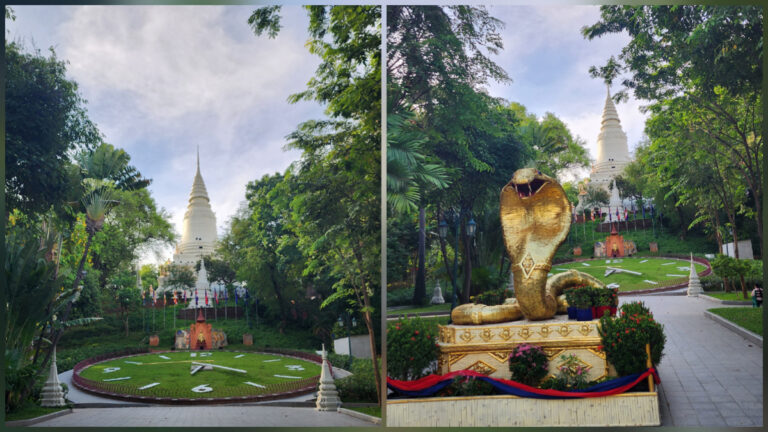
The same tradition appears in stories connected with Phnom Krom, another monument associated with Yasovarman I. There too, the Leper King story is part of the site’s later cultural memory rather than proof that the ruler historically suffered from the disease.
Who Was the “Leper King”? Yama, Not a Diseased Ruler
The statue itself gives us a much stronger clue.
The seated figure traditionally called the Leper King is generally associated with Dharmaraja, a title linked with Yama, the Hindu god of death and judge of the dead. That interpretation changes the entire meaning of the monument.
Instead of a sick human ruler, the figure becomes a supernatural being connected with death, judgement and cosmic order. This also fits the broader setting better than the literal leprosy story. The statue stood in a royal ceremonial area and was surrounded by dense carvings of divine and mythological beings.
Yama appears in Hindu and Buddhist traditions in different forms, but his association with death and judgement is central. The title Dharmaraja reinforces the idea of a ruler or judge upholding cosmic law.
That does not automatically tell us exactly what ceremonies took place on the terrace. It does, however, make the old image of a diseased Khmer king much harder to sustain.
Was This a Royal Cremation Site?
One important interpretation is that the Terrace of the Leper King may have been associated with royal funerary rituals, possibly including cremation.
This remains a hypothesis rather than a proven function. No surviving structure allows us to reconstruct a royal funeral here with certainty, and the wooden or temporary architecture that may once have stood on the platform has disappeared.
The idea nevertheless fits several clues. The terrace lies beside the royal palace zone, the statue is associated with Yama, and the sculptural programme is filled with supernatural beings. Scholars have therefore suggested that a pavilion used for a royal funeral pyre may once have stood on the terrace.
The neighbouring Terrace of the Elephants adds useful context. That long platform belonged to the public ceremonial landscape where royal authority could be displayed before processions, soldiers and crowds. Immediately beside it, the Terrace of the Leper King may have served a very different aspect of kingship: ritual connected with death.
That contrast is much more convincing than the later idea that the Khmer deliberately placed a symbol of diseased or collapsing power beside a monument to triumph.
The Wall Angkor Buried Inside Another Wall
The most fascinating feature of the terrace is easy to miss if you only look at its exterior.
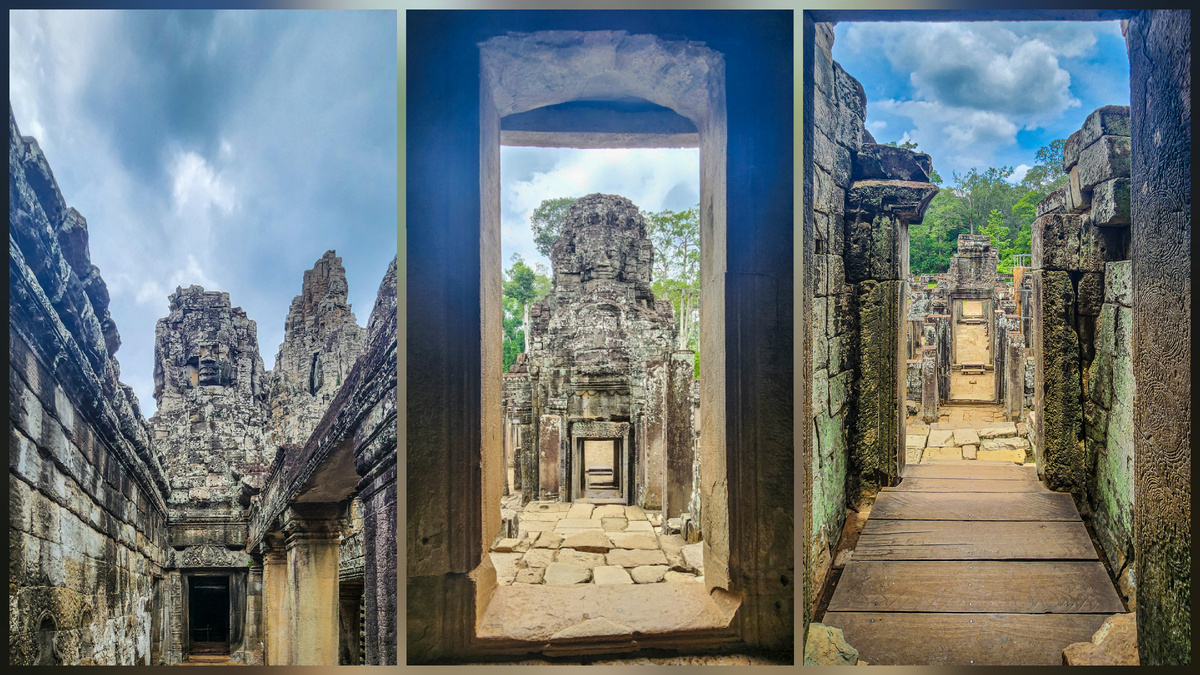
Behind the visible outer façade is an earlier carved wall. It was not designed as a secret corridor for visitors. The narrow passage exists because the monument was altered during the Angkorian period.
An earlier version of the terrace already had a richly carved surface when later builders enlarged or remodelled the structure. Instead of completely removing the older wall, they constructed a new façade in front of it. The earlier sculptures were effectively sealed inside the monument.
Archaeologists later cleared the space between the two walls, creating the passage visitors can walk through today. The result is unusual because you can see two construction phases almost directly beside each other.
The hidden wall also benefited from being enclosed. Protected from centuries of direct rain, sun and vegetation, some of its carvings retained sharper details than those exposed on the exterior.
This is the feature I would spend the most time on. Walking through the narrow passage is not interesting because it was intended as a mysterious or claustrophobic space. It is interesting because you are moving between two different versions of the same monument.
The outer wall represents a later phase. The wall beside you preserves part of an earlier one.
What the Carvings Actually Show
At first glance, the terrace can seem almost overloaded with figures. The surfaces are dense, and the narrow internal passage brings the sculpture much closer than at most other Angkor monuments.
But the imagery is not random chaos.
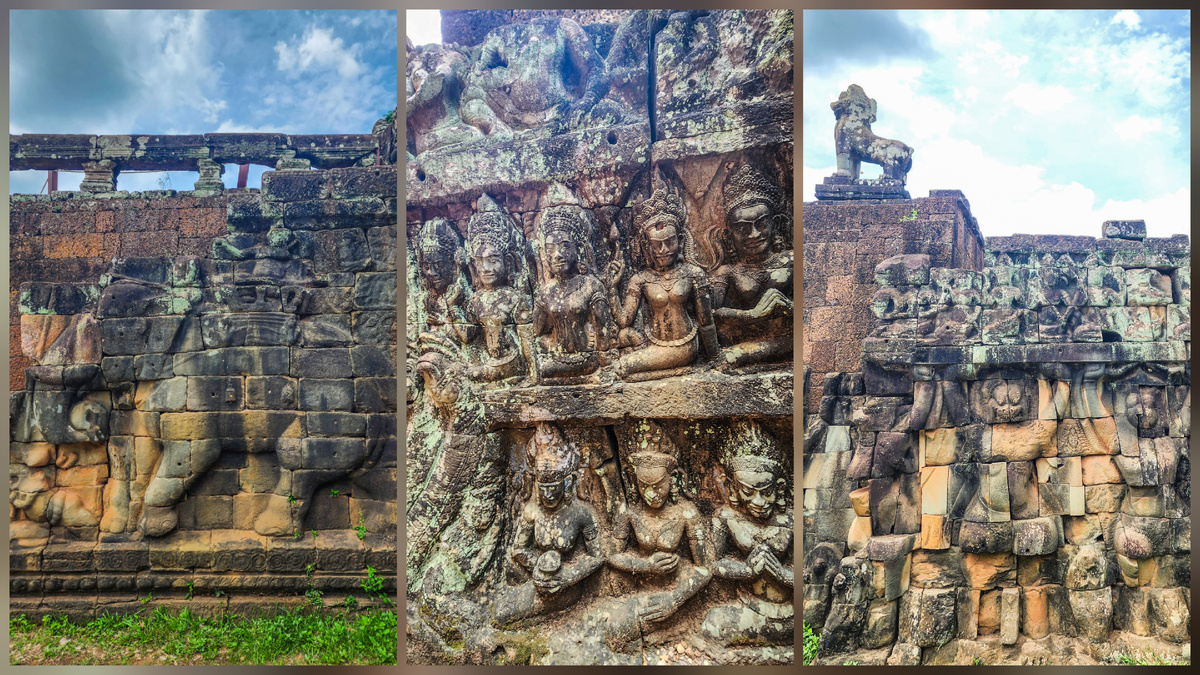
The figures are organised in horizontal registers and include nagas, garudas, guardians, giants, female figures and other divine or supernatural beings. Rather than illustrating the collapse of royal power, the walls create a densely populated sacred world.
Some interpretations connect these beings with the different levels of the supernatural cosmos, including realms associated with Mount Meru and other non-human worlds. That fits the religious imagination of Angkor much better than reading the carvings as a deliberate political warning about decay.
The effect is still intense. Rows of figures rise one above another, and the enclosed passage forces you to view them from very close range. But the intensity comes from the density of the sacred population, not from evidence that the sculptors were trying to portray social disorder.
The “Leper King” You See Today Is a Replica
The figure displayed on the terrace today is not the original statue.
The original is preserved in the National Museum of Cambodia in Phnom Penh, where it can be seen alongside many other important works of Khmer sculpture. If your Cambodia trip includes both Siem Reap and Phnom Penh, this creates an unusually direct connection between an archaeological site and the museum collection.
My guide to the National Museum of Cambodia explains what else to look for there and why many of the objects make more sense after visiting Angkor.
Knowing that the terrace statue is a replica is also a useful reminder that archaeological sites are not frozen exactly as they were discovered. Important original sculptures are often moved to controlled environments for protection, while copies remain on site to preserve the visual relationship with the architecture.
What to Look for When You Visit
Do not treat the Terrace of the Leper King as a thirty-second extension of the Terrace of the Elephants.
Start by looking at its position within the Royal Square. The palace area lies behind the terraces, while the enormous ceremonial space opens in front of them. That geography helps explain why scholars connect both monuments with royal functions.
Then look at the seated figure while remembering that the statue you see is a replica and that its famous nickname reflects a later interpretation rather than a confirmed royal identity.
Most importantly, find the passage between the two carved walls. Notice how close the older reliefs are, compare their condition with the exposed exterior surfaces and watch how the horizontal registers continue through the narrow space.
Once you understand why the second wall exists, the terrace becomes much more than another collection of carvings. It becomes visible evidence that Angkor itself was continually rebuilt.
If you have more time around Siem Reap after the main temple circuit, you can also compare other archaeological sites, cultural performances and evening activities rather than filling every day with another temple.
So Who Was the Leper King?
Probably no historical ruler represented by this statue.
Later tradition connected the Leper King with Yasovarman I, while the statue’s weathered surface helped make the story visually convincing. Over time, the nickname became attached to the monument and survived long after archaeology offered another explanation.
The evidence points instead toward Yama or Dharmaraja, a figure associated with death and judgement. The terrace may also have played a role in royal funerary ritual, although that function remains a scholarly interpretation rather than a certainty.
Then there is the buried wall, which reveals that the monument itself changed over time. What looks like one terrace is actually the result of multiple building phases.
That is what makes the site so interesting. The famous name is probably misleading, the statue is not what generations of visitors assumed, and part of the monument remained literally hidden inside another version of itself.
The legend is memorable. The archaeology is better.
Useful Travel Resources
Flights
Compare flights to Cambodia and connections across Southeast Asia.
Hotels
Compare accommodation in Siem Reap by location, current price and guest reviews.
Tours & Activities
Browse attraction tickets, Angkor tours and other things to do around Siem Reap.
Tours & Experiences
Compare guided tours and other experiences around Angkor.
Airport Transfers
Arrange transport between Siem Reap Angkor International Airport and your accommodation before arrival.
eSIM
Set up mobile data before arriving in Cambodia.
Travel Insurance
Check travel insurance options before your trip.
Affiliate disclosure: This article contains affiliate links. If you book through them, I may earn a commission at no extra cost to you.