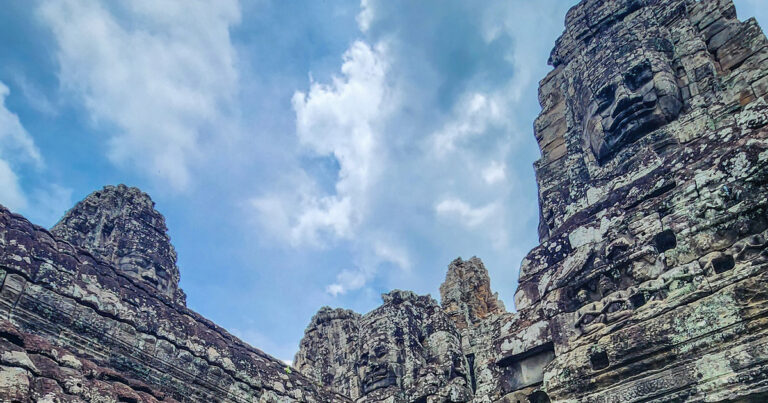
Angkor One-Day Itinerary: Sunrise at Angkor Wat, Angkor Thom & Ta Prohm
Angkor had been on my travel list long before I ever reached Cambodia.
I studied French for about fifteen years through school and university, and the former French Indochina was constantly somewhere in the background: Vietnam, Laos, Cambodia, Saigon, Annam and, of course, Angkor. By the time I finally reached Siem Reap, I had already travelled through Vietnam and Laos, while Angkor still felt like the missing piece.
The opportunity finally appeared while I was in Vietnam and needed to make a visa run. A friend was already waiting in Siem Reap, and instead of treating Cambodia as a quick border trip, we built several days around Angkor.
Our first full day was deliberately ambitious: sunrise at Angkor Wat, the temples and terraces of Angkor Thom, Neak Pean, Preah Khan, Ta Prohm and finally Phnom Bakheng.
This is not the easiest or cheapest way to see Angkor in one day. It is a long itinerary and makes much more sense with a private car than with a slow temple-by-temple tuk-tuk route. But for a first introduction, it gave me exactly what I wanted: not just a collection of famous temples, but a sense of how the different parts of Angkor fit together.
For the wider trip, including the journey from Phu Quoc, accommodation and the temples outside the main Angkor circuits, see my three-day Siem Reap and Angkor itinerary.
Angkor One-Day Itinerary at a Glance
| Stop | Why Visit |
|---|---|
| Angkor Wat | Sunrise, bas-reliefs and Cambodia’s most famous temple |
| Bayon | Face towers and scenes of everyday Angkorian life |
| Baphuon | Temple-mountain and one of Angkor’s great restoration stories |
| Terrace of the Elephants | Royal ceremonial platform inside Angkor Thom |
| Terrace of the Leper King | Dense reliefs and the mysterious figure associated with Yama |
| Prasat Suor Prat | Row of unusual towers opposite the Royal Square |
| Dei Chhnang Gate | Quieter gate of Angkor Thom |
| Neak Pean | Small island temple surrounded by water |
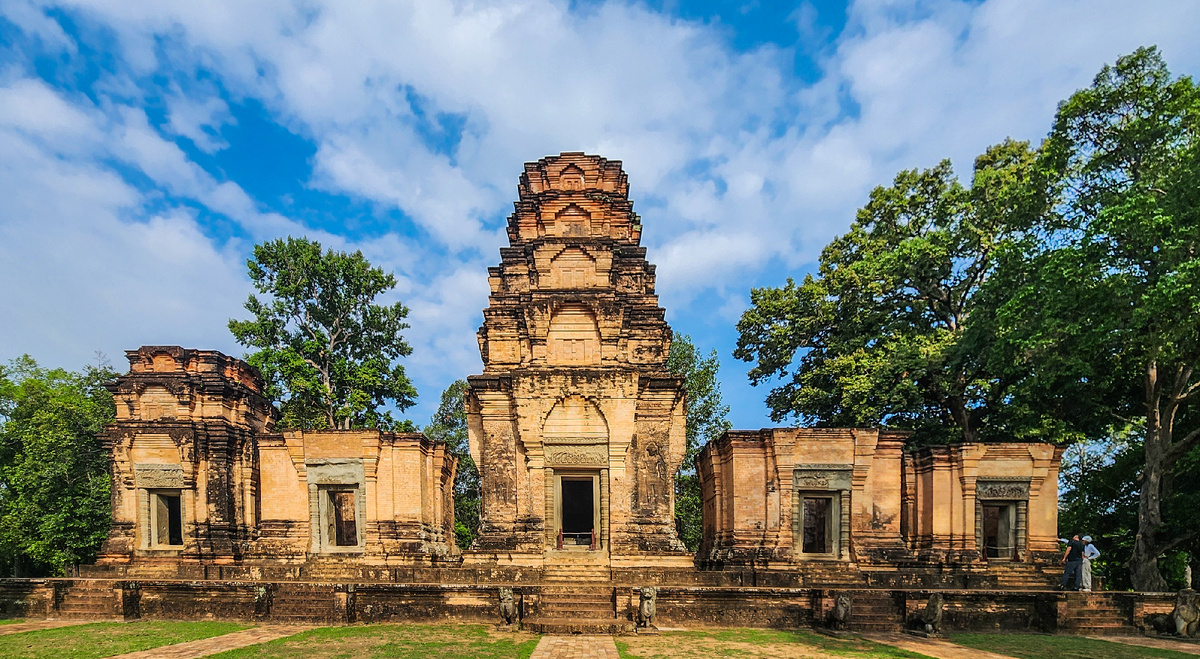
| Preah Khan | Large, atmospheric temple complex built by Jayavarman VII |
| Ta Prohm | Famous combination of giant trees and temple ruins |
| Phnom Bakheng | Hilltop views across the Angkor landscape |
This is a full and intensive day. If you prefer slow travel, photography or long breaks, I would split the route across two days rather than trying to reproduce it exactly.
Where to Stay in Siem Reap
For an early Angkor sunrise, staying in Siem Reap is the practical option. You will find far more restaurants, hotels and evening options in town, while the main temple area is still close enough for an early transfer.
Why We Chose a Private Guide and Car
We had booked an individual Angkor tour in advance, and after doing it this way I would make the same choice again for a first visit.
Our setup included an air-conditioned car, a Russian-speaking guide who had lived in Cambodia for years, and a local guide-assistant who knew the entrances, routes and practical details inside the park.
It was not the cheapest way to explore Angkor, but the benefit became obvious as the day progressed.
Angkor is enormous. The World Heritage area covers hundreds of square kilometres and includes successive Khmer capitals, temples, reservoirs, roads and archaeological remains. On a map, many of the major monuments look relatively close together, but during a full day the distances, heat and time spent walking add up quickly.
A guide also changed how I understood the temples. Without context, it is very easy for the fifth or sixth monument of the day to become another collection of old stone, towers and carvings. Once you start connecting kings, religions, construction periods and the layout of the ancient capitals, they stop blending together.
You do not need exactly the same setup we had. There are several ways to organise a day at Angkor:
- private car with a guide;
- private tuk-tuk with or without a guide;
- small-group sunrise tour;
- private sunrise tour;
- guide plus temple transfers;
- completely independent transport if you already know what you want to see.
For one or two major temples, independent transport is easy enough. For an itinerary this long, I found having the logistics handled for us much more valuable.

Angkor and Angkor Wat Are Not the Same Thing
This is the first thing worth understanding before planning the day.
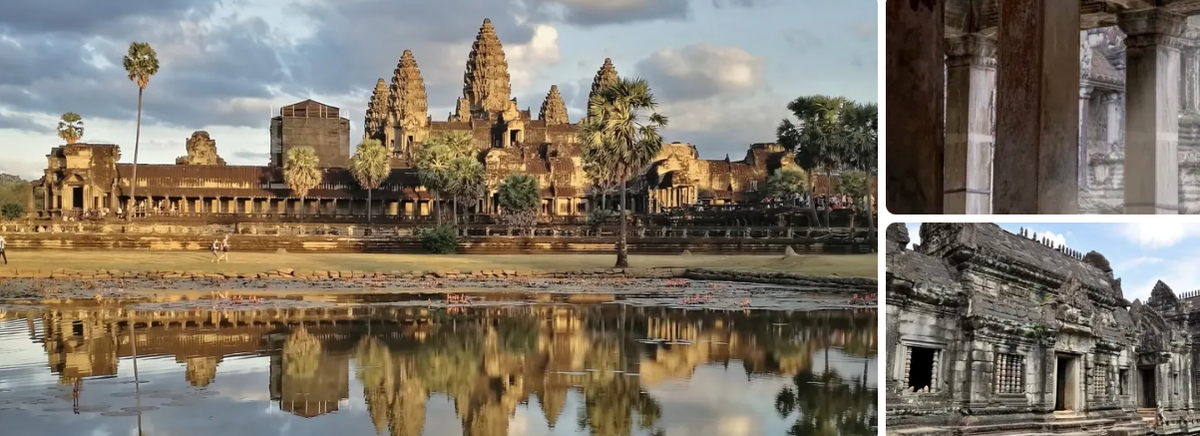
Angkor Wat is one temple. Angkor is an enormous archaeological landscape.
The Angkor World Heritage Site contains the remains of different Khmer capitals from roughly the 9th to the 15th centuries. It includes temples, reservoirs, canals, roads, embankments and former urban areas spread across approximately 400 square kilometres.
Angkor Wat is simply the most famous monument within that much larger system.
Built in the early 12th century during the reign of Suryavarman II, Angkor Wat was originally a Hindu temple dedicated to Vishnu. It later became an important Buddhist site and remains an active religious monument today.
Angkor Thom, which you visit later in the day, belongs largely to another period and another king: Jayavarman VII.
Understanding that distinction immediately makes the route easier to follow.
Starting Before Sunrise at Angkor Wat
We left Siem Reap at around four in the morning.
At that hour the city was still dark, with only occasional headlights and the first early traffic appearing on the roads toward the archaeological park.
Sunrise at Angkor Wat is famous enough that it can sound like one of those travel experiences everyone repeats simply because it is on a checklist. I still think it is worth doing, particularly on a first visit.
There are two practical advantages.
The first is temperature. Cambodia becomes hot quickly, and starting before sunrise gives you several hours before the strongest heat.
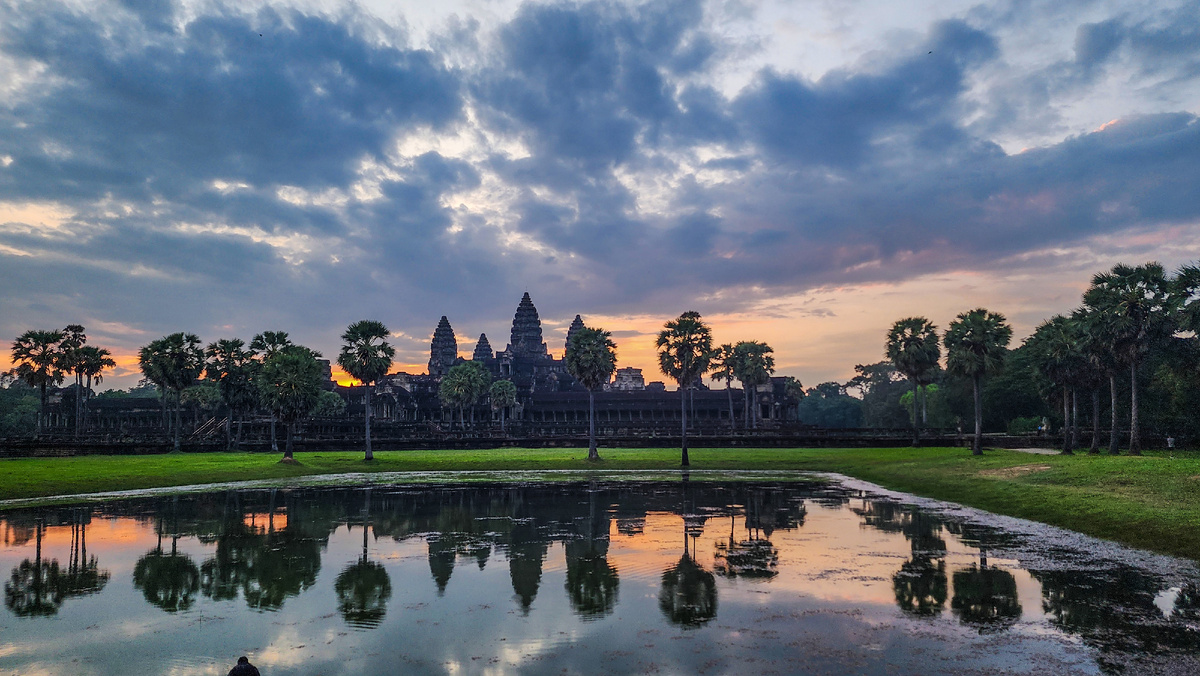
The second is the view itself. Angkor Wat’s towers gradually appear against the changing sky, often reflected in the ponds in front of the temple. The exact colours and reflections depend heavily on weather and season, so there is no guarantee of the dramatic red sunrise you see in heavily edited photographs.
For me, the appeal was less about getting a perfect sunrise photo and more about finally seeing a place that had been somewhere in the background of my imagination for years.
Why Angkor Wat Faces West
Once you start looking at the actual architecture, one unusual feature becomes obvious.
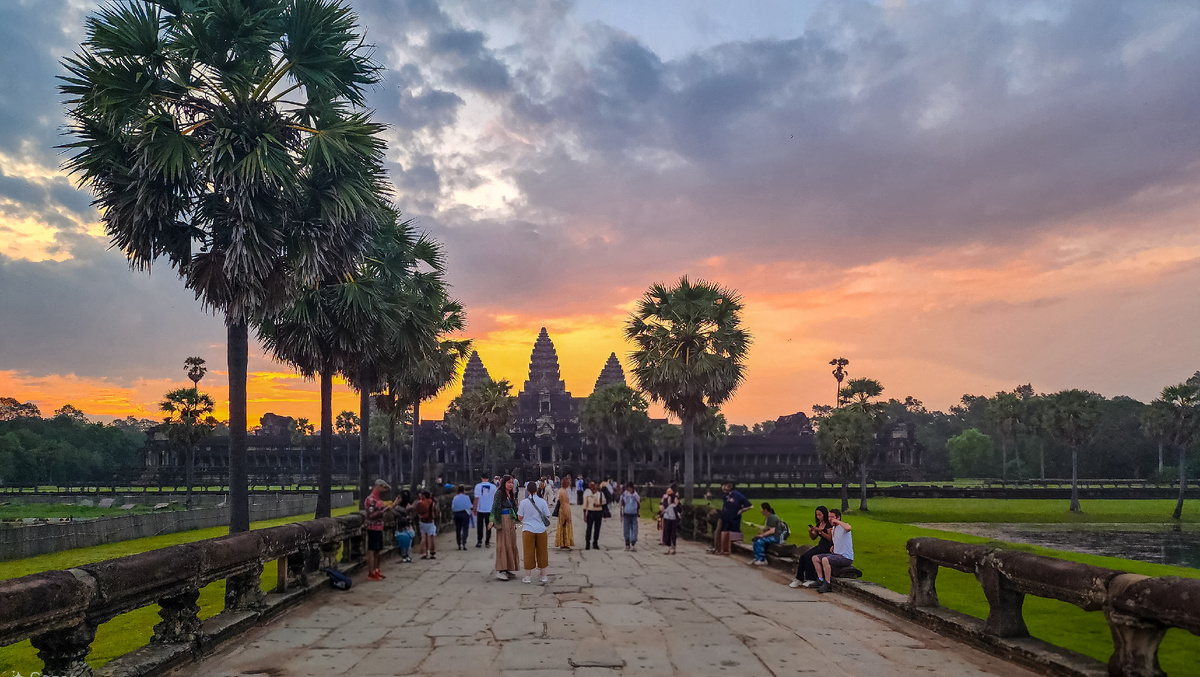
Angkor Wat is primarily oriented toward the west, unlike the eastern orientation found at many Khmer temples.
There is no single universally accepted explanation for this. The western orientation has sometimes been connected with Vishnu, who is associated with the west in Hindu tradition, and it has also contributed to theories about funerary symbolism connected with Suryavarman II.
It is better not to reduce the entire monument to one explanation.
What is certain is that the western approach shapes the experience of entering Angkor Wat. You cross the moat and long causeway toward the central towers, gradually moving from the outer landscape into an increasingly restricted sacred space.
Understanding the Architecture
Angkor Wat is far easier to appreciate once you stop thinking of it as one enormous building.
The temple is organised through successive layers: moat, enclosure, causeways, courtyards, galleries and increasingly elevated levels leading toward the central towers.
The design is closely connected with Hindu cosmology. The central towers evoke Mount Meru, the sacred mountain at the centre of the universe, while the surrounding architectural layers create a symbolic sacred landscape around it.
The scale is extraordinary, but the precision is equally interesting. Long galleries remain aligned across huge distances, stairways rise toward increasingly restricted areas and the entire composition was planned around a strong geometric order.
That becomes easier to see once you are inside rather than looking at the familiar postcard view from across the pond.
The Bas-Reliefs: Angkor Wat’s Stone Narrative
One of the biggest mistakes you can make at Angkor Wat is rushing through the galleries because you want to reach the central towers.
The bas-reliefs are one of the most important parts of the temple.
Long sections of the galleries depict scenes from Hindu epics and mythology, including the Ramayana, the Mahabharata and the famous Churning of the Ocean of Milk. Other panels depict battles, processions and the royal world of Suryavarman II.
With a guide, these galleries become much easier to read.
Instead of seeing an endless surface of carved figures, you begin to recognise armies, deities, demons, mythological animals and repeated visual symbols.
The same applies to the apsaras and devatas throughout the temple. They are not random decorative figures added to empty walls. Their hairstyles, jewellery, clothing and poses contain an enormous amount of visual detail.

Climbing the Upper Level
If access is open during your visit and you meet the requirements for entry, you can climb toward the upper sanctuary.
The staircase is steep, although modern visitor stairs make the ascent much easier than the original stone steps.
From above, the organisation of the temple becomes much clearer. You can see the courtyards, galleries, outer enclosure and green landscape extending beyond the moat.
It also reinforces something that photographs often hide: Angkor Wat is not simply a façade with five towers. It is a layered architectural system built to control movement from the outside toward the sacred centre.
Entering Angkor Thom
After Angkor Wat, we continued to Angkor Thom, the great walled city associated with Jayavarman VII.
Angkor Thom covers roughly nine square kilometres and was one of the most important urban centres of the late Angkorian period.
The monumental gates are part of the experience. Causeways lead toward towers topped with enormous faces, while rows of gods and demons hold the body of a naga along the sides.
Inside the walls are several major monuments, including Bayon, Baphuon, the royal terraces and the remains of the palace area.
This is why treating “Angkor” as one temple becomes confusing very quickly. By this point in the morning, you have already moved from Angkor Wat into another city built under a different king and shaped by a different religious programme.
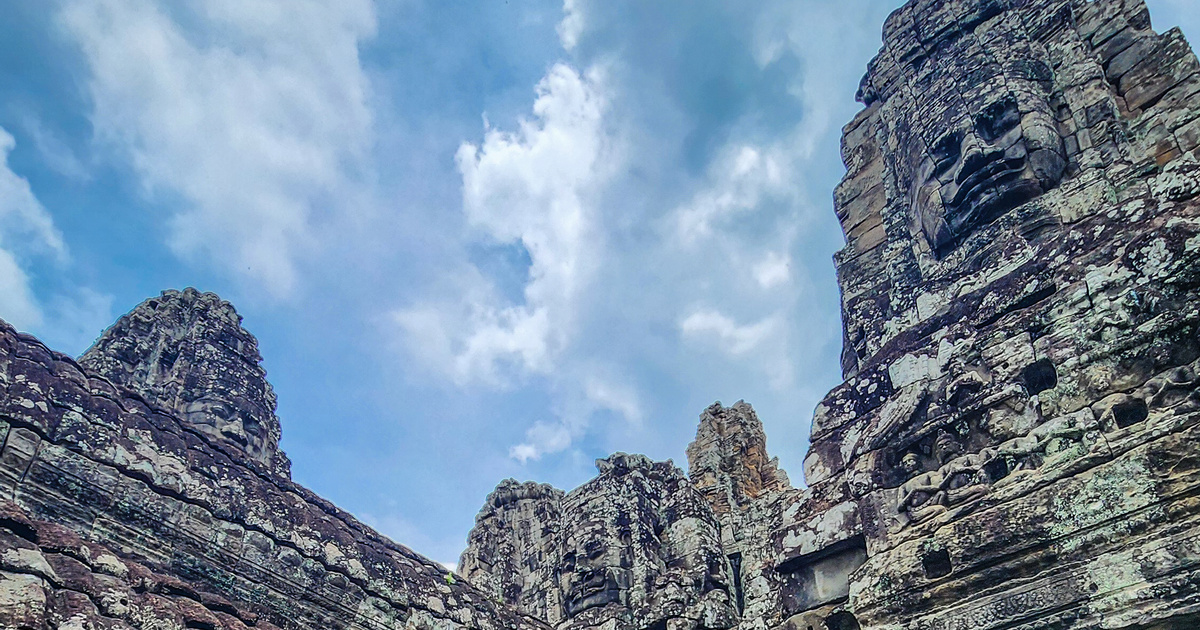
Bayon: The Temple of Faces
Bayon stands close to the centre of Angkor Thom and is one of the easiest Khmer temples to recognise.
Its towers are covered with enormous serene faces looking outward in different directions.
Their precise identity remains debated. They have often been connected with the bodhisattva Avalokiteshvara, with Jayavarman VII himself, or with a deliberate merging of royal and divine imagery.
Whatever interpretation you prefer, the effect is unusual. From the lower levels you see individual faces above the stonework; as you move through the temple, they begin to appear from multiple angles at once.
Bayon’s bas-reliefs are equally important.
Unlike the predominantly mythological and royal imagery at Angkor Wat, many Bayon reliefs show scenes of everyday life: markets, cooking, animals, military activity, boats and ordinary people.
That makes Bayon one of the best places in Angkor to look beyond kings and gods and see fragments of how people lived.
Baphuon and Angkor’s Giant Stone Puzzle
From Bayon we continued toward Baphuon, an earlier temple-mountain incorporated into the later city of Angkor Thom.
The approach itself is memorable: a long elevated stone causeway runs toward the temple, making the structure appear gradually larger as you get closer.
Baphuon is also connected with one of Angkor’s most extraordinary conservation projects.
In the 20th century, the temple was dismantled so that the unstable structure could be rebuilt using anastylosis, a restoration method in which original architectural elements are documented and then returned to their proper positions.
Work was interrupted during decades of war and political upheaval. Records were lost, thousands of stones remained spread around the site, and the later restoration became an enormous archaeological puzzle.
The project was eventually completed, and Baphuon reopened after decades of work.
Knowing that history changes how you look at the temple. What appears to be an ancient ruin is also the result of one of the largest and most complicated restoration projects undertaken at Angkor.
Terrace of the Elephants
The Terrace of the Elephants formed part of the royal ceremonial area of Angkor Thom.
The platform stretches for roughly 300 metres and once supported wooden structures that have disappeared. Its surviving stone walls are decorated with elephants, garudas, lions and other figures.
From here, the king and royal court could observe ceremonies, processions and public events taking place in the open area in front of the terrace.
Today it is easy to walk past quickly because there is no huge temple standing above it. But the terrace makes much more sense when you imagine the royal square filled with wooden pavilions, officials, soldiers and ceremonial activity rather than the open archaeological landscape visible now.
Terrace of the Leper King
Immediately north is the Terrace of the Leper King, whose modern name comes from a seated statue found at the site.
For years the weathered appearance of the figure encouraged stories that it represented a Khmer king suffering from leprosy.
The archaeological interpretation is different. The figure is identified with Yama, the Hindu god associated with death and judgement.
The most interesting part of the terrace is not only the statue but the narrow internal passage created when an earlier decorated wall was enclosed by a later construction phase.
Walking through it brings you extremely close to dense rows of carved figures, including divine and mythological beings.
This is a good example of why Angkor often becomes more interesting once legend and archaeology are separated rather than mixed together.
Prasat Suor Prat
Across the open royal square stands a row of towers known as Prasat Suor Prat.
Their original purpose is uncertain.
One famous account comes from Zhou Daguan, the Chinese diplomat who visited Angkor in the late 13th century. He described a form of divine judgement in which people involved in disputes were placed in separate towers and waited to see which person later became ill.
Whether the surviving towers were used exactly in this way remains debated.
They are still worth noticing because their repeated vertical forms create one of the most distinctive edges of the royal square, even though many visitors pass them without stopping.
A Quieter Gate: Dei Chhnang Gate
Instead of relying only on Angkor Thom’s much busier South Gate, we also stopped at Dei Chhnang Gate, on the northern side of the city.
The basic architectural language is familiar: a monumental gateway, large faces above the passage and the forest closing in around it.
The difference was the atmosphere.
With fewer vehicles and tour groups passing through, it was easier to stop and actually look at the structure rather than trying to photograph it between tuk-tuks.
For a day packed with major monuments, small quieter stops like this help break up the route.
Neak Pean: Water, Healing and a Temple Island
The character of the day changes completely at Neak Pean.
Instead of another large stone temple, you walk along a long wooden causeway across the former reservoir known as Jayatataka toward a small island sanctuary.
Neak Pean was built under Jayavarman VII in the late 12th century. Its central sanctuary is surrounded by pools, with water historically moving through sculpted outlets into adjoining basins.
The site has long been associated with purification and healing. The water was believed to have beneficial properties, although calling the complex a literal medieval hospital or “spa” simplifies its religious function too much.
What makes the stop worthwhile today is the contrast.
After hours of stone towers and enclosed courtyards, Neak Pean is mostly about water, open space and the approach across the reservoir landscape.
Preah Khan: Temple, Royal Foundation and Centre of Learning
From Neak Pean we continued to Preah Khan, built by Jayavarman VII in 1191 and dedicated to his father.
Preah Khan is enormous but feels less monumental in a single-view sense than Angkor Wat. Its scale reveals itself while you move through it.
Long sequences of doorways line up through the temple. Courtyards lead into galleries, galleries into smaller chambers, and parts of the structure remain intertwined with trees and vegetation.
Inscriptions show that Preah Khan was much more than a simple shrine. It supported a large religious community and was associated with teaching and Buddhist scholarship. It may have functioned as an important centre of learning as well as a major religious foundation.
For me, this is one of the temples where having a guide helps most. Without context, the repeated corridors can feel like a beautiful maze. Once you understand its scale and institutional role, the ruins become much easier to read.
Ta Prohm: Where Conservation Includes the Trees
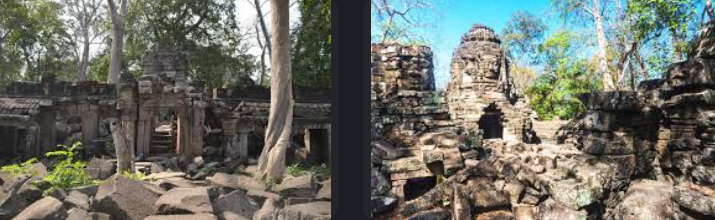
Ta Prohm is one of the most recognisable temples in Cambodia because enormous tree roots grow over walls, galleries and doorways.
Its modern fame increased dramatically after appearing in Lara Croft: Tomb Raider, but the relationship between architecture and vegetation was famous long before the film.
There is a popular idea that Ta Prohm was simply left exactly as explorers found it, with the jungle allowed to take over.
The reality is more complicated.
Ta Prohm is actively conserved. Archaeologists, engineers and forestry specialists stabilise structures, restore damaged sections, manage vegetation and monitor large trees whose roots interact with the ancient masonry.
At the same time, some of the iconic tree-and-stone compositions have deliberately been preserved because they have become an important part of the site’s character.
That balance is one of the things that makes Ta Prohm interesting. The trees can help define the atmosphere of the temple, but they can also damage walls, foundations and roofs. Conservation here involves managing both.
Why Ta Prohm Feels So Different
Architecturally, Ta Prohm belongs to the great building programme of Jayavarman VII and was dedicated to his mother.
But most visitors remember something else first: scale created by nature rather than by architecture.
A tree emerging over a gallery can make a doorway look tiny. Roots spread across stone like additional structural elements, even when they are actually placing pressure on the masonry beneath them.
In the middle of a hot Angkor day, the forest also changes the physical experience. There is shade, filtered light and a much more enclosed atmosphere than on the exposed terraces of Angkor Wat or Baphuon.
That makes Ta Prohm a good late-day stop even before you consider its fame.
Phnom Bakheng: Finishing Above the Angkor Plain
Our final major stop was Phnom Bakheng.
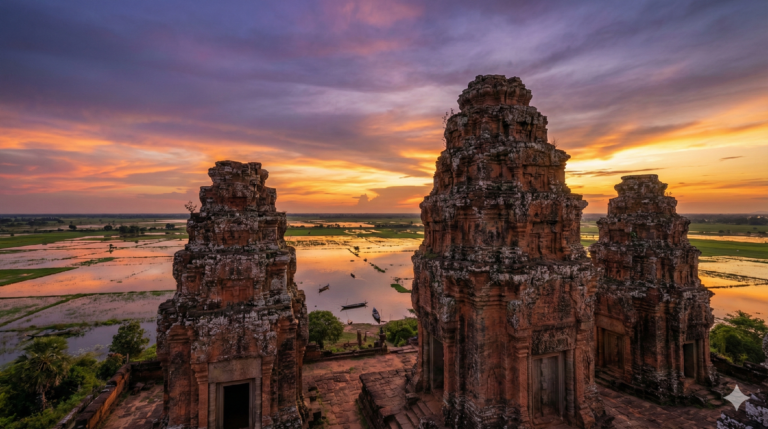
The temple is much older than Angkor Wat. It was built around the turn of the 10th century during the reign of Yasovarman I as the state temple of his new capital.
Today it is best known as a viewpoint.
You climb the hill through forest before reaching the ancient temple-mountain near the summit. From the upper area, the surrounding Angkor landscape becomes much easier to understand.
Angkor Wat appears in the distance above the trees, while the flat terrain extends toward the horizon.
After spending an entire day moving between individual monuments, this broader view helps put the scale of the archaeological park back together.
Phnom Bakheng is extremely popular in the late afternoon, so do not expect a deserted sunset viewpoint. Access arrangements and visitor limits can also change, making it worth allowing enough time rather than arriving at the last possible moment.
If the priority is a quieter landscape sunset rather than a view over Angkor itself, I prefer Phnom Krom as a separate option on another day.
Can You Really See All of This in One Day?
Yes, because we did it, but I would not recommend this exact itinerary to everyone.
It works best if:
- this is your first visit and you want a broad overview;
- you start before sunrise;
- you have private transport;
- you are comfortable walking for most of the day;
- you do not need an hour of photography at every temple;
- you are prepared for heat and humidity;
- someone else is managing the route.
Trying to reproduce the same day while constantly negotiating tuk-tuk stops, checking maps and researching every monument as you arrive would make it much more tiring.
If you prefer slow travel, split the route.
A more relaxed version could use one day for Angkor Wat, Angkor Thom and Ta Prohm, with Preah Khan, Neak Pean and other Grand Circuit sites saved for another day.
Angkor Pass Prices
You need an Angkor Pass for the main temples in the archaeological park.
Current official prices are:
| Angkor Pass | Price | Validity |
|---|---|---|
| 1 Day | $37 | 1 day |
| 3 Days | $62 | Any 3 days within 7 days |
| 7 Days | $72 | Any 7 days within 30 days |
For this exact itinerary, a one-day pass is enough.
If you also plan to visit the Roluos temples, Banteay Srei, Pre Rup, Banteay Samré or return to Angkor on another day, the three-day pass gives you much more flexibility.
What to Wear and Bring
For a sunrise-to-late-afternoon Angkor day, comfort matters more than almost anything else.
I would bring:
- comfortable shoes with good grip;
- lightweight clothing covering shoulders and knees;
- a hat or cap;
- sunscreen;
- plenty of water;
- mosquito repellent;
- a small power bank;
- something light to eat between stops.
Temple rules and access restrictions can vary between monuments, but covering shoulders and knees avoids problems at religious areas and upper sanctuaries.
The heat is the bigger practical issue. A route that looks easy on a map can become exhausting after several hours of climbing stone stairs and walking through exposed courtyards.
Is a Guide Worth It at Angkor?
For me, yes, particularly for the first serious day.
You can absolutely visit Angkor without a guide. Transport is easy to arrange, maps are readily available and the major temples are well known.
The question is not whether it is possible. It is what you want from the day.
If your priority is photography, wandering independently and spending as much or as little time as you want at each temple, going without a guide can be ideal.
If you want to understand why Angkor Wat differs from Bayon, who Jayavarman VII was, why some temples are Hindu and others Buddhist, how the ancient cities relate to each other and what you are actually seeing in the reliefs, a good guide makes the first visit much richer.
For us, the combination of guide and comfortable transport also meant we were still functioning by the time we reached the final temples rather than spending the afternoon thinking only about the heat.
What I Would Do Differently
I would keep the early start, Angkor Wat at sunrise, Bayon, Ta Prohm and the general logic of the route.
What I would change depends on the goal.
If I wanted more photography time, I would remove one or two middle stops.
If I wanted more history, I would probably spend longer in Angkor Thom and Preah Khan rather than trying to reach every monument.
And if I had only one day in Cambodia, I would still choose a guide and comfortable transport rather than trying to maximise savings.
This particular day worked because it gave us an overview first. On the following days, smaller temples and more distant sites made much more sense because we already understood the basic chronology and geography.
Where to Go After the Main Angkor Route
Once you have seen Angkor Wat, Angkor Thom and Ta Prohm, the temples outside the classic first-day route become much more interesting.
Some of the best additions are:
- Bakong, the great 9th-century temple-mountain at Roluos;
- Pre Rup, the 10th-century state temple of Rajendravarman II;
- Banteay Samré, a quieter temple with strong Angkor Wat-period architecture;
- Banteay Srei, famous for exceptionally detailed sandstone carving;
- Beng Mealea, a large temple complex farther east;
- Koh Ker, a former Khmer capital with its distinctive stepped pyramid;
- Phnom Krom, a hilltop temple south of Siem Reap overlooking the Tonle Sap landscape.
These places add the chronology that a one-day “greatest hits” route cannot provide. Instead of seeing Angkor as one city built at one moment, you begin to see centuries of rulers, capitals, religions and architectural experiments layered across the same region.
Is One Day in Angkor Enough?
One day is enough for a strong first introduction, but not enough to understand Angkor in depth.
Our route gave us the major contrasts: Angkor Wat at sunrise, the face towers of Bayon, the royal spaces of Angkor Thom, water at Neak Pean, the corridors of Preah Khan, the trees at Ta Prohm and the wider landscape from Phnom Bakheng.
What it did not provide was much time to stop.
That is why I think one day works best as the beginning rather than the entire Angkor experience. If your trip allows it, use the first day to understand the major monuments and then spend another one or two days exploring the quieter and more distant sites.
For me, that was when Angkor stopped being a collection of famous photographs and started making sense as the remains of a huge, changing capital that developed over centuries.
Useful Travel Resources
These are the services I use or check when planning trips and comparing travel options.
Flights
Compare routes and fares to Cambodia and across Southeast Asia.
Hotels
Search accommodation in Siem Reap and compare locations, prices and guest ratings.
Tours & Activities
Useful for attraction tickets, transfers and organised sightseeing.
Tours & Experiences
Compare private guides, sunrise tours and Angkor day trips.
Airport Transfers
Pre-book a transfer between Siem Reap Angkor International Airport and your hotel.
eSIM
Get mobile data before arriving in Cambodia without looking for a physical SIM card.
Car Rental
Compare local car rental options for destinations where self-driving makes sense.
Travel Insurance
Check travel insurance options before your trip.
This post contains affiliate links. If you book or purchase through one of these links, I may earn a commission at no extra cost to you.