Phnom Krom Temple in Siem Reap: History, Sunset & How to Visit
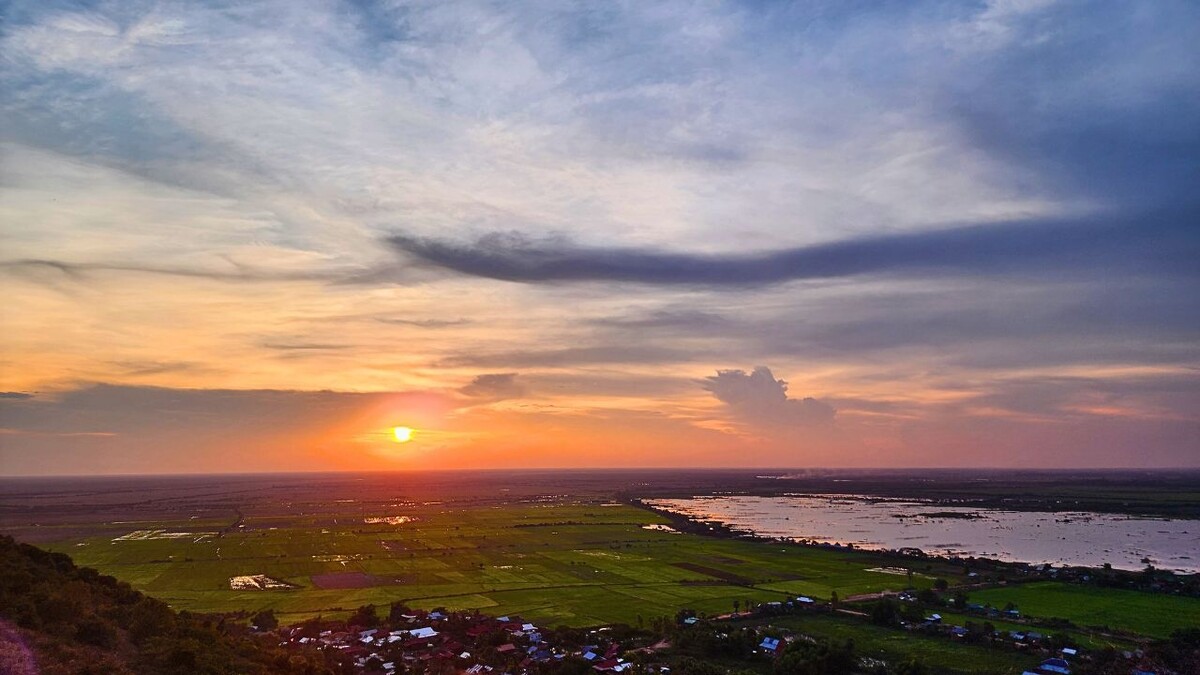
Phnom Krom is usually described as one of the best places near Siem Reap to watch the sunset. The hill rises above the flat countryside south of the city, with rice fields stretching toward Tonle Sap and an almost uninterrupted view across the horizon.
That view is the reason most people come here, but it is not the most interesting thing about Phnom Krom.
At the top of the hill stand the remains of a Hindu temple built more than 1,100 years ago during the reign of Yasovarman I, one of the kings who shaped the early Angkorian capital. Its three sandstone towers were dedicated to Shiva, Vishnu and Brahma, and belong to the same ambitious period of temple building that produced Phnom Bakheng and Phnom Bok.
I first included Phnom Krom in my three-day Siem Reap and Angkor itinerary. Like many visitors, I initially thought of it mainly as a sunset stop. Once you look beyond the viewpoint, however, the hill becomes much more interesting: it connects the early history of Angkor, Hindu cosmology, local legends and the landscape around Tonle Sap in one relatively small site.
Phnom Krom Quick Guide
| Location | About 12 km southwest of central Siem Reap |
| Period | Late 9th to early 10th century |
| King | Yasovarman I |
| Architectural style | Bakheng |
| Religion | Hindu |
| Main deities | Shiva, Vishnu and Brahma |
| Hill height | About 140 metres |
| Opening hours | 6:00 AM–7:00 PM |
| Ticket | Angkor Pass required for international visitors |
| Time needed | Around 30–60 minutes for the temple, longer if staying for the views |
| Best time to visit | Early morning or late afternoon |
| Best for | History, views, photography and sunset |
| Combine with | Tonle Sap, southern Siem Reap or a wider Angkor itinerary |
Where to Stay in Siem Reap
Phnom Krom is close enough to Siem Reap to visit without changing hotels or staying near the lake. If you are planning several days around Angkor, staying in or around central Siem Reap is usually the most convenient option for temples, restaurants and transport.
Yasovarman I and the Early Angkorian Capital
Phnom Krom was built during the reign of Yasovarman I, who ruled the Khmer Empire from 889 to 910.
His reign was an important turning point in the development of Angkor. Yasovarman moved the royal centre from Hariharalaya, near present-day Roluos, to a new capital called Yasodharapura. This new city developed around Phnom Bakheng and became part of the vast urban landscape that we now associate with Angkor.
Yasovarman was particularly associated with temples built on natural hills. Three of the most prominent examples survive around Siem Reap: Phnom Bakheng near the centre of the new capital, Phnom Bok to the northeast and Phnom Krom to the south near Tonle Sap.
The choice of elevated sites had religious significance. In Hindu cosmology, Mount Meru represents the sacred mountain at the centre of the universe. Khmer rulers repeatedly translated this idea into architecture, sometimes by constructing enormous stepped temple-mountains and sometimes by adapting natural hills to create sacred spaces above the surrounding plain.
Phnom Krom fitted perfectly into this landscape. It stood at the southern edge of the Angkor region overlooking the lowlands around Tonle Sap, while Phnom Bok occupied another elevated position to the northeast.
These temples were not isolated monuments. Together with reservoirs, roads, settlements and other religious foundations, they formed part of a much larger landscape organised around the royal capital.
Three Towers for Shiva, Vishnu and Brahma
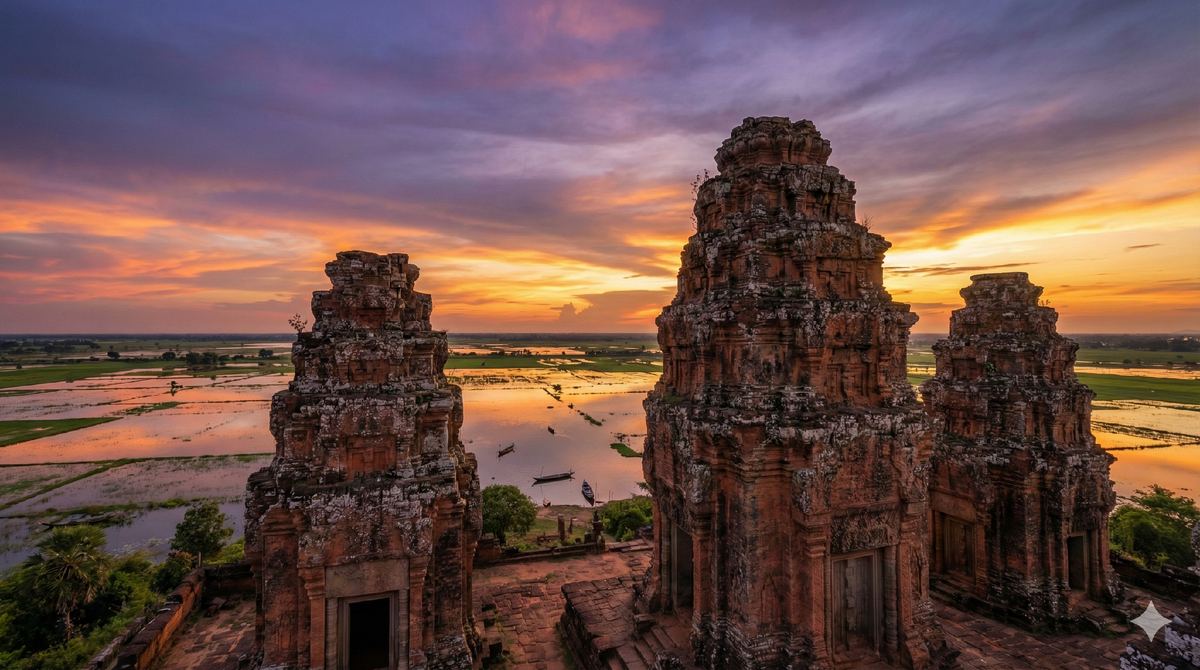
The central feature of Phnom Krom is a row of three sandstone sanctuary towers standing on a single platform.
The central tower was dedicated to Shiva, the northern tower to Vishnu and the southern tower to Brahma. Together the three deities are commonly associated with the Hindu Trimurti.
The arrangement is one of the features that makes Phnom Krom particularly interesting, although it was not unique. Phnom Bok, another hilltop temple associated with Yasovarman I, followed a very similar plan and was dedicated to the same three deities.
The towers at Phnom Krom are heavily damaged today, but enough survives to understand their original arrangement. They stand along a north-south axis and have openings on the eastern and western sides, while the north and south sides are formed by false doors.
The main sanctuaries were once surrounded by additional structures built from sandstone, brick and laterite. Much of this architecture has disappeared or survives only as foundations and fragments, making the three main towers the dominant feature of the site today.
The Statues Once Inside Phnom Krom
The empty towers can make Phnom Krom feel austere, but originally they contained large sacred images.
Archaeological clearance and excavation carried out in 1938 uncovered fragments of statues representing Shiva, Vishnu and Brahma, together with their pedestals. The fragments were found scattered around the temple, the neighbouring monastery and even farther down the hill.
The sculptures were reconstructed, although their later history was complicated by decades of political instability and looting in Cambodia.
The Shiva statue has a particularly interesting story. Its head was eventually acquired by the Metropolitan Museum of Art in New York before being returned to Cambodia in 1997. It was reunited with the body and is now associated with the collection of the National Museum of Cambodia in Phnom Penh.
Today the original monumental figures are no longer standing inside the three towers. What remains at Phnom Krom gives only a partial impression of what visitors would have seen when the temple was functioning as an active Hindu sanctuary.
Why Is Phnom Krom So Eroded?
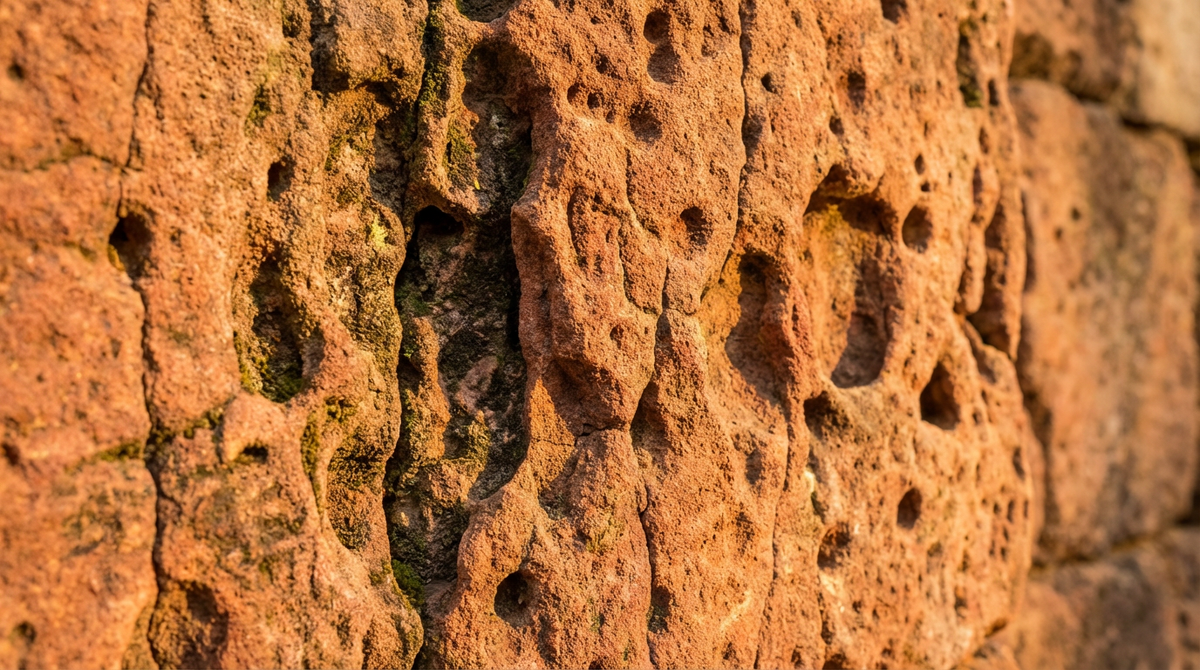
Compared with many better-preserved Angkorian temples, Phnom Krom looks unusually weathered. Decorative details have faded, edges have softened and the surfaces of the towers appear badly worn.
The simplest explanation is also the most convincing: exposure.
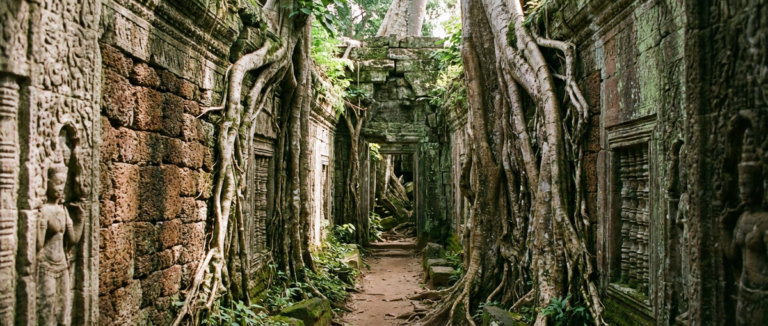
The temple has stood for more than a thousand years on an open hill above the surrounding plain. Wind, tropical rain, humidity and water infiltration have gradually affected the sandstone, brick and laterite structures.
Modern conservation work is still dealing with these problems. APSARA National Authority has carried out restoration and reinforcement work at Phnom Krom, including measures to address erosion, weakened masonry and water damage.
The condition of the temple therefore does not need a story about incompetent ancient engineers or defective stone. Weathering over eleven centuries is enough to explain much of what we see today.
At the same time, that erosion gives Phnom Krom a very different character from more extensively restored sites. It is a much smaller and rougher monument than Angkor Wat or Banteay Srei, and the surviving architecture feels closely tied to the exposed hill on which it stands.
The Hanuman Legend
The history of Phnom Krom is archaeological, but the hill also has its own local mythology.
One tradition connects its unusually rocky landscape with Hanuman, the monkey warrior from the Ramayana. According to the story, the exposed rocks are associated with Hanuman’s search for medicinal plants during the epic.
As with many legends attached to Angkorian landscapes, this should not be treated as a literal explanation of how the hill was formed. It is more useful as an example of how physical landmarks became incorporated into religious stories long after the geology itself was established.
The distinction between history and legend matters at Phnom Krom because both are part of the site’s identity. The temple can be dated and linked to Yasovarman I through archaeology and architectural history, while stories about Hanuman belong to a separate tradition through which local communities interpreted the landscape.
Yasovarman I and the Legend of the Leper King
Yasovarman I is also connected with one of Angkor’s best-known legends: the Leper King.
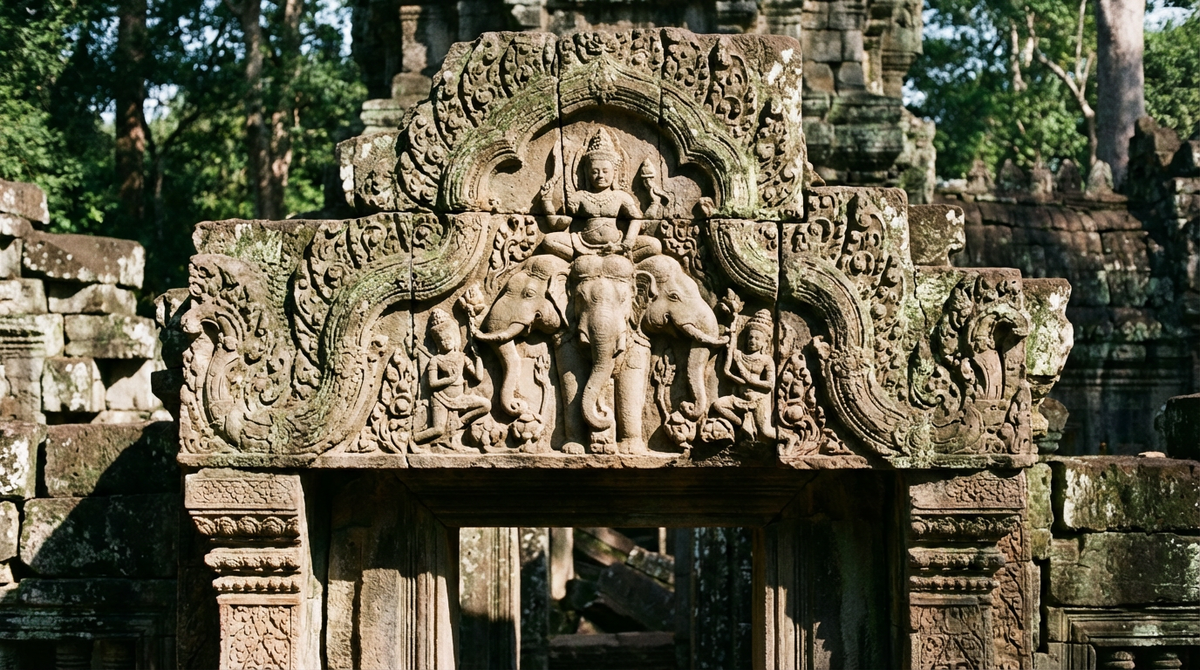
Visitors to Angkor Thom may recognise the name from the Terrace of the Leper King, where a seated statue became associated with stories of a Khmer ruler suffering from leprosy.
The identity of the figure has been debated for a long time. Cambodian tradition and later accounts sometimes connected the Leper King with Yasovarman I, but the terrace at Angkor Thom was constructed centuries after his reign. Other interpretations identify the statue with Dharmaraja or Yama, the Hindu god associated with death and judgement.
For that reason, it is better to treat the connection between Yasovarman and the Leper King as part of Cambodian historical folklore rather than a confirmed episode in the history of Phnom Krom.
The severely eroded stone at Phnom Krom has occasionally encouraged more dramatic versions of the story, in which the temple somehow shares the illness of its builder. There is no archaeological reason to interpret the damage this way. The condition of the monument is much more convincingly explained by centuries of exposure to the elements.
Why Phnom Krom Is Such a Good Viewpoint
Whatever the original religious purpose of the temple, the hill’s geography explains why Phnom Krom has become one of the better-known viewpoints around Siem Reap.
At around 140 metres high, it rises sharply above a landscape that is otherwise extremely flat. From the upper areas you can see rice fields, villages, waterways and the huge lowland basin around Tonle Sap.
The scenery changes considerably with the seasons. During the wet season, water spreads across large areas of the floodplain and creates reflective surfaces between the fields and settlements. During the dry season, the same landscape becomes a patchwork of agricultural land, roads and villages.
The view is therefore not simply a distant lake panorama. Phnom Krom gives you a much clearer sense of how Siem Reap, Angkor and Tonle Sap fit together geographically.
APSARA promotes the hill for both sunrise and sunset, although sunset is the more popular choice for most travellers. The western side looks toward Tonle Sap, while the open landscape allows long views in several directions.
Phnom Krom and Tonle Sap
Tonle Sap is much more than a scenic backdrop to Phnom Krom.
The lake and its floodplain have played an essential role in the history of central Cambodia. Its seasonal rise and fall supports fisheries, agriculture, transportation and communities around the lake, while the wider water system was closely connected with the development of the Angkor region.
This is one reason I think Phnom Krom becomes more interesting after you have already spent some time exploring Angkor.
At the major temples, it is easy to think of the Khmer Empire primarily in terms of stone monuments. From an elevated site like Phnom Krom, the wider setting becomes more obvious. Angkor depended on settlements, agricultural land, reservoirs, waterways and infrastructure spread across a huge area.
The temples were part of that landscape rather than isolated structures surrounded permanently by jungle.
A Hindu Temple Beside a Buddhist Monastery
Phnom Krom also shows how sacred places in Cambodia continued to evolve after the Angkorian period.
A Buddhist monastery stands on the hill close to the ancient Hindu temple. Rather than making the site feel historically inconsistent, this reflects a pattern found throughout Cambodia, where older sacred locations continued to be used as religious traditions changed.
The ancient sanctuary was created for Hindu deities during the reign of Yasovarman I. Buddhism later became dominant, while the hill itself continued to have religious and community significance.
Today Phnom Krom is not only an archaeological attraction. Local residents also come here for exercise, picnics and evening views, particularly at weekends. That combination of ancient temple, working monastery and ordinary local life makes it feel different from some of the busiest monuments inside the main Angkor circuits.
How to Visit Phnom Krom
Phnom Krom is about 12 kilometres southwest of central Siem Reap, near the northern edge of Tonle Sap.
The journey from the city is straightforward by tuk-tuk, car or motorbike. Cycling is also possible, although the heat and final climb need to be taken into account.
Once you reach the hill, expect an uphill approach and stairs. There is no reason to rush the visit, particularly in Cambodia’s heat, so late afternoon is generally more comfortable than the middle of the day.
The archaeological site is currently open from 6:00 AM to 7:00 PM. APSARA suggests around 20–30 minutes for the temple itself, but I would allow longer if you want to explore without rushing and stay for the surrounding views.
Do You Need an Angkor Pass for Phnom Krom?
Yes. Phnom Krom is part of the Angkor Archaeological Park, so international visitors need a valid Angkor Pass to enter the temple area.
Current official ticket prices are:
| Angkor Pass | Price | Validity |
|---|---|---|
| 1 Day | $37 | 1 day |
| 3 Days | $62 | Any 3 days within 7 days |
| 7 Days | $72 | Any 7 days within 30 days |
If Phnom Krom is the only Angkorian monument you plan to visit that day, buying a pass purely for this temple would not offer particularly good value. It makes much more sense to include Phnom Krom on a day when your pass is already being used for other Angkor sites.
For a first visit, I would prioritise the main temples and then add Phnom Krom if the route and timing work naturally.
Phnom Krom at Sunset
Sunset is the obvious time to visit Phnom Krom, but it is worth arriving before the final light rather than treating the hill as a place to reach five minutes before the sun disappears.
That gives you time to see the temple properly, walk around the hill and understand the setting before choosing a place for the view.
The atmosphere can also be quite different from the famous sunset at Phnom Bakheng. Phnom Krom attracts visitors, but it is also used by local residents who come to exercise, meet friends, picnic or simply spend the end of the day outside.
When I visited the area, that local evening activity was one of the details I remembered most. It made Phnom Krom feel less like a formal attraction organised around a single photo opportunity and more like a place that remains part of everyday life around Siem Reap.
What to Combine with Phnom Krom
Because Phnom Krom lies south of Siem Reap, it works best as part of a route rather than as a separate half-day excursion.
You can combine it with sightseeing around Siem Reap, a visit toward Tonle Sap, or simply use it as the final stop after a day exploring the Angkor region.
If you are planning your first trip and want someone else to arrange transport, temple stops or a guide, both private and small-group options are widely available from Siem Reap.
For the wider itinerary, see my three-day trip from Phu Quoc to Siem Reap and the temples of Angkor, where Phnom Krom fits into the route rather than being treated as an isolated attraction.
Is Phnom Krom Worth Visiting?
Phnom Krom would not replace Angkor Wat, Bayon, Ta Prohm or Banteay Srei on a first short visit to Siem Reap. If you have very limited time, the major temples should still come first.
It becomes more worthwhile when you have an extra afternoon, are already travelling toward the southern side of Siem Reap, or want to see something beyond the standard temple circuits.
The temple itself is relatively small and heavily weathered, but its history adds much more to the visit than the sunset alone. Phnom Krom belongs to the early development of Angkor under Yasovarman I, preserves an unusual three-sanctuary arrangement dedicated to Shiva, Vishnu and Brahma, and sits in a position where the wider landscape toward Tonle Sap becomes easy to understand.
Come in the late afternoon and you can explore the ruins before watching the light change across the rice fields and lake basin. Knowing what those eroded towers represent makes the view considerably more interesting than simply arriving for another sunset photo.
Useful Travel Resources
These are the services I use or check when planning trips and comparing travel options.
Flights
Compare routes and fares for Cambodia and the rest of Southeast Asia.
Hotels
Search accommodation in Siem Reap and compare locations, prices and guest ratings.
Tours & Activities
Useful for attraction tickets, local activities and organised sightseeing.
Tours & Experiences
Compare guided Angkor tours, private day trips and other experiences around Siem Reap.
Airport Transfers
Pre-book a transfer between Siem Reap Angkor International Airport and your hotel.
eSIM
Get mobile data before arriving in Cambodia without looking for a physical SIM card.
Car Rental
Compare local car rental options for destinations where self-driving makes sense.
Travel Insurance
Check travel insurance options before your trip.
This post contains affiliate links. If you book or purchase through one of these links, I may earn a commission at no extra cost to you.