How Angkor Wat Was Built: Foundations, Water & Stone
When you stand in front of Angkor Wat, the obvious question is not only who built it, but how anyone managed to build something this large in the 12th century and keep it standing for nearly 900 years.
The five towers get most of the attention, but some of the temple’s most impressive engineering is almost invisible.
Angkor Wat was built on a landscape shaped by seasonal water. Its enormous stone structures rise above engineered foundations, surrounded by a moat about 190 metres wide. Vast quantities of sandstone had to be quarried near Phnom Kulen and transported dozens of kilometres to the construction site. Even the temple’s unusual west-facing orientation appears to have been part of a carefully planned religious and political design.
The real achievement was not that Khmer engineers defeated the Cambodian landscape.
They learned how to build with it.
If you are planning a visit rather than researching the engineering, start with my Angkor One-Day Itinerary: Sunrise at Angkor Wat, Angkor Thom & Ta Prohm.
Angkor Wat Engineering at a Glance
| Built | Early 12th century |
| King | Suryavarman II |
| Original religion | Hinduism |
| Principal deity | Vishnu |
| Main visible material | Sandstone |
| Other structural materials | Laterite, sand and engineered earth |
| Sandstone source | Quarry areas near the southeastern foot of Phnom Kulen |
| Distance from quarry zone | Roughly 35–40 km |
| Moat width | About 190 metres |
| Orientation | West |
| Architectural concept | Temple-mountain representing Mount Meru |
The Foundation Beneath Angkor Wat
One of the easiest mistakes is to imagine Angkor Wat as an enormous stone structure sitting directly on naturally solid ground.
It is more complicated than that.
The builders first created and shaped an artificial platform. Beneath the visible architecture are carefully prepared layers of earth and sand, while parts of the monumental masonry use a combination of a sand core, laterite and sandstone.
That distinction matters.
The carved sandstone we see today is only the visible exterior of a much larger engineered structure.
Sand can support enormous loads when conditions remain stable, but its behaviour is closely connected with moisture and groundwater. Large fluctuations in groundwater can affect the stability of foundations built on sandy layers.
This is one reason water management remains important to the conservation of Angkor even today.
Angkor Wat did not survive because of one miraculous foundation technique. Its stability came from a system in which the prepared ground, structural materials, drainage and surrounding water all worked together.
Why Angkor Wat Needed a 190-Metre-Wide Moat
The moat surrounding Angkor Wat is approximately 190 metres wide.
It is easy to see it as a beautiful foreground for the famous sunrise view, or simply as a defensive barrier.
It was much more than that.
A Sacred Ocean Around Mount Meru
Angkor Wat was designed as a temple-mountain.
In Hindu cosmology, Mount Meru stands at the centre of the universe, surrounded by mountains and cosmic oceans.
The central towers represent the sacred mountain, while the moat forms part of this symbolic landscape.
Water was therefore built into the religious meaning of the monument from the beginning.
A Carefully Managed Water Environment
The moat also had an engineering role.
Angkor developed inside a landscape filled with reservoirs, channels, embankments, ponds and other water-management structures.
At Angkor Wat, the surrounding water helped create more stable moisture conditions around the temple’s sandy foundations.
The moat should not be imagined as a giant tank that single-handedly prevents the temple from sinking.
A better way to understand it is as part of an engineered water landscape that helped maintain the groundwater conditions on which the foundations depended.
The clever part was not removing water from the problem.
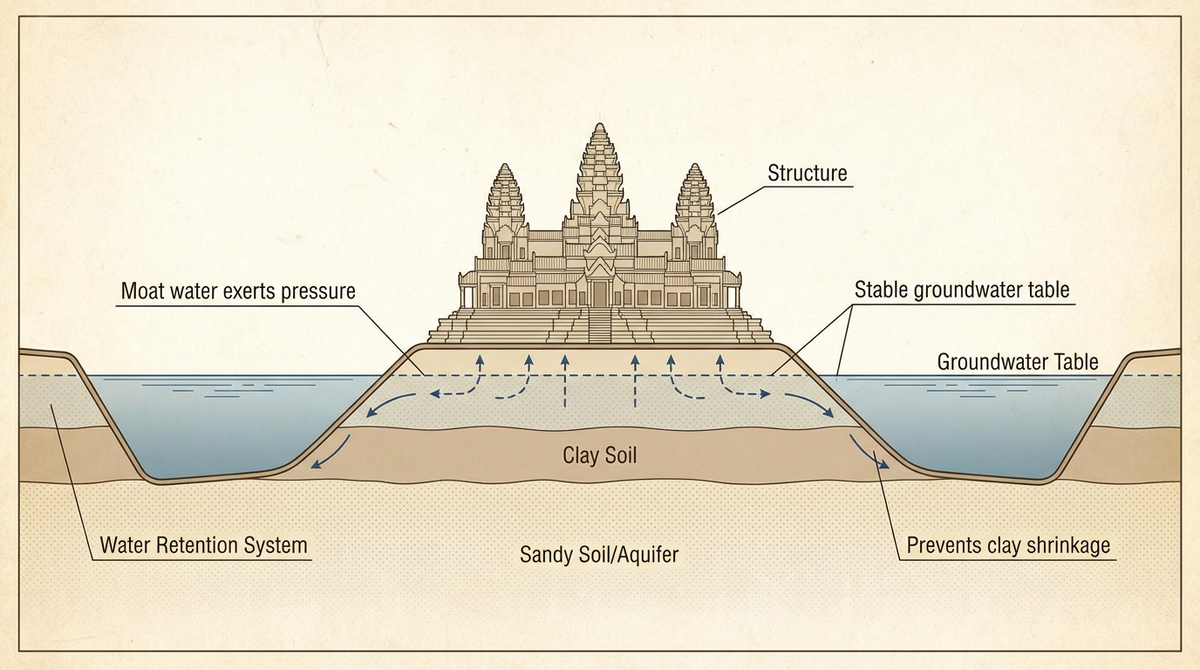
It was making water part of the solution.
Where Did the Sandstone Come From?
Angkor Wat required an extraordinary quantity of sandstone.
But there is no major sandstone quarry beside the temple.
Research has traced much of the stone used at Angkor to quarry areas near the southeastern foot of Phnom Kulen, roughly 35 kilometres northeast of the monuments.
More than 50 ancient quarry sites have been identified in the area.
That means a large part of the construction process began far away from Angkor Wat itself.
Stone had to be extracted, prepared, transported and then positioned within one of the most ambitious building projects of the Khmer Empire.
The scale becomes easier to appreciate once you walk through the galleries and realise how much of the visible architecture is carved sandstone.
Doorways, columns, walls, galleries, towers and long decorative surfaces all required stone, skilled labour and an enormous level of organisation.
How the Stone Reached Angkor
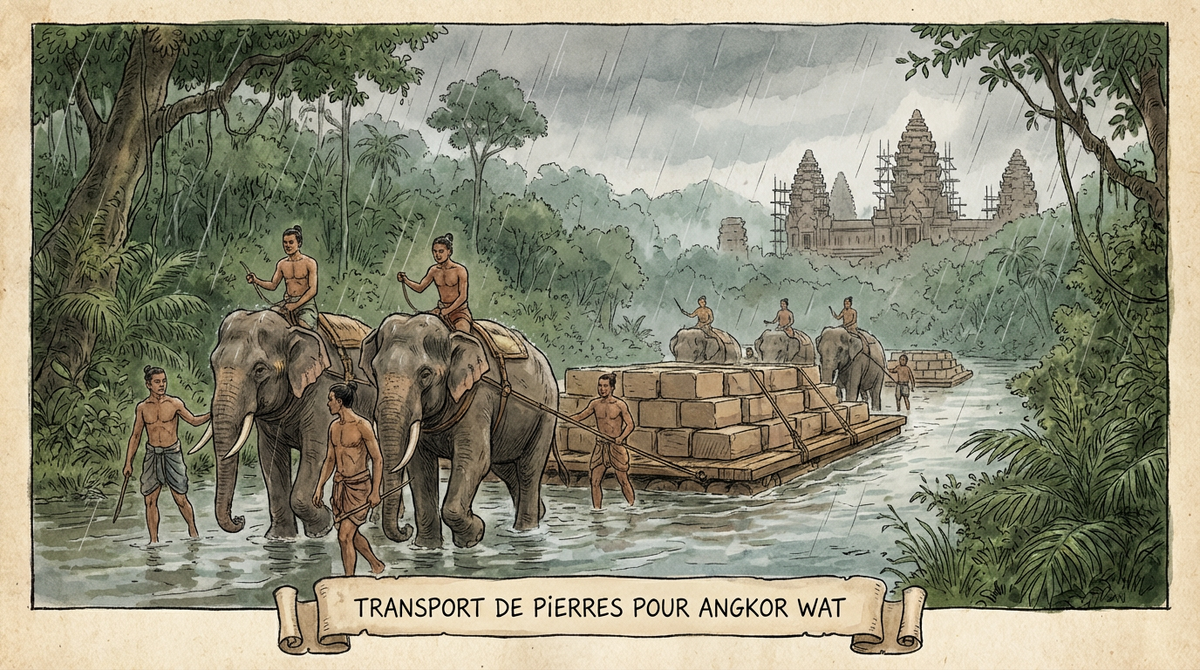
Moving that much stone overland for dozens of kilometres would have been extremely difficult.
The answer appears to have been water.
Archaeological research has identified a network of canals and rivers connecting the Phnom Kulen quarry region with the Angkor area.
These waterways provided a far more efficient route for moving heavy sandstone toward the construction zone.
That changes the way Angkor Wat should be understood.
The canals were not simply agricultural infrastructure. Waterways could also connect resources, settlements and major building projects.
At Angkor, transport, agriculture, water management and monumental construction were parts of the same larger system.
The temple was not built in isolation.
It depended on an organised landscape around it.
Angkor Wat Was the Result of Centuries of Experimentation
Suryavarman II did not invent Khmer monumental architecture from scratch.
Earlier rulers had already spent centuries developing the temple-mountain concept.
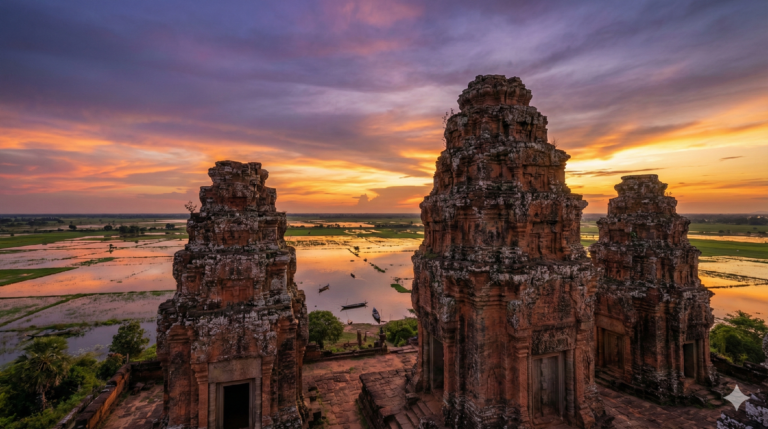
Bakong shows an important early stage of that architectural tradition, while Pre Rup demonstrates how the form evolved before Angkor Wat.
By the time Angkor Wat was built, Khmer architects already had generations of experience with raised temple platforms, axial planning, stone construction and symbolic landscapes.
What changed was the scale.
Suryavarman II took an established architectural language and pushed it to an extraordinary level of complexity.
Why Does Angkor Wat Face West?
This is one of the most unusual features of Angkor Wat.
Most major Khmer sanctuaries are oriented toward the east, the direction of sunrise.
Angkor Wat’s principal entrance faces west.
There is no single explanation that has been proved beyond dispute, but two interpretations are particularly important.
The Vishnu Explanation
Angkor Wat was dedicated to Vishnu, rather than Shiva, who had been central to many earlier Khmer state temples.
Vishnu has associations with the west in Hindu tradition, so the unusual orientation may relate to the specific religious identity of the sanctuary.
That explanation is plausible, but it does not settle the question completely.
Was Angkor Wat Also Connected with Suryavarman II’s Afterlife?
The second interpretation is more intriguing.
West is associated with sunset and death, and several unusual features of Angkor Wat have long encouraged scholars to connect the monument with funerary symbolism.
The orientation is one piece of evidence.
Another is the unusual anti-clockwise progression traditionally used to read much of the narrative decoration around the galleries. This direction has sometimes been compared with movement associated with funerary rituals.
Angkor Wat has therefore often been interpreted not simply as a temple to Vishnu, but as a monument closely connected with the divine afterlife of Suryavarman II.
That does not mean archaeologists have discovered the king’s tomb inside Angkor Wat.
They have not.
It is more accurate to describe the monument as a Vishnu temple with powerful royal and possibly funerary symbolism.
The Equinox Sunrise
The temple’s relationship with the sky adds another layer.
Around the equinox, visitors standing on the western side of Angkor Wat can watch the rising sun appear directly over the central tower.
It is one of the most striking astronomical experiences at Angkor.
The alignment demonstrates how carefully the temple was planned in relation to direction, proportion and solar movement.
But it should not be used as a simple explanation for why the entire complex faces west.
The alignment is real.
The original reason for the western orientation is still more complicated.
What the Bas-Reliefs Tell Us
The long galleries of Angkor Wat are not simply decorated walls.
They form an enormous visual narrative combining religion, kingship and political power.
One of the most famous scenes is the Churning of the Ocean of Milk, a Hindu myth in which gods and demons pull the serpent Vasuki around Mount Mandara in search of the elixir of immortality.
Other galleries depict the Battle of Kurukshetra from the Mahabharata, scenes of heavens and hells, episodes from Hindu epics and the army of Suryavarman II.
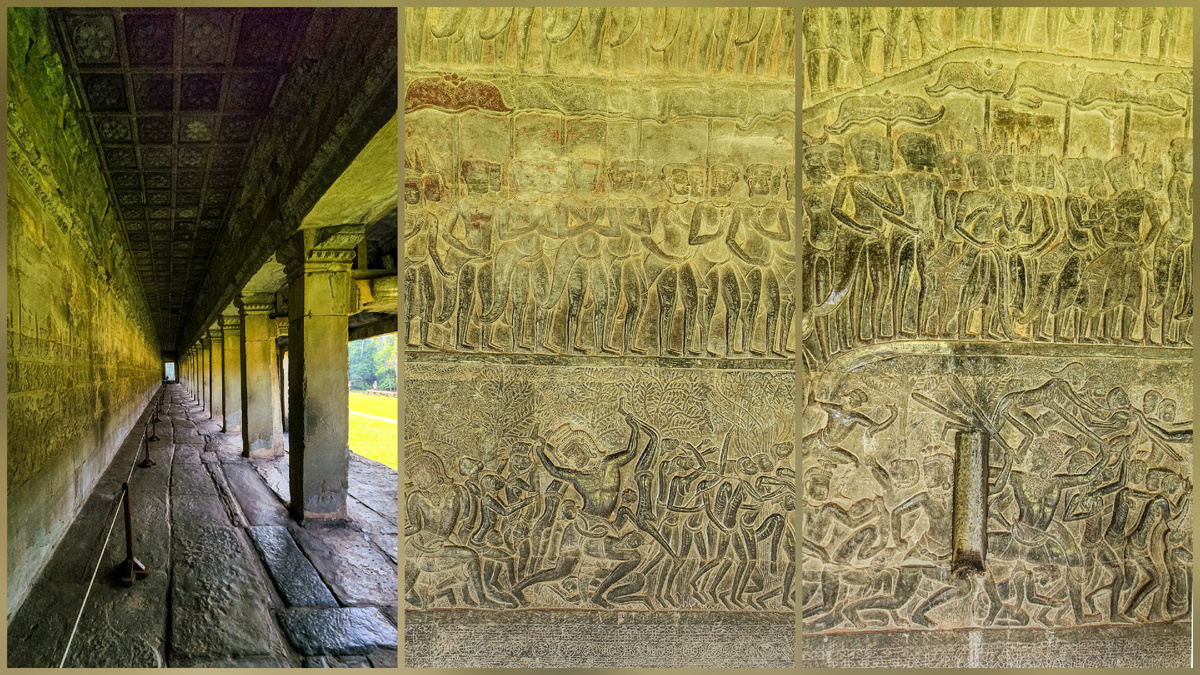
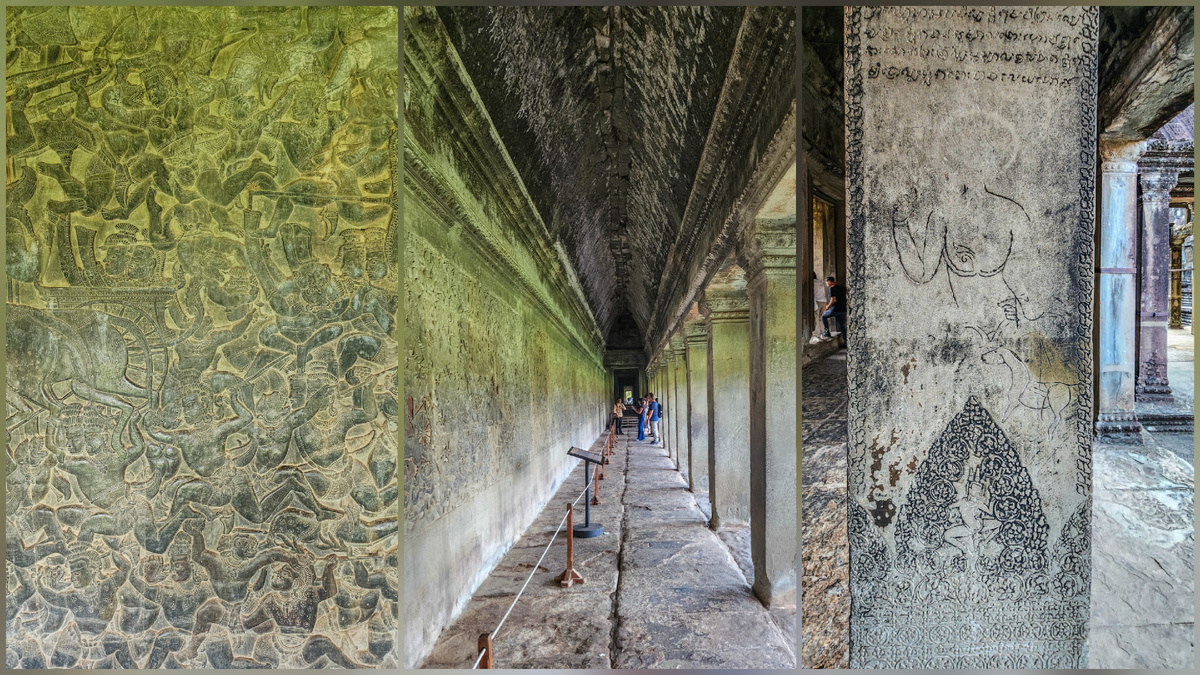
That combination is important.
Mythological scenes place the temple within a cosmic religious world.
At the same time, the king appears inside that visual system with his court and army.
The walls therefore connect the divine order of the universe with the political order of the Khmer kingdom.
Angkor Wat was not simply a sanctuary.
It was also a statement about royal power and the place of Suryavarman II within a sacred universe.
Why the Direction of the Bas-Reliefs Matters
The galleries also play a role in the debate about Angkor Wat’s western orientation.
Much of the narrative sequence is traditionally read anti-clockwise.
That is unusual enough that researchers have connected it with funerary ritual and used it as supporting evidence for the idea that Angkor Wat had a mortuary dimension.
But this is evidence, not a final answer.
That uncertainty is part of what makes the temple so interesting.
At Angkor Wat, the same architectural feature can have religious, political, astronomical and ritual meanings at the same time.
Why Angkor Wat Has Survived for Nearly 900 Years
There is no single engineering secret.
The temple survived because multiple systems worked together.
The builders created engineered foundations rather than simply placing heavy masonry on untouched ground.
Sand, laterite and sandstone were used for different structural purposes.
The moat helped maintain the water environment around the foundations.
Quarry and canal networks solved the enormous logistical problem of bringing sandstone to Angkor.
The monument was also built with extraordinary precision and durable materials.
And there is another reason.
Angkor Wat remained an important religious site even after the political centre of the Khmer Empire shifted elsewhere.
Unlike some temples that became heavily overgrown after losing their original role, Angkor Wat continued to be used and cared for through later centuries.
Engineering gave it physical resilience.
Continued human use gave it another form of protection.
What to Notice When You Visit Angkor Wat
Once you know the engineering story, the temple looks different.
The moat is no longer simply water in front of a sunrise photograph.
The causeway becomes part of a carefully controlled approach across a symbolic and hydraulic boundary.
The sandstone walls connect the temple to quarry landscapes near Phnom Kulen.
The western entrance raises questions about Vishnu, royal death and ritual direction.
And the bas-reliefs stop being decorative backgrounds and become part of the political and religious logic of the monument.
If you want someone to explain those details while you are actually walking through the temple, Angkor Wat is one of the places where a knowledgeable guide can add a lot.
Affiliate disclosure: This article contains affiliate links. If you book through them, I may earn a commission at no extra cost to you.
Angkor Wat and Ta Prohm: Two Different Ideas of Survival
Angkor Wat and Ta Prohm show almost opposite relationships between architecture and nature.
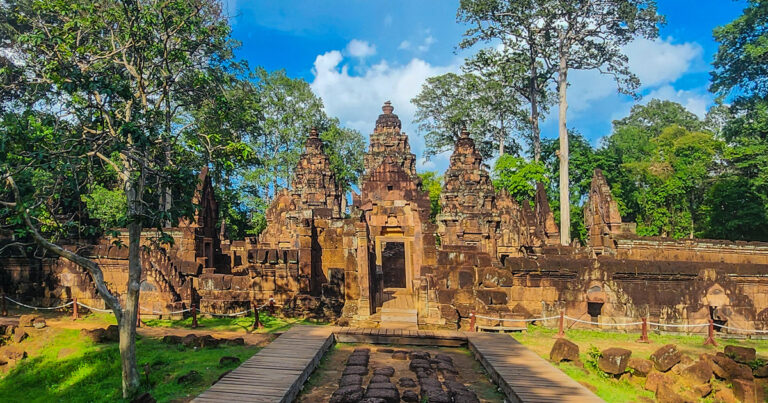
Angkor Wat demonstrates how Khmer engineers shaped water, terrain and stone into an extraordinarily controlled monument. At Ta Prohm, centuries of vegetation became part of the monument itself.
Both survived, but in very different ways.
Useful Travel Resources
Flights
Compare flight options and prices for Cambodia and the rest of Southeast Asia.
Hotels
Compare accommodation in Siem Reap for your Angkor visit.
Tours & Activities
Browse Angkor temple tours, tickets and other Siem Reap activities.
Tours & Experiences
Compare guided tours and experiences in Siem Reap.
Airport Transfers
Arrange a transfer between Siem Reap Angkor International Airport and your accommodation.
eSIM
Set up mobile data before arriving in Cambodia.
Travel Insurance
Check available travel insurance options before your trip.