Banteay Srei Temple: Carvings, History & How to Visit
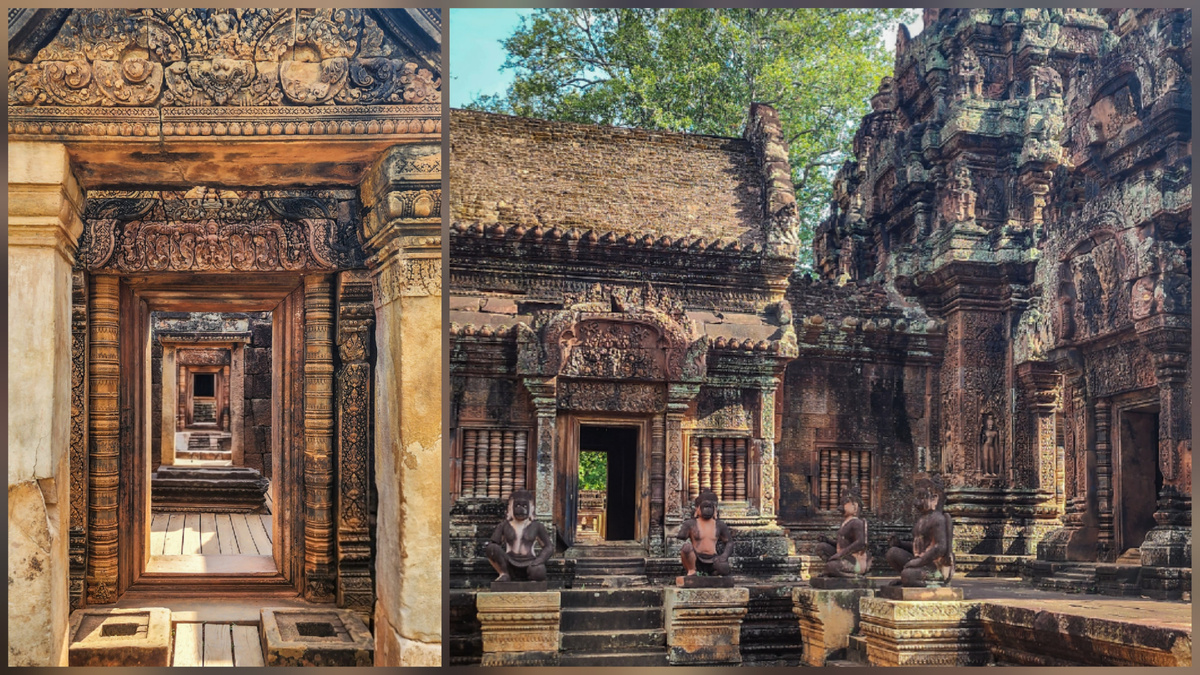
Banteay Srei is small enough that you can take in much of its sacred core at once, yet its carvings contain more detail than many temples several times its size. Consecrated in 967, it was founded by powerful courtiers rather than a reigning king, built from warm red sandstone and covered with mythological scenes that turn doorways and pediments into pages of stone.
Its later history is almost as interesting. André Malraux tried to remove sculptures from the temple in 1923, and less than a decade later Henri Marchal used Banteay Srei for one of Angkor’s important early anastylosis restorations.
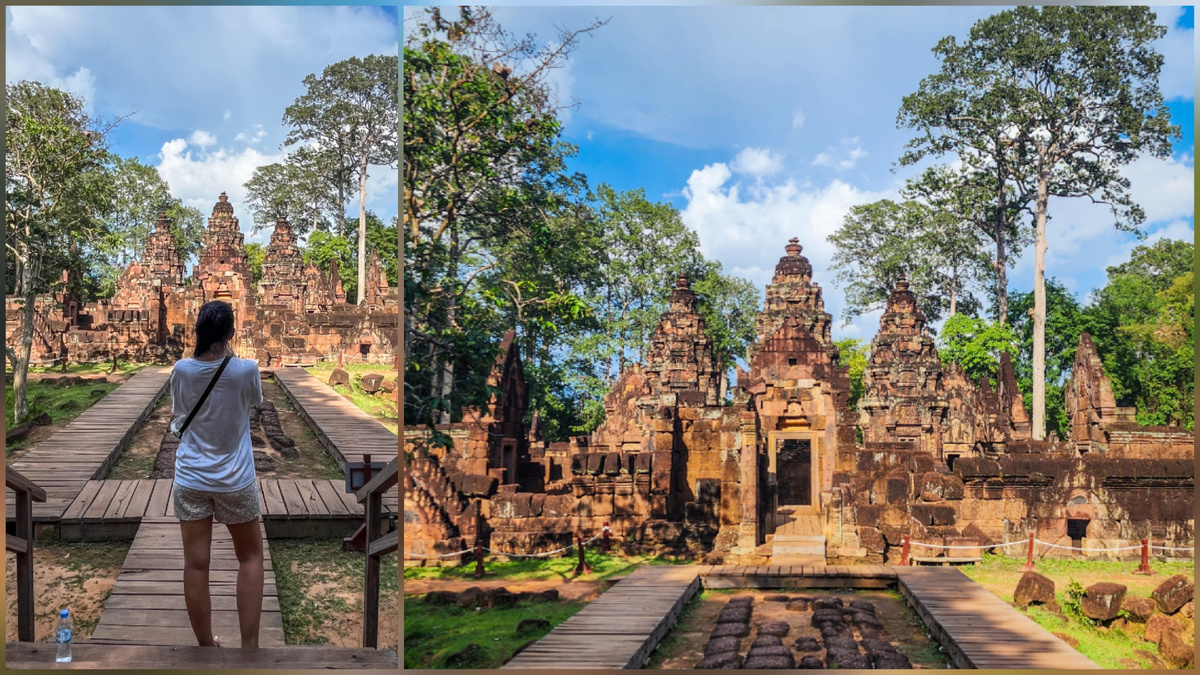
That combination is what makes the temple special. Angkor Wat dominates through scale, Bayon through monumental faces and Ta Prohm through architecture entangled with trees. At Banteay Srei, the surface itself becomes the attraction.
I visited it on a route through Pre Rup → Banteay Samré → Banteay Srei → Phnom Krom, and the sequence worked particularly well because each temple offered something completely different.
If you are still planning the major monuments, my Angkor One-Day Itinerary: Sunrise at Angkor Wat, Angkor Thom & Ta Prohm is the better place to start.
Banteay Srei at a Glance
| Location | About 25 km northeast of the main Angkor temple area |
| Consecrated | 22 April 967 |
| Period | 10th century |
| Religion | Hindu, primarily Shaivite with strong Vaishnavite imagery |
| Original sacred name | Tribhuvanamaheśvara |
| Historic settlement | Īśvarapura |
| Founders | Yajñavarāha and Viṣṇukumāra |
| Material | Red sandstone / quartz arenite |
| Known for | Exceptionally detailed carving and narrative pediments |
| Opening hours | 7:30 AM–5:30 PM |
| Ticket | Included in the Angkor Pass |
| Time to allow | 1–1.5 hours; closer to 2 hours if you love photography or mythology |
Why Banteay Srei Is Different
Banteay Srei does not compete with Angkor Wat on size, and that is precisely why it works.
The enclosures are compact, the sanctuary towers are relatively small and the distance between architectural elements is short. Instead of spending most of your attention trying to comprehend the scale of the complex, you can concentrate on individual lintels, pediments, guardians and mythological scenes.
The temple is sometimes treated as an early step toward the supposedly greater achievements of Angkor Wat and Bayon. That is misleading. Banteay Srei represents a distinctive high point of Khmer art in its own right, and UNESCO places it alongside Angkor Wat and Bayon among Angkor’s great artistic masterpieces.
Its small scale is not a weakness. It allows a different kind of experience.
Built in 967, but Not by a King
Banteay Srei is famous for being a major Khmer temple not commissioned by a reigning monarch.
That does not mean it was a modest local project.
Its founders, Yajñavarāha and Viṣṇukumāra, belonged to the royal and intellectual elite. Yajñavarāha was a learned Brahmin, royal adviser and teacher closely connected with the court and with the future king Jayavarman V.
The temple was consecrated on 22 April 967, more than a century before Angkor Wat.
That date is important because Banteay Srei shows how sophisticated Khmer architecture and sculpture had already become during the 10th century. There is no need to describe it as a rehearsal for what came later.
For an even earlier stage of Khmer monumental architecture, Bakong offers a useful comparison with the 9th-century temple-mountain tradition.
Banteay Srei Was Not Its Original Name
The modern name Banteay Srei is usually rendered as “Citadel of Women” and is also popularly interpreted as “Citadel of Beauty”.
It was not the temple’s ancient sacred name.
The principal sanctuary was associated with Tribhuvanamaheśvara, the name of a Shiva linga installed there, while the settlement around the temple was known as Īśvarapura.
The modern name has encouraged plenty of romantic explanations. You may read that the carvings were considered too delicate to have been made by men, or that the temple belonged to priestesses or some specifically female cult.
Those stories are memorable, but they are not established history.
The documented story is more interesting: Banteay Srei was a sophisticated Hindu sanctuary created by elite patrons and given an unusually ambitious sculptural programme.
Shiva and Vishnu in the Same Temple
Banteay Srei is primarily associated with Shiva, but its religious programme is not limited to one deity.
The surviving arrangement appears to divide parts of the complex along the central east-west axis, with stronger Shaivite associations to the south and Vaishnavite imagery to the north.
That helps explain why the carvings contain such a wide range of stories. Shiva and Parvati appear alongside Krishna and other figures connected with Vishnu.
For a visitor, this creates a useful way to look at the temple. Instead of seeing every carving as generic Hindu decoration, ask which deity belongs to the scene and where that scene sits within the complex.
The architecture and the imagery begin to make more sense together.
Why the Sandstone Looks Pink
Banteay Srei is famous for its warm red and pink colour.
Technically, much of the temple was built from a red quartz arenite, with its colour linked to hematite, an iron-rich mineral. Depending on the light, the surface can shift between pale brown, orange, rose and deeper reddish tones.
Low-angle light also creates stronger shadows inside the carving, making jewellery, foliage, faces and tiny architectural details appear more three-dimensional.
This is why early morning and late afternoon often photograph particularly well.
The important point is not that the stone was simply “soft”. Its geology and carving properties are more complex than that. What matters to the visitor is the extraordinary crispness with which sculptors were able to render very small details.
How Banteay Srei Is Laid Out
The complex is compact but carefully ordered.
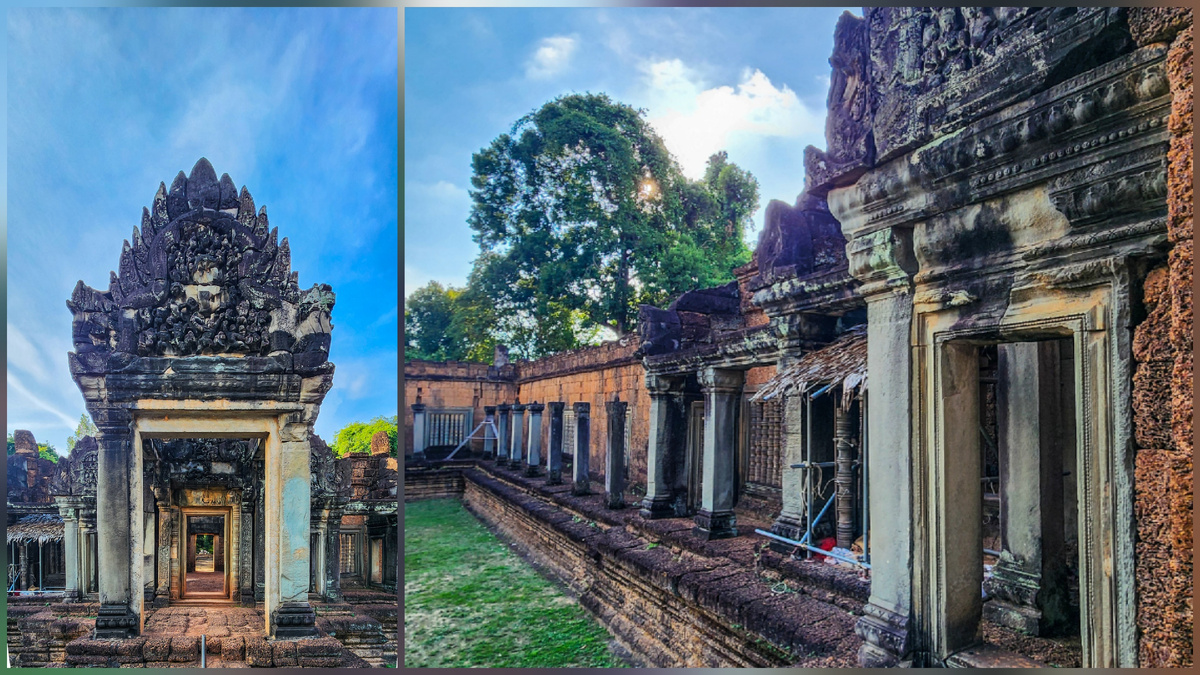
Successive enclosures, gateways, a moat, two subsidiary structures traditionally called libraries and three sanctuary towers lead toward the sacred centre. Movement follows an east-west axis and becomes increasingly restricted as you approach the inner sanctuary.
Because the site is relatively small, that progression is easy to understand.
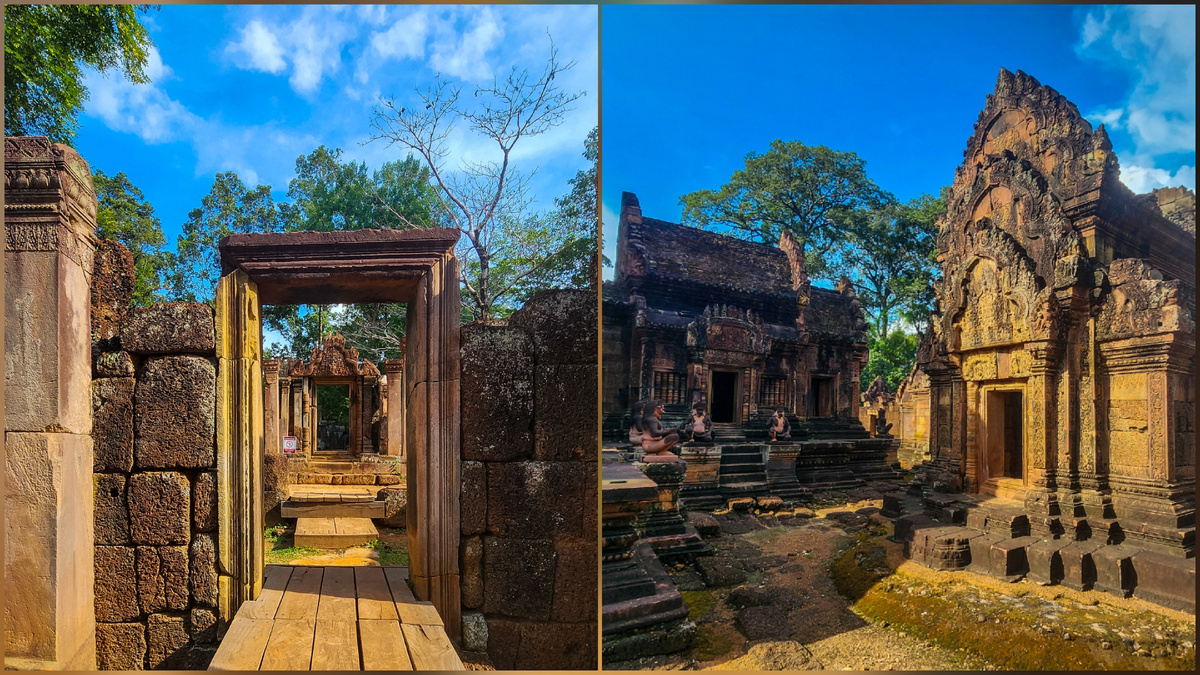
Walk slowly through each gateway and notice how it frames the next space. Then look upward. At Banteay Srei, the architecture is not just directing you toward the towers; it is constantly presenting sculpture above and around you.
Why the Pediments Matter
The triangular pediments above the doorways are one of the main reasons Banteay Srei matters in the history of Khmer sculpture.
Here, narrative scenes begin to take over surfaces that had often been dominated by more isolated, formal divine figures. The pediment becomes a place where an entire story can unfold.
Gods occupy one level, demons or warriors another, while mountains, forests, palaces and other elements help organise the action.
The so-called libraries are especially important. Some of the temple’s best-known mythological scenes appear on their pediments.
This changes the way to visit Banteay Srei. Do not walk directly toward the central sanctuary while looking straight ahead.
Keep looking above the doors.
Five Carvings to Look For
You do not need to know the Hindu epics in detail before arriving. Learning five scenes is enough to make the sculpture much easier to read.

1. Ravana Shaking Mount Kailasa
This is one of Banteay Srei’s most famous compositions.
The demon king Ravana attempts to shake Mount Kailasa, the sacred home of Shiva. Ravana strains beneath the mountain while Shiva remains composed above with Parvati.
The contrast is visible even before you know the story: enormous physical effort below, calm divine control above.
Once you recognise the scene, it stops being an elaborate pattern and becomes a piece of narrative art.
2. Kama Disturbing Shiva’s Meditation
Another famous composition presents Shiva facing a very different threat.
Kama, the god of desire, attempts to disturb Shiva’s meditation. The myth eventually leads to Shiva destroying Kama with the fire of his third eye.
Compare it with the Ravana scene. In one, Shiva faces brute physical force; in the other, desire and distraction.
The two scenes show how much narrative information Khmer sculptors could compress into a relatively small architectural space.
3. The Burning of the Khandava Forest
One of the most visually complicated scenes is connected with the burning of the Khandava Forest.
Indra sends rain in an attempt to extinguish the fire, while Krishna and Arjuna prevent the rain from reaching the forest. The divine elephant Airavata also appears in the composition.
This is a good scene to study with a zoom lens because several layers of action are packed into the same pediment.
It also demonstrates why describing Banteay Srei merely as “beautiful carving” misses the point. These are carefully organised stories.
4. Krishna Killing Kamsa
Another important scene comes from the mythology of Krishna.
Krishna confronts and kills the tyrant Kamsa, an episode that belongs to the wider Vaishnavite narrative tradition represented at the temple.
Finding scenes like this helps reveal the religious complexity of Banteay Srei. Shiva may dominate the main sacred identity, but Vishnu-related mythology is an important part of the sculptural programme.
5. Vali and Sugriva
Banteay Srei also includes a famous episode from the Ramayana involving the monkey brothers Vali and Sugriva.
Their conflict eventually draws Rama into the story and leads to Vali’s death.
This is also a useful reminder not to identify every monkey warrior in Khmer art as Hanuman. The Ramayana contains an entire world of vanara heroes, rulers and soldiers.
The 1923 André Malraux Theft
Banteay Srei has one of the strangest episodes in the modern history of Angkor.
In 1923, the young French writer André Malraux, long before becoming a famous novelist and French government minister, travelled to Cambodia with companions and removed sculptures from Banteay Srei.
The aim was to sell them.
The sculptures were intercepted before they could leave Cambodia, and Malraux was arrested in Phnom Penh. None of the pieces he removed ultimately left the country.
The affair later became an infamous part of his biography, but it also exposed just how vulnerable Khmer monuments were to looting and the international antiquities trade.
The scandal helped strengthen awareness that monuments such as Banteay Srei needed more serious protection.
How Henri Marchal Rebuilt Banteay Srei
Less than a decade later, the temple became associated with a very different approach to ancient architecture.
French conservator Henri Marchal travelled to Java in 1930 to study anastylosis, a restoration method based on documenting collapsed architecture and returning surviving original elements to their correct positions.
He applied the method at Banteay Srei between 1931 and 1933.
This did not mean simply rebuilding an old temple with new stone. Anastylosis relies as far as possible on original architectural elements, using modern additions only where necessary for structural stability or to reconnect surviving material.
The restoration at Banteay Srei became an important success in the history of Angkor conservation.
There is an interesting historical contrast here. In 1923, sculpture had been removed from the temple for private sale. In the following decade, archaeologists were developing methods intended to understand where original stones belonged and keep them within the monument.
The two events are not a direct cause-and-effect sequence, but together they show how dramatically attitudes toward Khmer heritage were changing.
Why You Cannot Walk Up to Every Carving
Banteay Srei rewards close looking, but some of its most delicate sculpture cannot be approached directly.
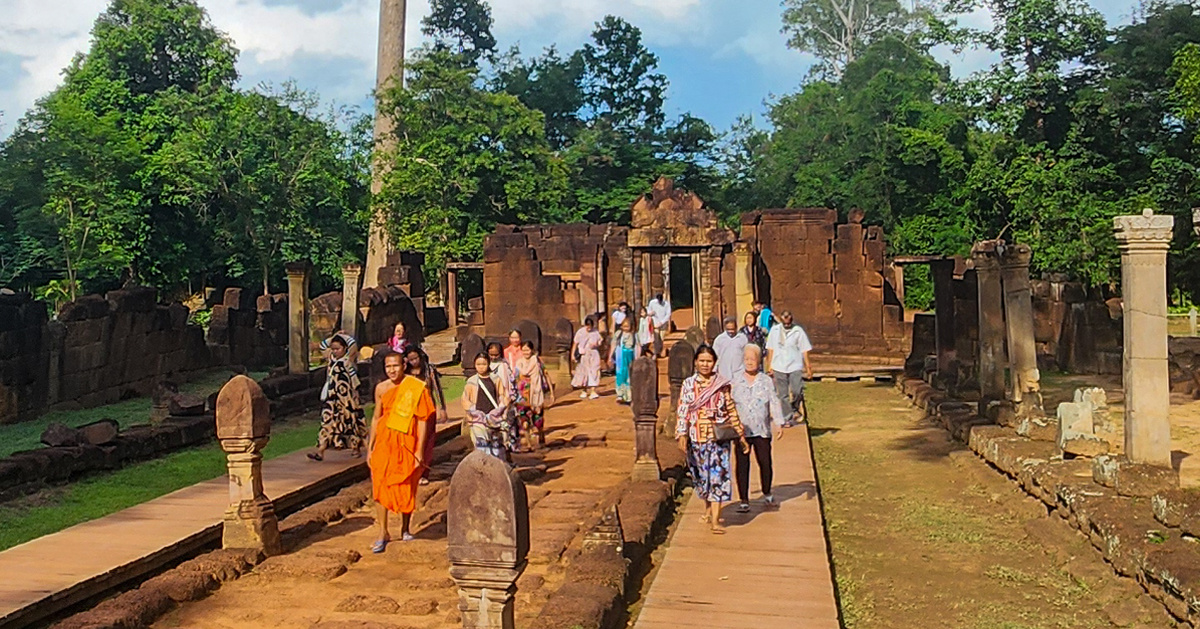
Visitor circulation has been managed precisely because ancient stone surfaces are vulnerable to wear. Barriers and prescribed routes help protect the monument while still allowing people to see the main architectural and sculptural features.
This makes a phone with a good zoom or a longer camera lens genuinely useful.
Take one wide photograph first so you remember where the scene sits within the architecture, then zoom in on faces, jewellery and smaller figures. You will often notice details in the photograph that were difficult to see from the visitor path.
Opening Hours, Angkor Pass and How Long to Spend
Banteay Srei is currently open from 7:30 AM to 5:30 PM.
It is included in the regular Angkor Pass, so there is no separate Banteay Srei admission ticket.
| Angkor Pass | Price | Validity |
|---|---|---|
| 1-day | $37 | 1 day |
| 3-day | $62 | Any 3 days within 7 days |
| 7-day | $72 | Any 7 days within 30 days |
For most visitors, 1 to 1.5 hours is comfortable. If you photograph the carvings or want to identify individual scenes, allow closer to 2 hours.
If Banteay Srei is your first temple of the trip, Angkor Enterprise currently also lists a ticket counter at Banteay Srei, so you do not necessarily have to begin at the main ticket office elsewhere.
Best Time to Visit: Go Near Opening, Not at Sunrise
You will still find travel advice recommending Banteay Srei at sunrise because of the colour of the sandstone.
There is an obvious problem: the temple currently opens at 7:30 AM.
So unless the schedule changes, do not build your day around watching sunrise from inside the temple.
The better strategy is to arrive close to opening time. Temperatures are more comfortable, the light is still relatively soft and you have a better chance of seeing the carvings before larger groups arrive.
Late afternoon is another good option because lower light creates deeper shadows across the reliefs. Just leave enough time before the 5:30 PM closing time to explore without rushing.

How to Get to Banteay Srei
Banteay Srei lies around 25 kilometres northeast of the main Angkor temple group, so it requires more travel than moving between Angkor Wat, Bayon and Ta Prohm.
A private car or driver is the most comfortable option, particularly if you are combining several temples. A tuk-tuk is also possible, although the longer road journey can become tiring in hot weather.
I would not add Banteay Srei casually to an already overloaded one-day classic circuit. It works much better as part of a dedicated second or third temple day.
If you prefer to organise the route with a guide and transport included, compare the itinerary carefully rather than choosing only by price.
The Route I Used: Pre Rup → Banteay Samré → Banteay Srei → Phnom Krom
This was the route I used, and the progression worked because the temples did not feel repetitive.
Start with Pre Rup, a 10th-century state temple dominated by its tall brick-and-laterite temple-mountain. Banteay Samré then shifts into compact Angkor Wat-period architecture before Banteay Srei changes the emphasis almost completely toward fine sandstone sculpture.
Later, Phnom Krom adds another contrast: an early hilltop temple and a much wider view toward the Tonle Sap landscape.
That made the day feel like a progression rather than a checklist.
For a three-day Angkor Pass, this kind of route also makes much better use of the extra time than simply repeating another variation of the Small Circuit.
Is Banteay Srei Worth Visiting?
Yes, especially if you have more than one day around Angkor.
I would not sacrifice Angkor Wat, Bayon or Ta Prohm on a very short first visit simply to reach Banteay Srei. But once the major monuments are covered, this is one of the strongest additions you can make.
Its appeal is not simply the pink sandstone.
Banteay Srei gives you a 10th-century temple founded by elite courtiers rather than a reigning king, a sophisticated combination of Shaivite and Vaishnavite imagery, some of Angkor’s most important narrative pediments, a notorious modern looting story and a key chapter in the development of archaeological restoration.
Its compact scale makes all of that easier to see.
Banteay Srei was not a rehearsal for greater temples.
It was a different kind of masterpiece.
Useful Travel Resources
Flights
Compare flights to Cambodia and connections across Southeast Asia.
Hotels
Compare accommodation in Siem Reap by location, current price and guest reviews.
Tours & Activities
Browse attraction tickets, Angkor tours and other things to do around Siem Reap.
Tours & Experiences
Compare guided tours and experiences around Angkor.
Airport Transfers
Arrange transport between Siem Reap Angkor International Airport and your accommodation before arrival.
eSIM
Set up mobile data before arriving in Cambodia.
Travel Insurance
Check travel insurance options before your trip.
Affiliate disclosure: This article contains affiliate links. If you book through them, I may earn a commission at no extra cost to you.