Bayon Temple Faces: Who Are the Smiling Faces of Angkor?
Bayon feels completely different from Angkor Wat.
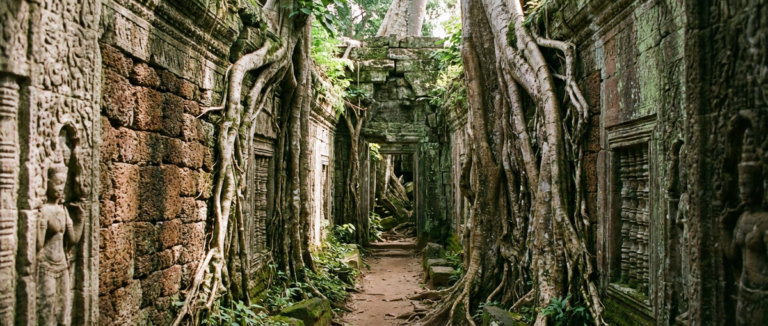
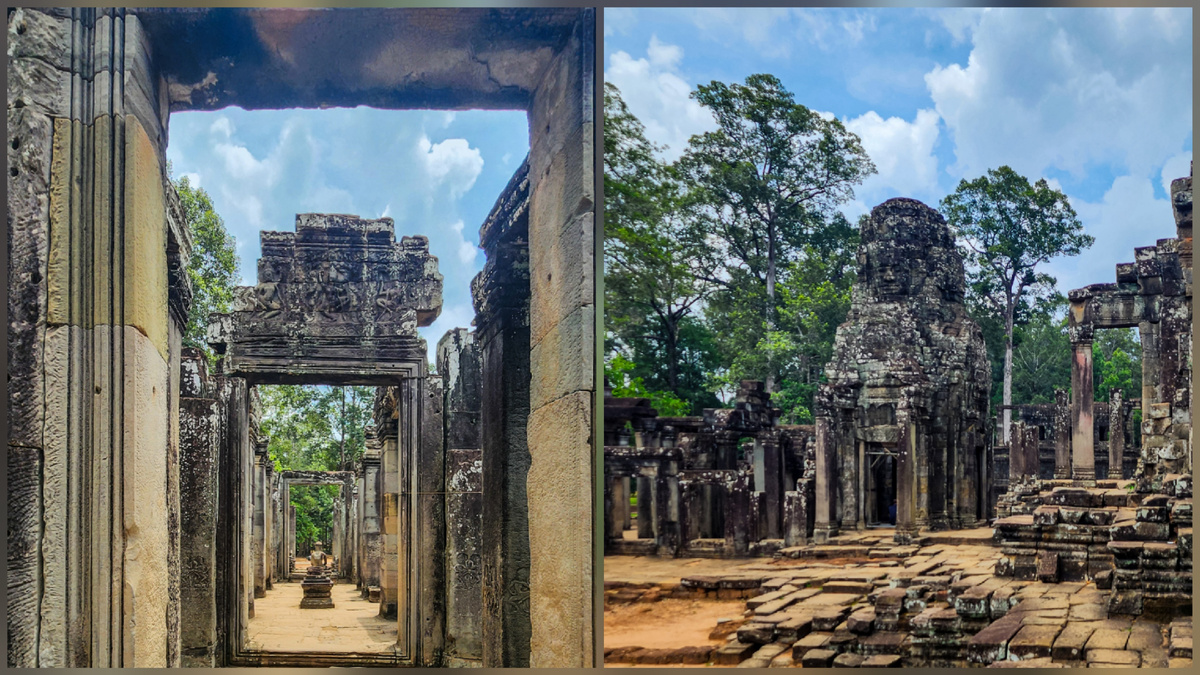
Angkor Wat opens outward through long causeways, wide galleries and carefully controlled symmetry. Bayon does the opposite. Its passages tighten around you, towers crowd together, and enormous stone faces appear above doorways and between walls.
Turn one way and another face emerges. Move a few metres and a different one seems to be watching from above.
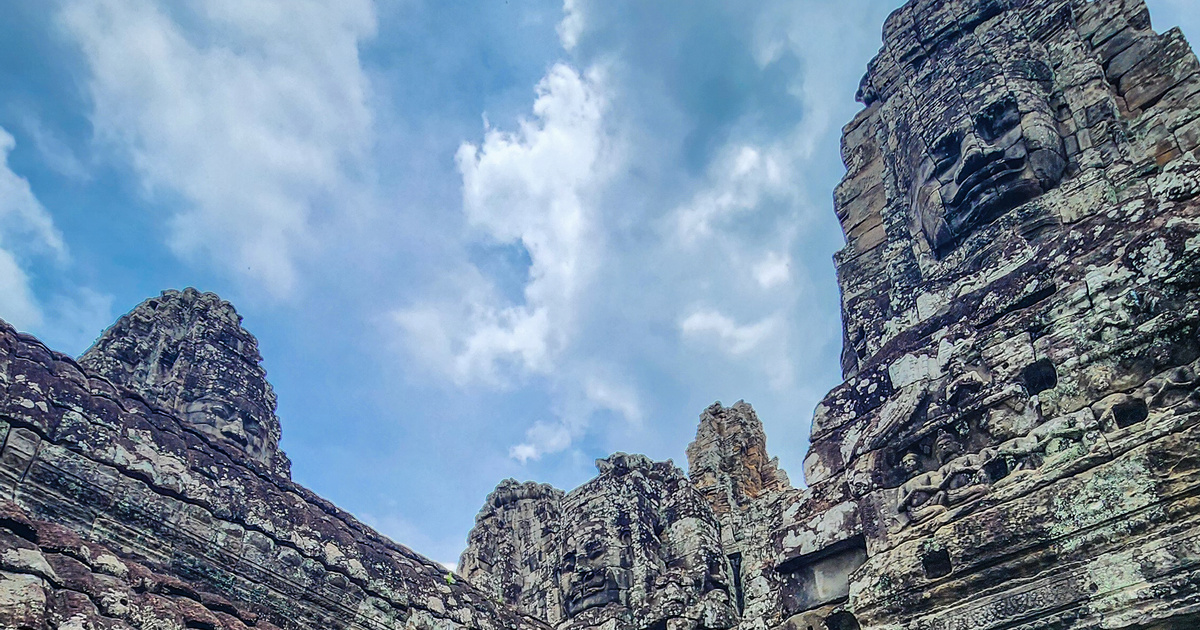
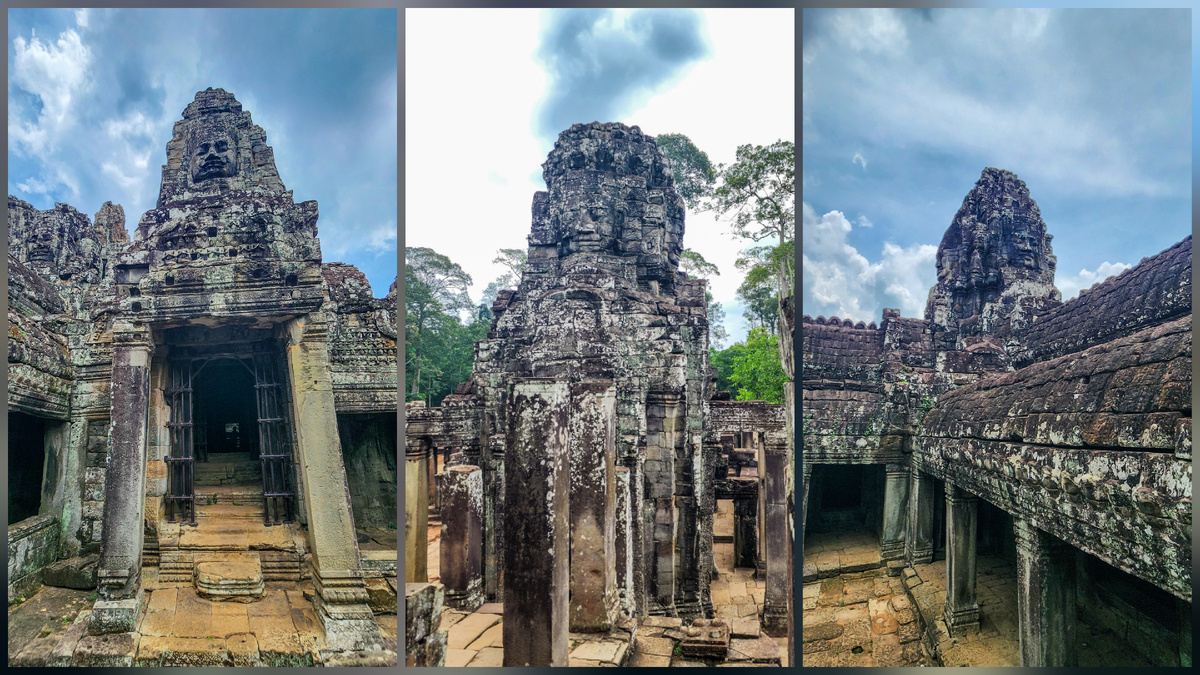
More than 170 monumental faces survive at Bayon today, each with lowered eyelids, full lips and the same restrained smile that has become one of the most recognisable images of Angkor.
But the obvious question still has no simple answer.
Who are they?
For more than a century, scholars have proposed kings, Buddhas, bodhisattvas and protective deities. The most familiar explanation identifies the faces with Avalokiteshvara, perhaps given the features of King Jayavarman VII.
More recent research suggests something even more interesting.
Perhaps the faces are not all meant to represent the same being at all.
If you are visiting Bayon as part of the classic temple circuit, see my Angkor One-Day Itinerary: Sunrise at Angkor Wat, Angkor Thom & Ta Prohm for the practical route.
Bayon Temple at a Glance
| Location | Centre of Angkor Thom |
| Built | Late 12th to early 13th century |
| King | Jayavarman VII |
| Original religion | Mahayana Buddhism |
| Known for | Monumental stone face towers |
| Surviving faces studied | 173 |
| Other highlights | Historical and everyday-life bas-reliefs |
| Later changes | Hindu and Buddhist alterations over several centuries |
Bayon at the Centre of Angkor Thom
To understand the faces, it helps to understand where Bayon stands.
The temple occupies the symbolic centre of Angkor Thom, the great royal city associated with Jayavarman VII.
Jayavarman VII came to power after one of the most dramatic periods in Khmer history. Angkor had been attacked by the Cham in 1177, and the king later led the Khmer recovery before establishing a new monumental programme across the empire.
Angkor Thom became the political heart of that programme.
Bayon stood at its centre.
That position matters.
This was not a small religious sanctuary hidden at the edge of the city. Bayon occupied one of the most important symbolic locations in the royal capital.
Its towers rose above a temple filled with Buddhist imagery, royal symbolism, historical scenes and hundreds of monumental faces looking outward in different directions.
The architecture almost forces you to ask whether religion and kingship were meant to be separated here at all.
How Many Faces Are Actually at Bayon?
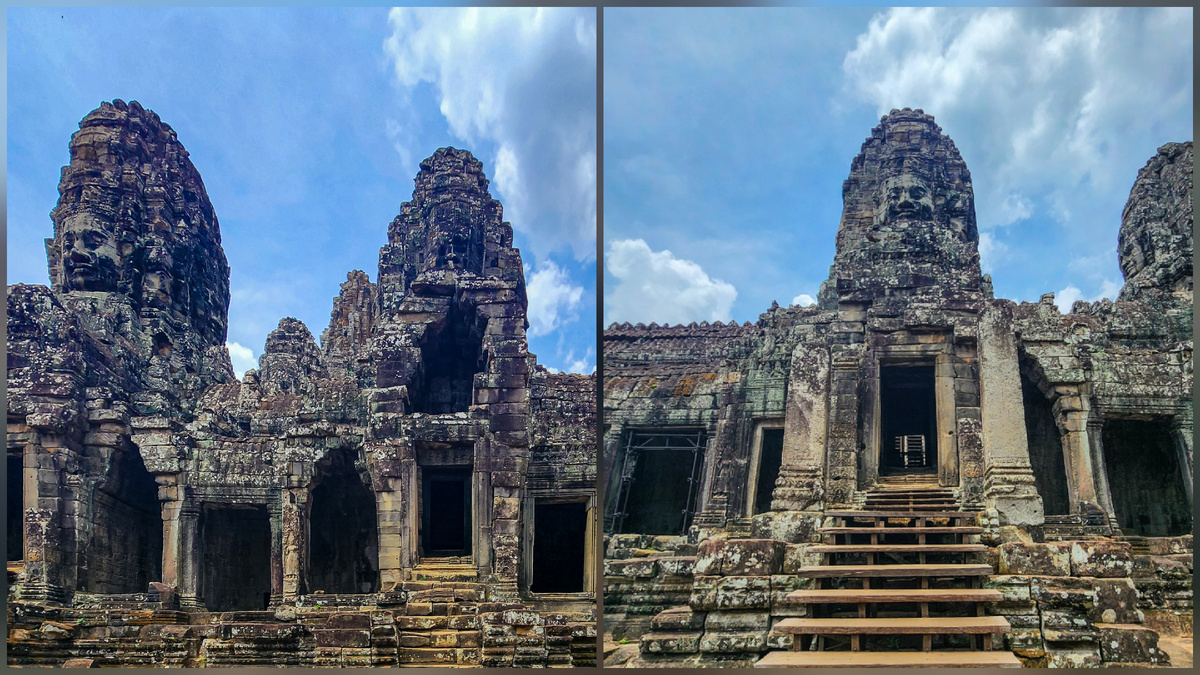
Guidebooks often repeat a neat formula: 54 towers, four faces on each tower, around 200 faces in total.
The reality is less tidy.
The number and arrangement of the original face towers remain debated, partly because the temple changed over time and some towers have been lost or altered.
Not every surviving tower has four complete faces.
A much more useful number comes from modern conservation research.
A long-running Japanese conservation project at Bayon has documented and studied 173 surviving monumental faces.
That research matters because scholars did not simply count them.
They compared their features.
And the results complicate the old idea that every face represents one identical figure.
Theory 1: Avalokiteshvara, the Bodhisattva of Compassion
For decades, one of the most influential explanations has been that the faces represent Avalokiteshvara, also known in Khmer Buddhist contexts as Lokesvara.
This interpretation fits the religious world of Jayavarman VII.
The king was a major patron of Mahayana Buddhism, and Lokesvara, the bodhisattva associated with compassion, played an important role in the art and religious ideology of his reign.
The faces also seem to fit the mood.
Their eyes are lowered rather than confrontational. Their mouths form a restrained smile. They do not appear angry or militaristic.
Seen this way, the towers become an architectural expression of compassion spreading in every direction.
The four faces looking toward the four cardinal points could represent a sacred presence extending across the kingdom.
It is an elegant explanation.
But there is a problem.
The monumental faces do not carry an obvious iconographic attribute that identifies them beyond doubt as Avalokiteshvara.
If the answer were that simple, the debate probably would have ended long ago.
Theory 2: Jayavarman VII
The second famous theory identifies the faces with Jayavarman VII himself.
There are surviving portrait sculptures traditionally associated with the king, and scholars have often noted similarities between those portraits and the Bayon faces.
The resemblance is not enough to prove that every tower is literally a royal portrait.
But the idea fits the political world of the temple.
Jayavarman VII did not separate kingship from religion in the modern sense. Royal authority, Buddhist merit, sacred protection and the well-being of the kingdom could reinforce one another.
If the Bayon faces were deliberately given features associated with the king, their meaning would have been extraordinarily powerful.
The king’s image would not simply stand in a palace.
It would become part of the sacred architecture at the centre of his capital.
Faces would look outward across Angkor Thom, linking royal authority with a divine or bodhisattva-like presence.
This is where the familiar interpretation comes from that the faces combine Jayavarman VII and Avalokiteshvara rather than representing only one or the other.
It is plausible.
It is also not proven.

Theory 3: What If the Faces Are Not All the Same?
This is the interpretation I find most interesting.
Modern research by the Japanese conservation team studying Bayon has classified the surviving faces into different visual types rather than treating all of them as copies of one figure.
Among the proposed categories are Deva, Devata and Asura.
In other words, the old question may be too simple.
Instead of asking:
Who is the person shown on every tower?
we may need to ask:
Are the towers presenting a larger sacred population?
That changes the entire reading of Bayon.
The faces could form part of a protective sacred programme surrounding the temple rather than repeating one portrait more than a hundred times.
It also helps explain why the faces look similar enough to feel unified but not necessarily identical when examined closely.
The idea does not automatically cancel the older theories.
A sacred programme could still have incorporated royal imagery or the religious ideology of Jayavarman VII.
But it makes the mystery much more complicated than “king or bodhisattva?”
What Scholars Can Actually Say Today
There is still no single universally accepted identification for the Bayon faces.
Over the history of research, they have been interpreted in several ways, including representations of:
- Jayavarman VII;
- Avalokiteshvara or Lokesvara;
- Buddha;
- Hindu deities;
- protective sacred beings;
- or combinations of royal and divine imagery.
The safest conclusion is also the most interesting.
The faces belonged to a carefully designed religious and political programme, but their exact identity cannot yet be reduced to one simple answer.
That uncertainty is not a weakness in the story.
It is the reason Bayon remains such an interesting monument.
Look Down: Bayon’s Other Great Story
The faces draw your attention upward.
The bas-reliefs make you look down.
And they tell a very different story.
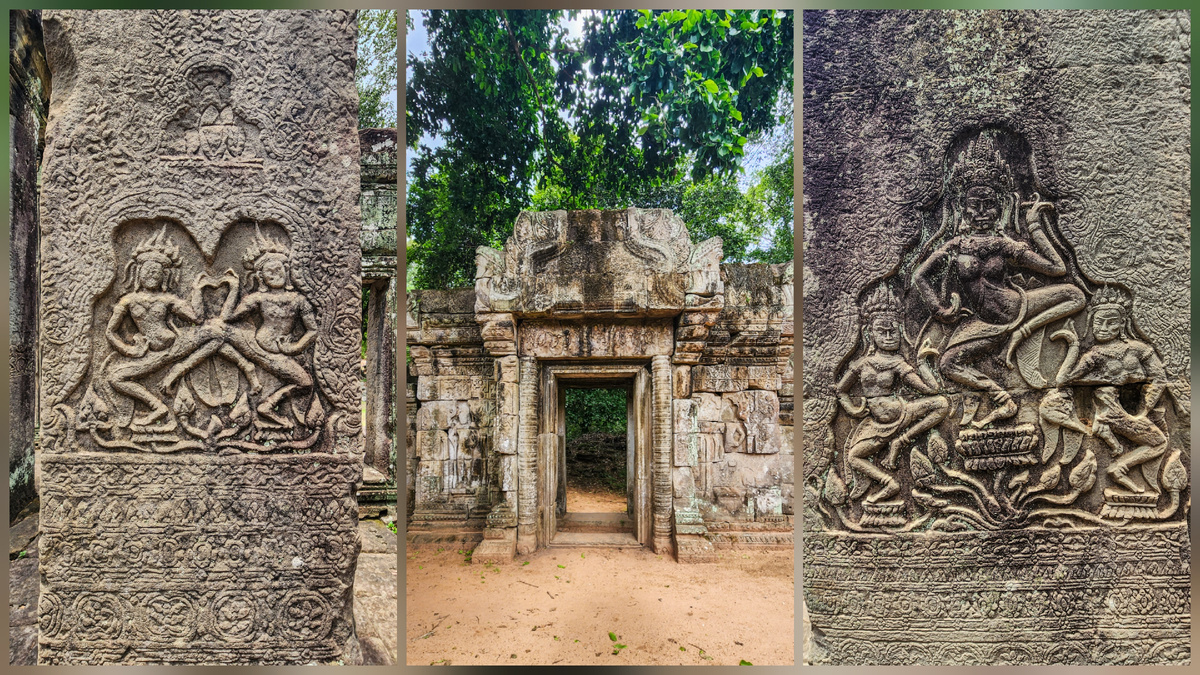
Angkor Wat is famous for monumental narratives drawn from Hindu mythology and epic literature. Bayon also contains religious imagery, but many of its reliefs are remarkable for something much more immediate.
Ordinary life.
Look closely and you can find scenes involving:
- markets;
- cooking;
- boats;
- animals;
- soldiers;
- processions;
- domestic activities;
- battles;
- people interacting in streets and settlements.
This is one of the reasons Bayon is so valuable.
Its walls do not show only gods and kings.
They preserve fragments of everyday Khmer life.
There are also military scenes connected with the conflicts between the Khmer and the Cham, giving the galleries a historical dimension that feels very different from purely mythological temple decoration.
That creates one of Bayon’s best contrasts.
Look up and you see monumental beings whose identity is still debated.
Look down and you see people cooking, travelling, fighting and going about their lives.
The mysterious and the ordinary occupy the same temple.
What Happened to Bayon After Jayavarman VII?
Bayon did not remain unchanged after the king’s death.
Religious politics shifted.
During the 13th century, particularly under the Hindu restoration associated with Jayavarman VIII, Buddhist imagery across Angkor was attacked, removed or transformed.
Bayon was affected by this iconoclastic reaction.
Its original central sanctuary contained an important image of the Buddha, but the statue was broken and removed.
Other Buddhist images were altered or replaced as the religious identity of the monument changed.
Later periods added further layers.
This is why trying to describe Bayon as a temple from one single moment is misleading.
It began as part of Jayavarman VII’s Mahayana Buddhist capital, but Hindu and later Buddhist traditions changed the monument over subsequent centuries.
The Bayon visitors see today is the result of all those phases.
Why Bayon Feels Like Someone Is Always Watching
The feeling of being surrounded by faces is not just created by their number.
It comes from the architecture.
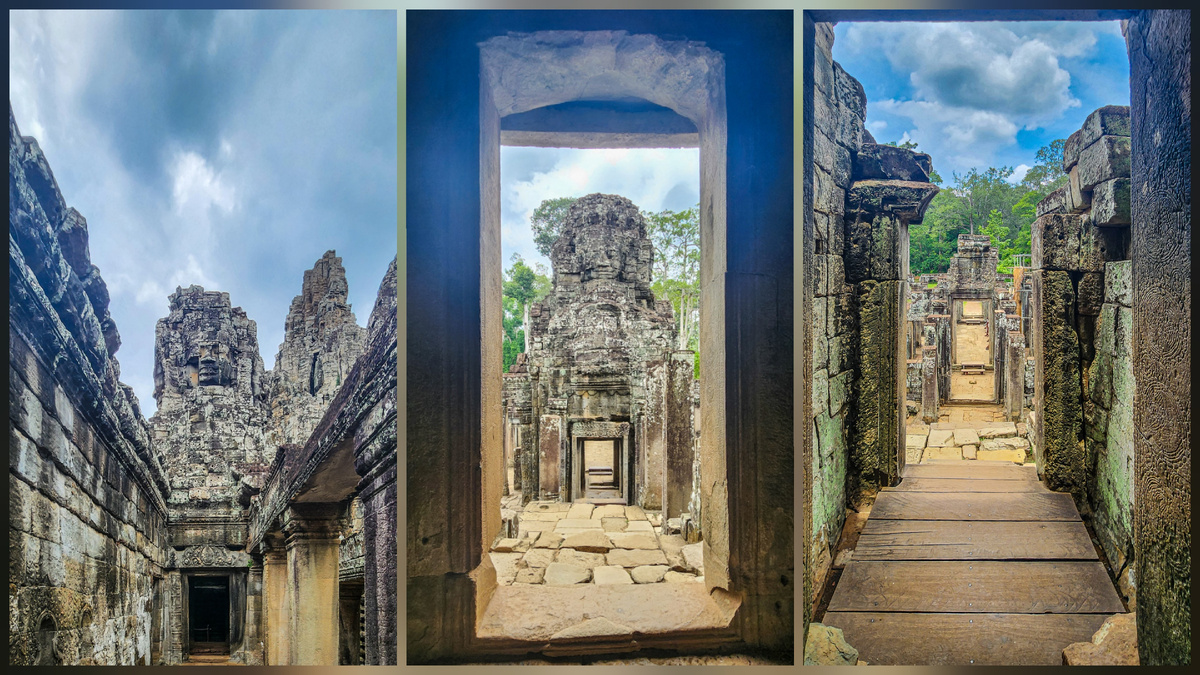
Bayon’s upper levels are dense.
The face towers stand close together, and walls repeatedly interrupt long sightlines. You rarely get the same clean, open perspective that defines Angkor Wat.
Instead, the temple reveals itself in fragments.
A face appears above a wall.
Another emerges behind a tower.
Walk around a corner and suddenly two or three are visible at once.
Then one disappears and another takes its place.
The effect changes constantly as you move.
That is why photographs do not completely capture Bayon.
A still image can show one famous stone face.
Walking through the temple gives you the strange sensation that the architecture itself keeps rearranging those faces around you.
Bayon Was Not Designed as a Simple Portrait Gallery
It is tempting to interpret the temple using modern ideas of surveillance or royal propaganda.
Jayavarman VII placed his state temple at the centre of the capital, so political meaning was certainly part of Bayon’s world.
But we should be careful not to turn interpretation into fact.
There is no inscription saying:
These faces are the king watching his subjects.
The temple operated within a religious culture where political authority, cosmology and sacred protection were deeply connected.
A face could communicate more than one idea at once.
That may be precisely why the architecture is so difficult to decode today.
The Mystery Is Still Being Studied
Bayon is not an archaeological mystery that was solved a century ago.
Research and conservation continue.
Japanese specialists have worked with Cambodian authorities and UNESCO on Bayon for decades, documenting the structure, stabilising vulnerable sections and studying its sculpture and architecture.
The systematic examination of the monumental faces is part of that work.
That makes Bayon unusual even among famous archaeological sites.
The basic question visitors ask today:
Who are these faces?
is still connected to active scholarship.
The temple continues to produce new evidence.
What to Notice When You Visit Bayon
Do not rush through Bayon looking only for the most famous face to photograph.
Start by moving slowly through the upper levels and watching how the faces appear from different angles.
Look for differences between them rather than assuming they are identical.
Then spend time with the lower galleries.
The reliefs are easy to overlook after the visual impact of the towers, but they contain some of the most human scenes anywhere in Angkor.
And remember that Bayon was not isolated.
It was the symbolic centre of Angkor Thom, built as part of Jayavarman VII’s much larger transformation of the capital.
If you are visiting Bayon as part of the main Angkor circuit, a knowledgeable guide is particularly useful here because much of what makes the temple interesting is difficult to understand from the architecture alone.
Affiliate disclosure: This article contains affiliate links. If you book through them, I may earn a commission at no extra cost to you.
Bayon and Angkor Wat: Two Different Visions of Power
Angkor Wat and Bayon are often visited only a few hours apart, but they communicate power in completely different ways.
Angkor Wat relies on distance, symmetry and monumental order.
Bayon brings power much closer.
Its towers crowd around you. Its faces appear above narrow passages. Its reliefs mix warfare, royal ceremony and daily life.
At Angkor Wat, the architecture feels controlled from a distance.
At Bayon, you feel inside it.
That difference is one reason the classic Angkor one-day route works so well. Seeing the two temples on the same day makes the contrast much easier to understand.
So Whose Faces Are They?
There is still no final answer.
Avalokiteshvara remains one of the strongest religious interpretations.
Jayavarman VII remains central to the political interpretation.
And modern research suggests the monumental faces may represent several categories of sacred beings rather than one repeated identity.
Perhaps the most important lesson is that Bayon does not need one neat solution.
The temple was created inside a world where religion, kingship, protection and cosmology overlapped.
The faces may have been designed to express that complexity.
Stand below them and choose the theory you find most convincing.
Then remember that after more than a century of archaeological research, Bayon is still keeping part of its secret.
Useful Travel Resources
Flights
Compare flights to Cambodia and other destinations in Southeast Asia.
Hotels
Compare accommodation in Siem Reap for your Angkor visit.
Tours & Activities
Browse Angkor temple tours and other Siem Reap activities.
Tours & Experiences
Compare guided Angkor experiences.
Airport Transfers
Arrange transportation between Siem Reap Angkor International Airport and your accommodation.
eSIM
Set up mobile data before arriving in Cambodia.
Travel Insurance
Check travel insurance options before your trip.
This post contains affiliate links. If you book or purchase through one of these links, I may earn a commission at no extra cost to you.