Angkor Mythology Guide: Nagas, Garuda, Kala & Temple Guardians
Once you learn to recognise a few mythological figures, Angkor begins to look completely different. A creature that first seems like decorative stonework suddenly tells you which deity is important, which myth is being referenced or whether you are approaching a sacred threshold.
The same figures appear again and again across the temples: multi-headed nagas stretching along causeways, Garudas gripping serpents, lions guarding staircases, monstrous faces above doors and three-headed elephants carrying Indra. They do not all perform the same function, and they do not always have one fixed meaning. Khmer temple art borrowed from Hindu and Buddhist mythology and adapted those figures to architecture in remarkably flexible ways.
You do not need to memorise the entire Hindu pantheon before visiting. Learn a few visual clues and the temples become much easier to read.
If you are planning your first temple day, my Angkor One-Day Itinerary: Sunrise at Angkor Wat, Angkor Thom & Ta Prohm shows where many of these creatures appear along the classic route.
Angkor Mythology at a Glance
| Figure | How to recognise it | What it is associated with |
|---|---|---|
| Naga | Multi-headed serpent | Water, protection, sacred boundaries and myth |
| Garuda | Human-bird hybrid | Vishnu, sky and conflict with nagas |
| Singha | Stylised lion | Guardianship and royal or sacred power |
| Kala | Fierce face, often without a lower jaw | Time, destruction and architectural protection |
| Makara | Composite aquatic monster | Water and mythological ornament |
| Airavata | Multi-headed elephant | Indra, rain and royal imagery |
| Nandin | Reclining bull | Shiva |
| Vanaras | Monkey warriors | Ramayana, Hanuman, Sugriva and the monkey army |
How to Use This Bestiary at the Temples
The easiest way to understand Angkorian imagery is not to ask, “What does every carving symbolise?” That usually leads to oversimplified explanations.
Instead, ask three questions: What am I looking at? Where is it placed? Which deity or story does it connect with?
A reclining bull in front of a sanctuary immediately suggests Shiva. A three-headed elephant points toward Indra. Garuda often brings Vishnu into the story. Monkey warriors usually take you into the world of the Ramayana.
The location matters too. A creature on a bridge may work differently from the same creature carved into a lintel. Khmer artists reused mythological beings in different architectural contexts, sometimes layering several meanings into the same image.
This is also one reason a knowledgeable guide can add much more than dates and temple names. Good interpretation helps connect individual carvings with the larger stories around them.
1. Naga: The Serpent That Becomes a Bridge
How to recognise it
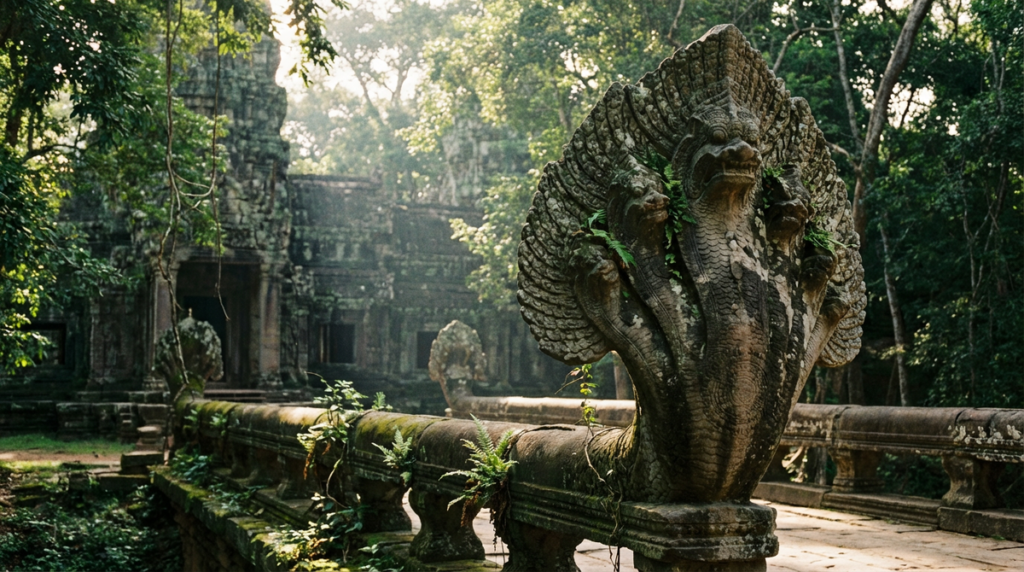
Look for a long serpent ending in a fan of multiple cobra heads, often five, seven or nine.
Where to look
Nagas appear along causeways, stairways, bridges and entrances throughout Angkor. Some of the most spectacular examples are associated with Angkor Wat and the monumental gates of Angkor Thom.
The naga is one of the most important creatures in Khmer art. In South and Southeast Asian religious traditions, nagas are powerful serpent beings closely associated with water, fertility, underground realms and protection.
At Angkor, their bodies often become architecture.
A long naga balustrade can physically guide you from ordinary ground toward a temple or city gate. Scholars have interpreted this form as a kind of symbolic bridge between the human and divine worlds, sometimes comparing it with a rainbow connecting different realms.
That does not mean every naga balustrade has only one meaning. The same creature can also be part of a specific mythological scene.
At the approaches to Angkor Thom, rows of 54 devas and 54 asuras hold the body of a giant naga. The composition evokes the Churning of the Ocean of Milk, one of the central myths represented in Khmer art.
The visitor therefore crosses a bridge that is simultaneously architecture, mythology and a symbolic transition into the sacred royal city.
2. Garuda: Vishnu’s Bird and Enemy of the Nagas
How to recognise it
Garuda usually combines a human body with avian features such as wings, claws, a beak-like face or powerful bird legs.
Where to look
Look on walls, pediments, architectural corners and compositions where Garuda appears to support a structure or grasp serpents.
Garuda is the king of birds and the vehicle of Vishnu. That makes him particularly important in a religious world where Vishnu played a major role, including at Angkor Wat.
His relationship with nagas is less peaceful than many travel explanations suggest.
In Indian mythology, Garuda and the nagas are traditional enemies. Khmer sculpture often makes that conflict visible by showing Garuda holding, defeating or standing over serpents.
This is a useful distinction when looking at carvings. If you find a large bird-like figure gripping snakes, you are not necessarily looking at a peaceful balance between sky and water. You may be seeing a visual reference to one of mythology’s great rivalries.

3. Singha: The Lion at the Staircase
How to recognise it
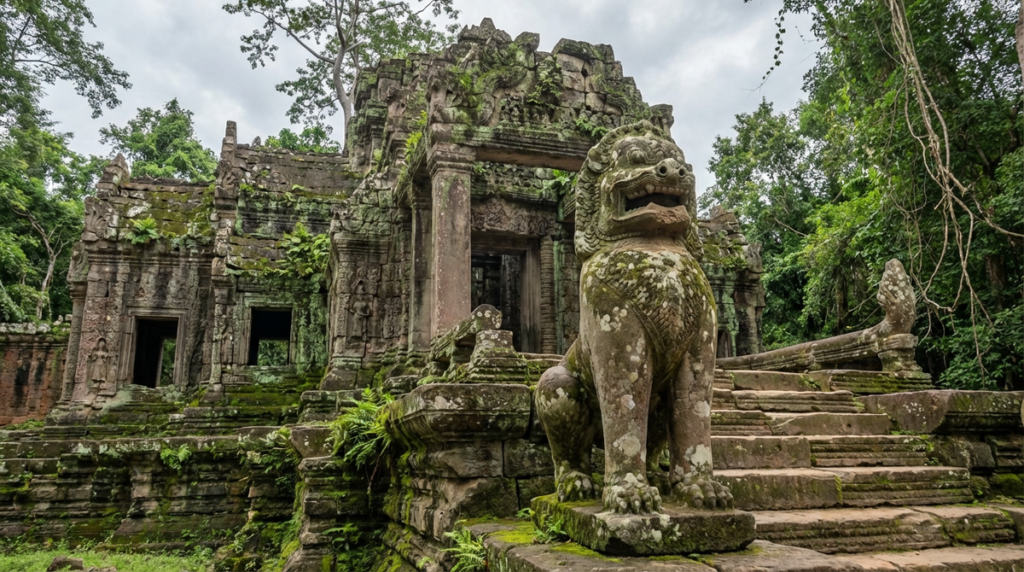
Khmer lions are highly stylised. They usually have powerful chests, prominent manes, open mouths and rigid bodies positioned beside an approach or staircase.
Where to look
Look at temple entrances, staircases and terraces. Lions appear at monuments from early Angkorian sites to the great temples around Angkor Thom.
The singha, or lion, functions primarily as a guardian and as an image of strength and authority.
Visitors sometimes hear that Khmer lions look unusual because Cambodian sculptors had never seen real lions and had to work from descriptions. That is a tempting story, but it is not necessary to explain their appearance.
Khmer artists developed their own highly stylised lion form as part of a long artistic tradition. The proportions, mane and body changed over time, which means lions can even help specialists think about the stylistic development of different periods.
If you visit Bakong, compare its guardian lions with those at later Angkorian temples. Once you start noticing the differences, “stone lion” stops being a single generic category.
4. Kala: The Face Above the Door
How to recognise it
Look for a fierce frontal face with bulging eyes, heavy features and an enormous mouth. In many representations, the lower jaw is absent or visually reduced.
Where to look
Kala often appears on lintels above doorways, sometimes at the centre of an elaborate composition of foliage and other mythological beings.
Kala is one of the easiest motifs to miss because visitors naturally look through doorways rather than above them.
Its religious associations are complex, but one important interpretation connects Kala with Time, the force that ultimately consumes everything. Mythological traditions surrounding related forms such as Kirtimukha describe an insatiable being that devours even itself until only the head remains.
This helps explain the extraordinary disembodied face seen in temple decoration.
It is safer, however, not to reduce every Kala to the idea that it is “eating evil thoughts” before a visitor enters. Its role in architectural ornament is broader than a simple supernatural security filter.
The practical rule is easier: when you approach a Khmer doorway, look up.

5. Makara: The Creature With Another World Coming Out of Its Mouth
How to recognise it
Makara is a composite aquatic creature whose form can combine features that resemble a crocodile, elephant, fish or other animals. Its exact appearance changes considerably across Indian and Southeast Asian art.
Where to look
Look at lintels, pediments and decorative architectural elements, especially where another creature, naga or vegetal ornament seems to emerge from an open mouth.
Makara belongs to the mythological world of water.
What makes it especially useful for recognising Khmer art is the way sculptors incorporated it into larger compositions. A makara may sit at the side of a lintel while foliage, nagas or other forms pour outward from its mouth.
That does not necessarily represent one creature literally giving birth to another, and there is no need to assign it a fixed meaning such as “the cycle of life”.
The more useful observation is architectural: the monster can become the visual source from which the rest of the ornament develops.
Once you learn its shape, some lintels that previously looked like pure floral decoration become much easier to decode.
6. Airavata: Indra’s Multi-Headed Elephant
How to recognise it
At Angkor, Airavata is commonly represented as a three-headed elephant.
Where to look
One of the easiest places to recognise the motif is at the monumental gates of Angkor Thom. It also appears in royal and elephant imagery elsewhere in the complex.
Airavata is the divine elephant associated with Indra, the god of storms, rain and the heavens.
That relationship gave the animal particularly powerful associations in an agricultural society where rainfall affected food, water and prosperity.
Airavata can also appear within royal visual language, connecting divine authority with kingship.
There is one simple mistake to avoid: not every elephant at Angkor is Airavata.
The Terrace of the Elephants contains many elephant images, including processional and decorative animals. When trying to identify Airavata specifically, look for the distinctive multi-headed form or a clear connection with Indra.

7. Nandin: The Bull That Tells You Shiva Is Nearby
How to recognise it
Nandin, often called Nandi, appears as a reclining or seated bull, usually facing toward a sanctuary.
Where to look
Look at temples associated with Shiva, including early Angkorian monuments such as Bakong and especially Preah Ko.
Nandin is the sacred bull and vehicle of Shiva.
For a visitor, that makes him one of the most useful figures in this entire guide. You do not need a long philosophical explanation to use the image correctly.
If you find a stone bull positioned toward a sanctuary, ask whether the temple has a strong Shaivite identity.
At early Khmer temple groups, that relationship between deity and vehicle can help you understand the religious organisation of the site before you have read a single inscription.
This is exactly the kind of visual clue that turns mythology into something practical.
8. Hanuman, Sugriva and the Vanara Army
How to recognise them
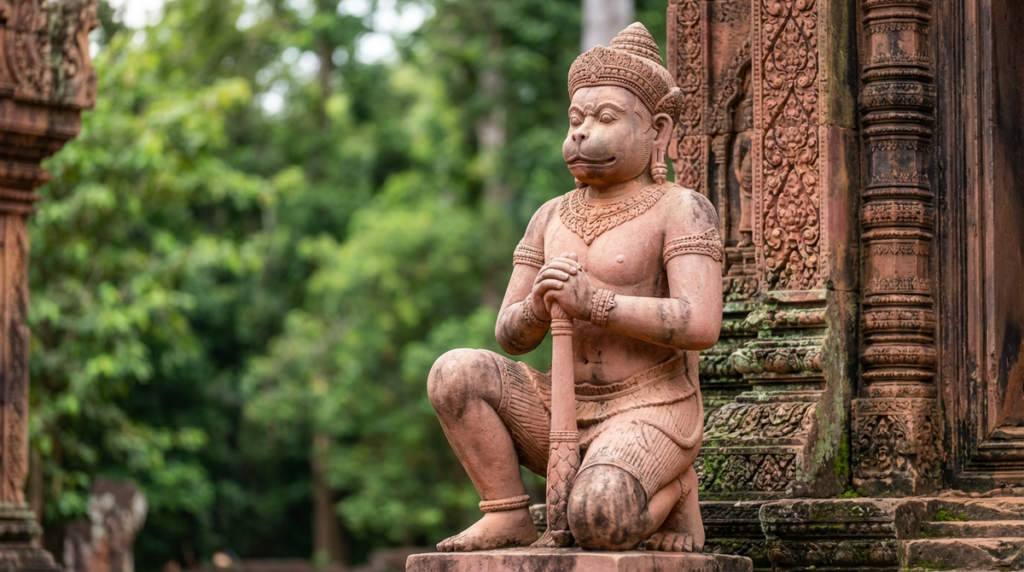
Look for human-like warriors with monkey faces, tails or other simian features.
Where to look
Monkey figures appear in narrative reliefs connected with the Ramayana, including scenes at Angkor Wat and Banteay Srei.
The biggest mistake is simple:
Not every monkey warrior is Hanuman.
Hanuman is the most famous vanara in the Ramayana, but he belongs to a much larger world of monkey heroes and soldiers. Other important figures include Sugriva and Valin, while entire armies of vanaras fight alongside Rama.
At Banteay Srei, for example, one of the famous narrative scenes involves the battle between Valin and Sugriva, with Rama intervening in the conflict.
At other Angkorian monuments, monkey warriors appear in larger episodes from the Ramayana, including the war against Ravana.
So when you see a carved monkey warrior, the useful question is not immediately “Is that Hanuman?”
Ask instead:
Which Ramayana scene am I looking at?
That will often get you much closer to the right answer.
Three Creatures Visitors Commonly Misidentify
Angkor becomes easier to read once you stop treating every similar figure as the same character.
Every monkey is not Hanuman. The Ramayana contains many vanara characters and entire monkey armies.
Every elephant is not Airavata. Look for the multi-headed elephant associated with Indra rather than identifying any carved elephant as the divine mount.
Every female celestial figure is not an apsara. Angkorian art includes dancing apsaras as well as standing devatas and other female figures. Their pose and context matter.
These distinctions may sound small, but they change the way you look at a temple. Instead of recognising a generic “mythological creature”, you begin identifying which story or deity the sculptor was referring to.
The Same Creature Can Mean Different Things
One reason Angkorian mythology is so easy to oversimplify is that these creatures do not behave like modern logos with one fixed definition.
A naga may guard a threshold, embody water, become part of a bridge and participate in the Churning of the Ocean of Milk.
Garuda can identify a connection with Vishnu while also appearing in violent confrontation with nagas.
A bull can function as an animal sculpture, a divine vehicle and an immediate clue that you are entering a Shaivite religious setting.
Placement changes meaning.
Context changes meaning.
The surrounding figures change meaning.
That is why the best way to use this guide is not to memorise eight definitions. Use the creatures as entry points into larger stories.
Try This at the Next Temple
At the next Angkor temple you visit, give yourself five minutes before reaching for the camera.
First, look for a naga along the approach or stairs. Then check the nearest doorway for Kala or another central lintel figure. Look beside the staircase for a singha, and somewhere around the sanctuary try to identify the vehicle of a deity, such as Nandin, Garuda or Airavata.
If you find monkey warriors, do not label them Hanuman immediately. Look at the rest of the scene and see whether you can work out which Ramayana episode is being shown.
Four or five identifications are enough to change the experience.
The temple stops being a mass of beautiful but anonymous ornament. You start seeing connections between architecture, gods and stories.
If you want to compare different temples and see how the same mythological vocabulary changes from one site to another, organised Angkor routes can make those contrasts easier to notice.
Angkor Is Not Just Decorated With Mythology
Angkorian artists did much more than cover religious buildings with attractive creatures.
They created a visual language.
A naga can transform a causeway into a mythological boundary. Garuda can bring Vishnu into a composition without the god himself appearing prominently. Nandin can tell you which deity a sanctuary served. Airavata points toward Indra, while monkey warriors can open an entire episode of the Ramayana.
The key is not to force every carving into one symbolic definition.
Learn to recognise the figures first.
Then look at where they stand, what surrounds them and which story the architecture is asking you to remember.
Once you can do that, Angkor stops feeling like a collection of ruins covered in mysterious ornament.
It starts becoming readable.
Useful Travel Resources
Flights
Compare flights to Cambodia and connections across Southeast Asia.
Hotels
Compare accommodation in Siem Reap by location, current price and guest reviews.
Tours & Activities
Browse attraction tickets, Angkor tours and other things to do around Siem Reap.
Tours & Experiences
Compare guided tours and experiences around Angkor.
Airport Transfers
Arrange transport between Siem Reap Angkor International Airport and your accommodation before arrival.
eSIM
Set up mobile data before arriving in Cambodia.
Travel Insurance
Check travel insurance options before your trip.
Affiliate disclosure: This article contains affiliate links. If you book through them, I may earn a commission at no extra cost to you.