
Phu Quoc vs Phuket: Which Island Fits Your Trip?
On paper, Phu Quoc vs Phuket looks like a contest between twins: two tropical islands of about the same size, long west-facing beaches, sunsets over the sea, and a marketing line that calls Phu Quoc the next Phuket. On the ground they offer different holidays. Phuket is a busy, well-connected island of separate beach towns, where the best extra days are spent at sea around Phi Phi and Phang Nga Bay and the nights can run late on Bangla Road.
Phu Quoc is quieter and newer, organised around resort zones, a theme park, a safari, a record-holding cable car and a nightly show over the water, with short airport transfers and earlier evenings. Night owls and travellers who want days at sea lean to Phuket; families chasing theme-park days and travellers who would rather not ride a scooter lean to Phu Quoc. Where you fly from often decides the rest.
Phu Quoc and Phuket side by side
The table lines up the practical basics; the sections below explain what each one changes for the holiday.
| Phuket | Phu Quoc | |
|---|---|---|
| Size | Thailand’s largest island, about 543 km² | Similar size, slightly larger |
| Air traffic | About three times Phu Quoc’s | Smaller airport, growing fast |
| Best extra days | Sea trips, an old town | Theme park, safari, cable car |
| Evenings | Late-night strip; licensed venues to 04:00 | Night market, beach bars, nightly sea show |
| Non-stop examples | Gulf hubs, Istanbul, some European cities (some seasonal), Australia, much of Asia | Mainly regional Asian hubs |
| Airport to main beaches | About 1 hour to the southern beaches | Most hotels 15–40 minutes away |
| Without a scooter | Grab, Bolt, one west-coast bus; pricey tuk-tuks | Grab, Xanh SM, metered taxis, resort bus lines |
| Swimming coasts | Main beaches on the west (Andaman) coast | West coast plus a sheltered south-east |
| Calmest sea | Roughly December–March; November and April shoulder | Dec–Mar best; late Nov and Apr transition |
| Visa-free stay | 30 days for most Western passports | 30 days, any nationality, direct arrivals only |
| Pre-arrival form | Free TDAC within three calendar days before arrival, counting the arrival day | Free pre-arrival declaration (prearrival.immigration.gov.vn) before you fly in |
A day and an evening on each island
Phuket: sea days, an old town and late nights
A Phuket day starts on the west coast, in the beach town you chose, and the island’s strongest extra days are spent on the water. Tour boats leave from piers on the east side, Rassada for the Phi Phi Islands national park and Chalong for many other day tours, so a sea day begins with a ride across the island. From Rassada, Phi Phi is about an hour by speedboat or two by ferry. Phang Nga Bay is the other standard trip, and in the dry season divers head out to the Similan Islands.
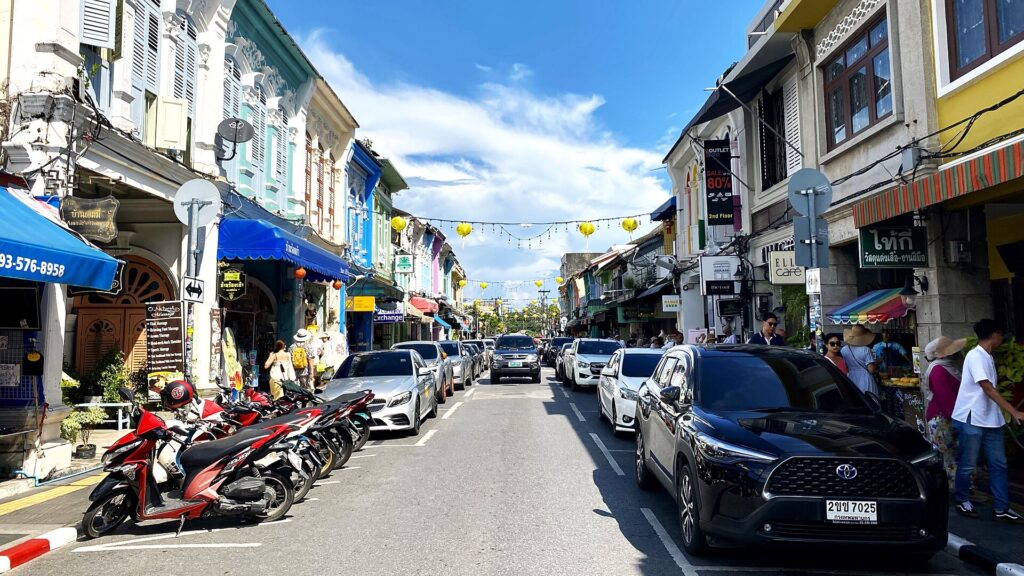
A land day belongs to Phuket Town. Its old quarter around Thalang Road is a lived-in historic town with everyday streets, and Phuket is a UNESCO Creative City of Gastronomy, so a long lunch there is part of the point. The day can end at Laem Phromthep on the southern tip, the island’s sunset viewpoint.
Evenings split three ways. Bangla Road in Patong turns pedestrian-only from about 18:00, and licensed venues there may stay open until 04:00, though many bars close earlier; entry checks apply and the minimum age is 20. On Sundays, Thalang Road becomes the Lard Yai walking-street market from about 16:00 to 22:00, a food-and-stalls evening in the old town. The other beach towns and the resorts make for a quieter night, which is why families and light sleepers do better basing themselves away from Patong.
This article contains affiliate links. If you book through one of them, I may earn a commission at no extra cost to you.
For a sea day from Phuket, compare current Phi Phi and island tours:
Phu Quoc: parks, a cable car and a sunset show, zone by zone
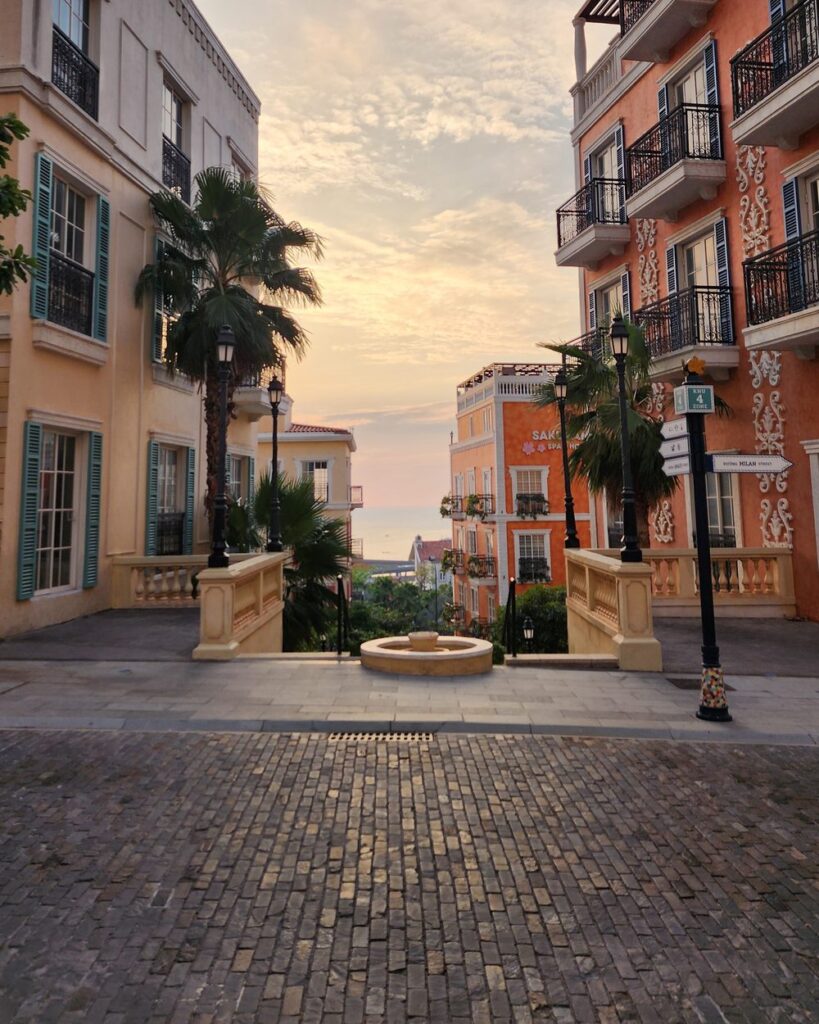
Phu Quoc’s days are shaped by zone, because its big attractions sit at opposite ends of the island and a taxi between them takes about an hour.
In the north, VinWonders, a large theme park, and Vinpearl Safari each fill most of a day, and Grand World nearby runs its own evening programme, so a family can spend the day and the evening there without a long ride. Rach Vem, on the north coast, is known for its starfish from November to April.
In the south, the Hon Thom cable car runs from An Thoi out over the sea to Hon Thom island. At 7,899.9 m it set the Guinness World Record for the longest non-stop three-rope cable car in 2018, and with a park and water park at the far end it fills half a day or more. The An Thoi islands lie off the same coast, and boat trips around them run best from December to April. The beaches here, Khem and Sao, face south-east. After dark, Sunset Town stages the Kiss of the Sea, a ticketed nightly show over the water that ends with fireworks.
In the middle, around Duong Dong and Long Beach, the day is simpler: the beach, a sunset over the sea from the west-facing sand, and the night market in Duong Dong, where many of the island’s bars also sit. The food signature is the island’s fish sauce, which carries EU protected designation of origin (PDO) status. For a different kind of late evening, a casino on the island admits foreign visitors, but clubs are few, so travellers after a late night out will find Phuket the better fit; travellers who want a show, a market dinner and an early start will find Phu Quoc suits them.
Beaches and the months the sea is calm
One swimming coast or two
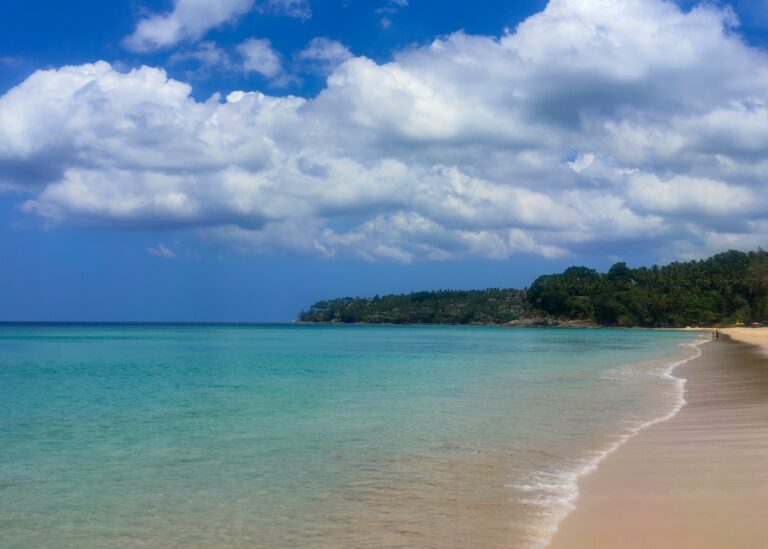
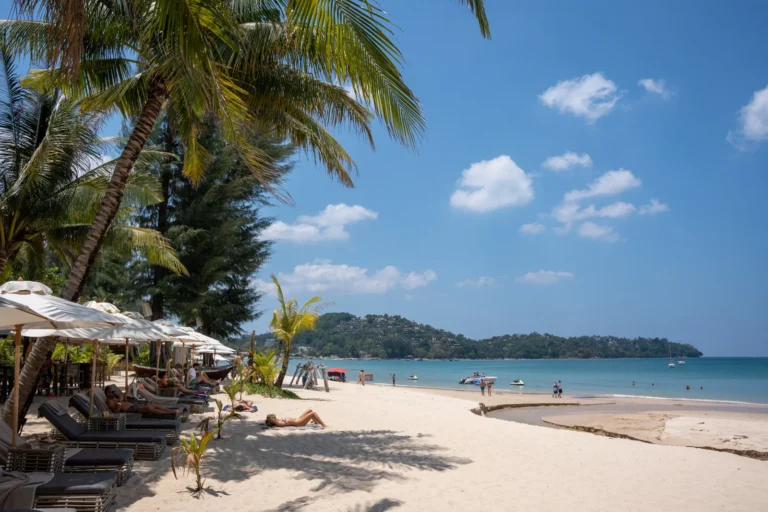
Phuket’s main swimming beaches face west onto the Andaman Sea, from Mai Khao and Nai Yang near the airport to Kata and Nai Harn in the south. Rawai, at the southern tip, is a working waterfront. The east side is mostly Phuket Town and its piers, with a few small east-facing bays such as Ao Yon on Cape Panwa.
Phu Quoc works with more than one coast. Long Beach runs for over 20 km down the west side and faces the sunset, while Khem and Sao lie on the south-east coast. The guide to the best beaches in Phu Quoc matches each one to a type of trip.
Dry season, monsoon and red flags
Phuket is at its best from roughly December to March, with November and April as shoulder months. The south-west monsoon brings the wet season from May to October, heaviest around September and October, though rain often arrives in bursts of an hour or two. A red flag means no swimming, and rip currents are a recorded risk. The main west-coast beaches take the monsoon swell; the few east-facing bays are often calmer but sit away from the main beach areas. Sea trips follow the same calendar: boats can be cancelled at short notice in the monsoon, and the Similan Islands national park closes from mid-May to mid-October (16 May to 15 October in 2026).
Phu Quoc’s most reliable beach months are December to March; late November and April are transition months, and the first showers can return at the end of April. The two peaks overlap almost exactly, so switching islands keeps you in the same high season.
Phu Quoc is wet from roughly May to October too, with August and September the wettest. The west coast turns rough then and the south-east coast around Khem and Sao becomes the sheltered side, while in the dry months the east is the exposed one. Highs sit around 30 to 33 °C all year on both. The practical wet-season difference is Phu Quoc’s second coast, though neither island is a dry alternative to the other. Phu Quoc’s month-by-month weather guide breaks this down coast by coast.
Flights, transfers and arrival paperwork
Which island your flight reaches
Phuket has non-stop flights from the Gulf hubs, Istanbul, several European cities (some seasonal) and Australia, plus a dense network across Asia and India. Phu Quoc’s international non-stops are mainly regional: Seoul, Singapore, Kuala Lumpur, Bangkok, Hong Kong, Taipei, Chinese cities and Central Asia. Compare the routes from your own departure city rather than the islands’ route lists: from some cities Phuket is the single flight, from many Asian hubs Phu Quoc is the shorter hop, and if the trip to Phu Quoc involves a connection, where you change planes matters for the visa exemption below.
From the airport to your hotel
Phuket International Airport (HKT) sits at Mai Khao, at the far north of the island, while the busiest beaches lie to the south. Patong is 50 to 60 minutes away by car and Kata about an hour, and the 16:00 to 19:00 rush adds another 30 to 45 minutes. The Smart Bus takes about two hours to Kata or Rawai.
Phu Quoc International Airport (PQC) sits mid-island: about 12 minutes to the middle of Long Beach, 20 to Duong Dong, 25 to An Thoi, Khem and Sunset Town, and 40 to Bai Dai and VinWonders in the north-west. A stay on Phuket’s southern beaches therefore means noticeably longer on the road at both ends, which matters after a long-haul flight or with tired children; north-coast bases near the airport cut the transfer. The guide from Phu Quoc airport to your hotel covers each arrival option.
Visa-free stays at a glance
Since 15 September 2026, most Western and Indian passport holders get 30 days visa-exempt in Thailand for tourism; older pages quoting a longer stay are out of date. Every arrival also needs the free Thailand Digital Arrival Card (TDAC), submitted on tdac.immigration.go.th within three calendar days before arrival, counting the arrival day.
Phu Quoc gives 30 days visa-free to any nationality, provided you fly in directly from abroad (an airside transit counts) and stay on the island. Before the flight to Phu Quoc, file the free pre-arrival declaration on prearrival.immigration.gov.vn up to three days ahead, travellers on the island exemption included, and have its QR code ready at passport control. The Phu Quoc visa guide explains what breaks the exemption.
Getting around without a scooter
Car-free travel works on both islands; the cost in time and fares differs.
Phuket: apps, one bus line and tuk-tuk fares
At Phuket airport, Grab has the authorised pickup zone; Bolt also operates on the island, but its airport pickup point, shown in the app, may be outside the terminal. An app ride from the airport to Patong runs roughly 750 to 1,250 baht, against a fixed 800 baht at the airport limousine counter. Tuk-tuks have no meters: the fare is agreed first, a few hundred baht within one beach area and more between beaches, and the apps undercut them on most trips.
Smart Bus Route 1 runs from the airport past the main west-coast beaches to Rawai for 100 baht, about every 30 minutes from morning until late evening. Songthaews link Phuket Town’s market with single beaches, which rules them out for beach-to-beach trips. Going car-free on Phuket is easy, and every change of beach is a ride with a fare attached.
Phu Quoc: app taxis and resort buses
Grab works across Phu Quoc (at the airport, pickup is beyond the terminal frontage), Xanh SM electric taxis can be booked and paid in the app, and metered Mai Linh and Vinasun taxis cover the rest. VinBus lines run the main corridors, including airport to Duong Dong and Grand World. The airport transfer is short and hops inside one zone are quick; crossing the island is the hour-long ride described above. Route-by-route options for each part of the island are in the guide to getting around Phu Quoc without a scooter.
For travellers who still want two wheels: You need a licence valid for the vehicle in the country you are visiting. Check whether your licence requires an International Driving Permit and whether your insurance covers riding. Helmets are compulsory in Vietnam, and many hire bikes in Thailand are unregistered.
Where you stay and what it costs
Beach towns versus resort zones
Phuket’s range runs from hostels to villa resorts across distinct beach towns, which makes the base the main decision: it fixes your airport time, your evening options and how many rides you take. Phu Quoc is dominated by large integrated resorts and complexes, with smaller hotels around Duong Dong and Long Beach, and suits choosing one zone and staying put. The guide to where to stay in Phu Quoc compares those zones.
Where your island budget goes
Your itinerary shapes the extras you pay for. On Phuket, allow for airport rides, tuk-tuks and app trips between beaches. On Phu Quoc, add up the attractions you plan to visit: the theme park, the safari, the cable car and the evening show each charge admission. A Phuket week built around one beach town and one or two boat trips keeps transport spending down; a Phu Quoc week with a park day, a cable-car day and a show adds up through the tickets. December to February is peak season on both islands, and Tet (Lunar New Year; the 2027 holiday runs 4 to 10 February) falls inside it.
Staying a month or longer
Beyond the visa-free periods above, both islands need a visa plan. In Thailand, an extension can be requested at an immigration office and is granted at the officer’s discretion, and the Destination Thailand Visa (DTV) exists for longer stays. On Phu Quoc, the island exemption cannot be extended, so a longer stay needs a Vietnam e-visa, which covers up to 90 days.
Bangkok Hospital Phuket and Vinmec Phu Quoc are international-standard private hospitals, and Phuket has more medical facilities overall. Phu Quoc’s long-stay trade-offs are a smaller pool of services and the construction programme covered in the questions below.
Phu Quoc or Phuket: who should pick which
Each traveller type gets one island and the reason that decides it.
- Your departure city flies non-stop to only one of them: that island, for the simpler arrival day.
- Wanting late nights out: Phuket, for Bangla Road.
- Wanting days at sea: Phuket, for Phi Phi, Phang Nga Bay and, in the dry season, the Similans.
- Not riding a scooter: Phu Quoc, for the short airport transfer and app taxis within a zone-based stay.
- Families planning theme-park and safari days: Phu Quoc, where those attractions sit together in the north.
- Couples: Phuket for sea days and an old town; Phu Quoc for a quiet resort zone with a sunset show.
- Travelling between May and October: Phu Quoc, for its more sheltered south-east coast, though neither island is dry.
- Staying one to three months: Phuket, for its deeper pool of services and accommodation.
If Phu Quoc is the fit, the Phu Quoc travel guide is the next read: it lays out the island zone by zone.
Next steps for the island you chose
Once the island and the type of base are chosen, three bookings shape the first days.
Hotels. On Phuket, check the distance from the airport; on Phu Quoc, choose the zone first and the hotel second. For December to February and Tet, compare early on either island.
Airport transfer. Phuket’s airport sits at the island’s northern tip, so the drive to the southern beaches is the longest ground leg of arrival day, and the 16:00 to 19:00 rush stretches it further. A pre-booked private transfer arranges the car before you land, so there is no app pickup to arrange on landing; transfers can be booked from either airport. On Phu Quoc, the ride is short and app taxis cover it well for most arrivals.
Hon Thom cable car. If the cable car helped you choose Phu Quoc, check current ticket inclusions and the day’s operating schedule before planning a day in the south.
Other Phu Quoc vs Phuket questions
Can you combine Phu Quoc and Phuket in one trip?
Yes, with a day set aside for the move. No direct flight links the two islands, so the route needs one connection, for example in Bangkok, Kuala Lumpur, Singapore or Hong Kong. Flying into Phu Quoc on an international flight from one of those hubs keeps the island’s direct-arrival exemption. Connecting through Ho Chi Minh City or Hanoi keeps it only if you stay airside, so avoid a domestic connection there and confirm the transit with the airline in writing. With a full day lost to the connection, the combination pays off on trips of two weeks or more.
Can you add Ho Chi Minh City or Hanoi to a Phu Quoc holiday?
Yes, with the right entry. Clearing immigration on the mainland ends the Phu Quoc exemption, and it never covers trips off the island. Passports on Vietnam’s 45-day visa-free lists, including the UK and most of the EU, can travel on; most others need a Vietnam e-visa. The Phu Quoc visa guide sets out both routes.
Will APEC 2027 construction affect a Phu Quoc trip?
Phu Quoc hosts APEC Leaders’ Week in November 2027, and new roads, an airport terminal and the first phase of a light-rail line are being built ahead of it. From late 2026 to mid-2027, expect road works and a changing airport layout, and check what is being built near the hotel before booking.