Su Muon Pagoda Phu Quoc, Vietnam: What to See & Visiting Tips
If Phu Quoc’s beaches are its postcard side, Su Muon Pagoda shows a quieter, more inward side of the island.
I visited Su Muon while driving around central and eastern Phu Quoc, Vietnam. The small temple complex sits on a green hillside not far from Duong Dong, but the atmosphere changes quickly once you arrive: temple steps, incense, old trees, colorful Buddhist statues and a large reclining Buddha higher up the slope.
There were very few people when I visited in early May, so I could walk around slowly rather than treat the pagoda as another quick sightseeing stop.
Quick answer: Su Muon Pagoda is worth visiting if you want a peaceful cultural stop away from Phu Quoc’s beaches and resorts. I would allow about 45 to 60 minutes, and it works particularly well when combined with Suoi Tranh or a longer drive toward the east coast.
Su Muon Pagoda at a Glance
Also known as: Chùa Sư Muôn / Hùng Long Tự
Location: on a hillside around 5 km from central Duong Dong
Entrance: free
Time needed: around 45 to 60 minutes
Best for: Buddhist architecture, statues, greenery, a quiet cultural stop and a break from the beach side of Phu Quoc
Good to know: there are steps and different levels to explore, so this is more than simply walking into one temple hall
Opening hours: check the current listing before your visit, as practical information can change
My Visit to Su Muon Pagoda
I came to Su Muon by car as part of a longer day around the island.
We had already been to Suoi Tranh, where the experience is mostly about walking through greenery, rocks and humid forest air. Su Muon was the next stop, and the transition worked surprisingly well.
The pagoda is also green and peaceful, but the atmosphere is completely different.
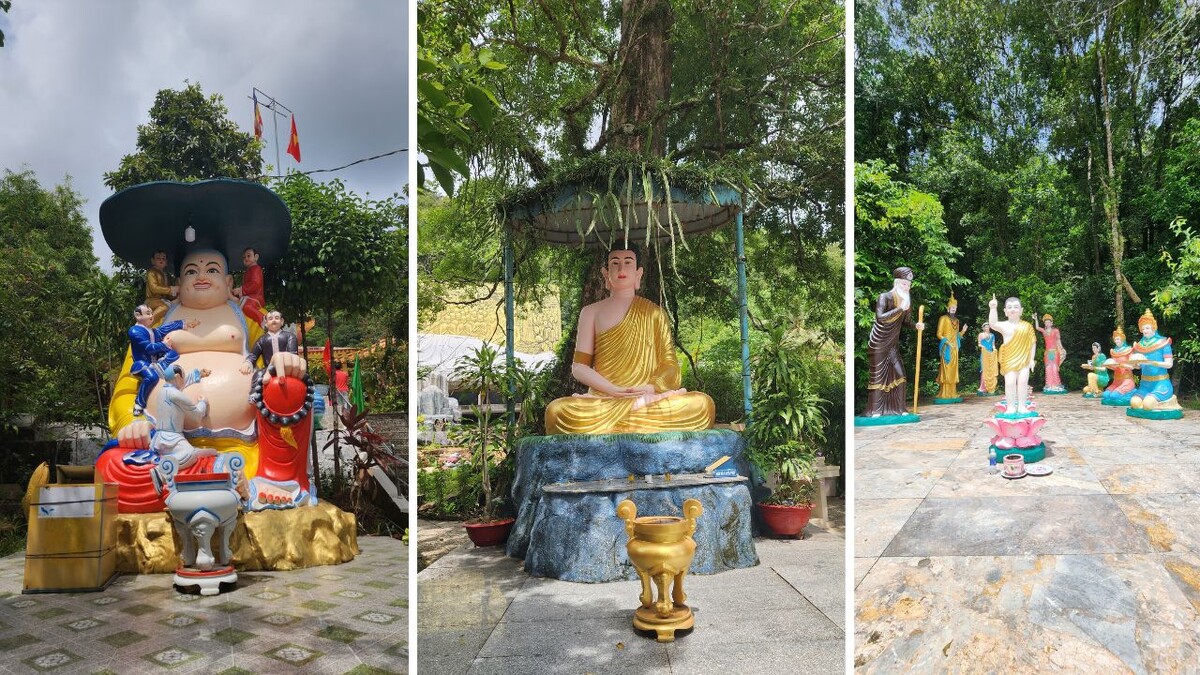
There are statues among the trees, incense around the temple, stone steps leading higher up the hillside and small details that make you slow down instead of rushing straight to one main monument.
Parking and access were straightforward when I visited, and there were very few people around.
What stayed with me most was not one individual statue. It was the contrast with the usual Phu Quoc routine of beaches, resorts and cafes.
What to See at Su Muon Pagoda
Su Muon is not a huge temple complex, but the grounds unfold gradually as you move uphill.
The Main Temple Area
The first part of the complex has the traditional elements you expect from a Vietnamese Buddhist temple: tiled roofs, stone paths, plants, altars and statues framed by dense greenery.
A short staircase leads up from the lower area.
Around the main temple you will see several Buddhist figures, including the large smiling Di Lặc, or Maitreya, with the round belly and cheerful expression that appears in temples throughout Vietnam.
This is also an active place of worship rather than a museum, so visitors may be praying or making offerings while you walk around.
The Main Hall
The main worship hall sits on a raised stone base.
Inside are Buddha figures and additional religious imagery. Remove your shoes where required and keep your voice low, particularly if people are praying.
You do not need to understand every Buddhist symbol to appreciate the space. I found the atmosphere, incense and surrounding greenery more memorable than trying to identify every figure one by one.

The Old Kơ-Nia Tree
Behind the main temple are large old trees that shade much of the hillside.
One of the best-known features of Su Muon is its huge kơ-nia tree.
You will see very different numbers online for its exact age, so I would not get too attached to whether it is supposedly 200, 300 or even more years old. The useful fact is much simpler: it is an impressive old tree and one of the most distinctive natural features of the temple grounds.
Under the canopy, the temperature feels cooler and the setting becomes noticeably quieter.
This was one of the parts of Su Muon I liked most because the temple does not feel separated from the surrounding vegetation. The trees are part of the experience rather than landscaping around it.
The Reclining Buddha and Upper Temple Area
Continue higher up the hillside and you reach one of the most visually striking parts of Su Muon.
A large white reclining Buddha lies in front of an elaborate golden relief filled with Buddhist figures, with green dragon statues around the platform and dense vegetation rising behind it.
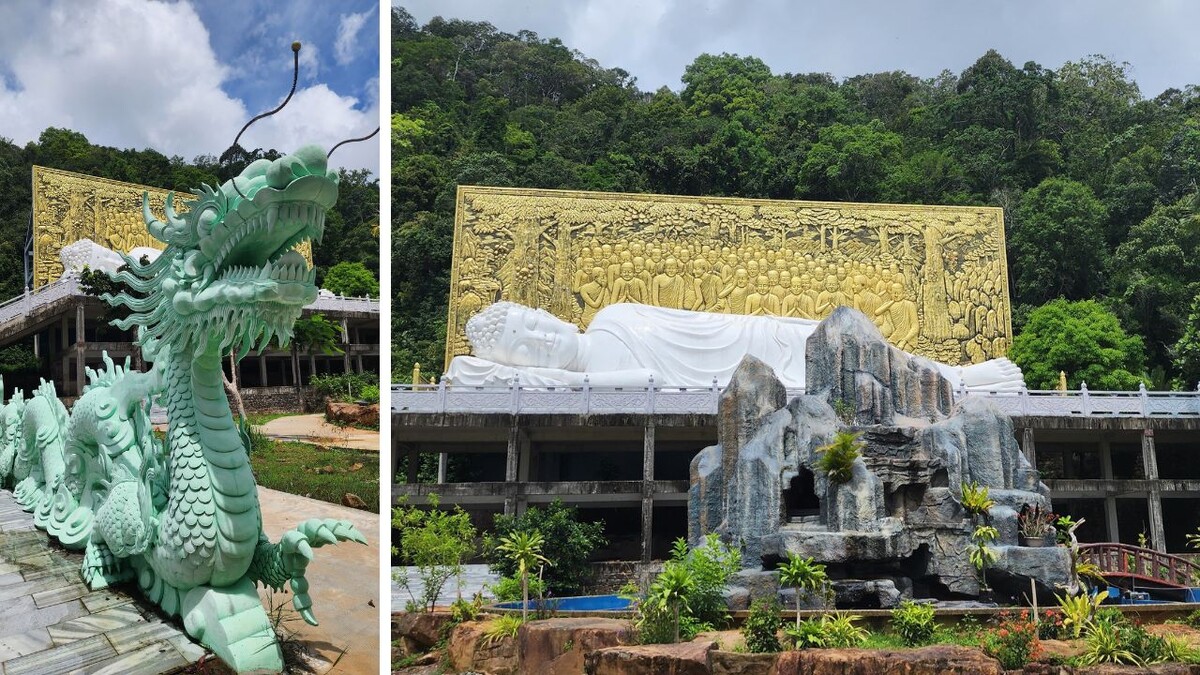
The reclining Buddha represents the Buddha entering final nirvana, but even without going deeply into Buddhist symbolism, this part of the temple feels very different from the lower courtyard.
It is larger, more dramatic and much more open.
From around the upper level, you can also look back across the roofs, trees and surrounding hillside.
If you visit Su Muon, I would not stop after seeing only the main hall. Continue uphill to this part of the complex.
The Old Well and Its Local Story
There is also an old well within the temple grounds.
Local accounts say that its water continues through the dry season and that the well once supplied water beyond the pagoda itself.
I would treat that as part of the local story surrounding Su Muon rather than something a visitor needs to prove or test.
It is one of several details that remind you this was not built as a tourist attraction. The temple existed here long before modern Phu Quoc developed around resorts and organized sightseeing.
A Short History of Su Muon Pagoda
Su Muon Pagoda is also known by its formal temple name, Hùng Long Tự.
The temple was founded in 1932 by the monk Nguyễn Kim Muôn. The original pagoda was a much simpler structure built from wood and other local materials.
The complex later suffered wartime damage and was rebuilt and expanded over the following decades.
Locals came to refer to the pagoda as Su Muon in memory of its founder, and that is the name most travelers will encounter today.
I would not call Su Muon the oldest pagoda on Phu Quoc. Other temples on the island have older histories. What matters here is that Su Muon has been part of the island’s Buddhist life for generations and remains an active place of worship rather than a historical display.
How Long Do You Need at Su Muon Pagoda?
I would allow 45 to 60 minutes.
That gives you enough time to walk through the lower temple area, look inside the main hall, spend some time around the trees and continue uphill to the reclining Buddha without treating the whole visit as a photo stop.
You can move through faster, but I do not think there is much point.
Su Muon works because it is quiet.
If you arrive, photograph the Buddha and leave twenty minutes later, you miss part of what makes the place different from the island’s larger attractions.
How to Get to Su Muon Pagoda
Su Muon is around 5 km from central Duong Dong, toward the inland road leading in the direction of Ham Ninh.
By Car or Taxi
This is the easiest option.
I visited by car, and access and parking were straightforward during my visit.
A taxi or ride-hailing car also makes sense because Su Muon is close enough to Duong Dong that you do not need your own vehicle simply to reach the temple.
By Scooter
A scooter works well if you are already comfortable riding on Phu Quoc and want to combine several central or east-coast stops in one day.
The larger advantage is flexibility. You can leave Su Muon and continue toward Suoi Tranh, Ham Ninh or farther east without arranging another ride.
If you do not want to ride at all, my Phu Quoc Without a Scooter guide explains the practical differences between the main areas and transport options around the island.
What to Wear and Temple Etiquette
Su Muon is an active Buddhist temple, so a few basic rules matter.
- Wear clothing that covers your shoulders and knees.
- Remove your shoes where required before entering worship areas.
- Keep your voice low around people who are praying.
- Avoid photographing worshippers closely without permission.
- Do not climb on statues or religious structures for photographs.
- Donations are optional. If you want to leave one, use the donation boxes provided.
You do not need special temple clothing. Modest travel clothes are enough.
When Is the Best Time to Visit?
I visited in early May and found the temple very quiet.
If possible, I would still favor the morning or later afternoon rather than the hottest part of the day. There are shaded areas under the trees, but you will also be walking uphill and between different parts of the complex.
If you mainly care about photographs, softer morning or afternoon light also works better around the statues and greenery than strong midday sun.
I would not plan the visit around an exact promise of having the temple to yourself. It is an active religious site, and visitor numbers will vary.
What to Combine With Su Muon Pagoda
Su Muon makes far more sense as part of a route than as the only reason for a full sightseeing day.
Suoi Tranh + Su Muon
This is the easiest combination.
I visited Suoi Tranh first and Su Muon afterwards, and the two stops work naturally together.
Suoi Tranh gives you forest, rocks and water. Su Muon adds the cultural and religious side of central Phu Quoc without requiring a long transfer across the island.
Suoi Tranh + Su Muon + East Coast
If you have a car or scooter and want a fuller day, continue from Su Muon toward the east coast.
This is close to the route I used on my longer drive around Phu Quoc: Suoi Tranh, Su Muon, then toward Cây Sao and the quieter east coast.
You can see how I grouped these stops in my 5-day Phu Quoc itinerary.
If you are more interested in the driving itself and how the different parts of the island connect, my Phu Quoc by Car article covers the wider loop.
Where to Stay for Su Muon Pagoda and Central Phu Quoc
You do not need to choose a hotel specifically for Su Muon, but your base changes how naturally the temple fits into the rest of the trip.
Duong Dong
Duong Dong is the most practical base if you want Su Muon to be one stop among markets, restaurants, central Phu Quoc and day trips in several directions.
The pagoda is only a short drive away, and you also have much easier access to everyday shops, food and the Night Market.
For a first visit to Phu Quoc where you plan to explore rather than stay inside one resort, this is one of the most flexible areas.
Long Beach and Cua Lap
Long Beach / Cua Lap works well if you want to stay closer to the sea but still keep Duong Dong and central-island attractions within easy reach.
Su Muon can fit into a half-day from here without turning into a major expedition.
This is a useful compromise if your trip needs both beach time and sightseeing.
Ham Ninh and the East Coast
Ham Ninh and the east coast are more niche choices.
Stay here if the quieter side of Phu Quoc is part of the attraction and you want to explore the east-coast roads, Cây Sao and small seaside properties rather than base yourself around Duong Dong nightlife.
For a first short trip, it is less convenient as an all-purpose base.
For a slower second trip, or if the east coast is specifically what interests you, it becomes much more appealing.
Is Su Muon Pagoda Worth Visiting?
For me, yes, particularly if you are already exploring central or eastern Phu Quoc.
I would not describe Su Muon as a spectacular attraction that justifies crossing the whole island for one photograph.
That is not its strength.
It is worth visiting for the combination of the hillside setting, Buddhist imagery, old trees, reclining Buddha and the feeling of stepping briefly outside the normal resort-island rhythm.
It also does not consume half a day. Around an hour is enough, which makes it easy to combine with Suoi Tranh and other stops.
If you like temples, quieter places and seeing more than beaches, I would include it.
If you have only a very short Phu Quoc trip and your priorities are beaches, Hon Thom or the island’s major attractions, it is an easy place to leave for a longer visit.
Bottom Line
Su Muon Pagoda is one of those Phu Quoc stops that makes more sense once you stop expecting every place to deliver a huge attraction.
The temple is small, green and peaceful. There are old trees, Buddhist statues, the striking reclining Buddha higher on the slope and enough detail to spend an unhurried hour walking around.
I liked it because it interrupted the familiar Phu Quoc pattern of beach, resort and cafe.
Combine it with Suoi Tranh or continue toward the east coast, and it becomes part of a much more interesting day around the island.
Some links on this page are affiliate links. If you make a booking or purchase through one of them, I may earn a small commission at no extra cost to you.