Wat Phnom in Phnom Penh: History, Legend & Visiting Guide
If there is one place in Phnom Penh that explains the city through its origins rather than its palaces, politics or twentieth-century history, it is Wat Phnom.
The temple sits on a wooded hill rising above an otherwise remarkably flat city. It is a small complex and does not require half a day, but its importance is much greater than its size suggests. According to Phnom Penh’s founding legend, this is the hill that gave the city its name.
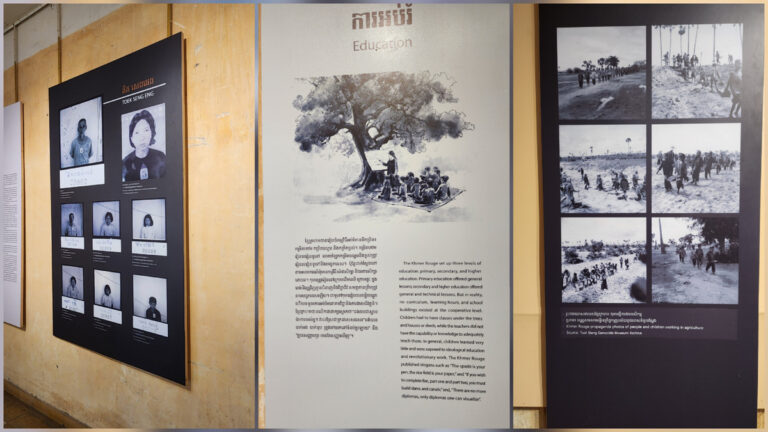
I came here in the late afternoon, near the end of my one day in Phnom Penh. Earlier that day I had visited Tuol Sleng Genocide Museum and spent hours moving through the centre.
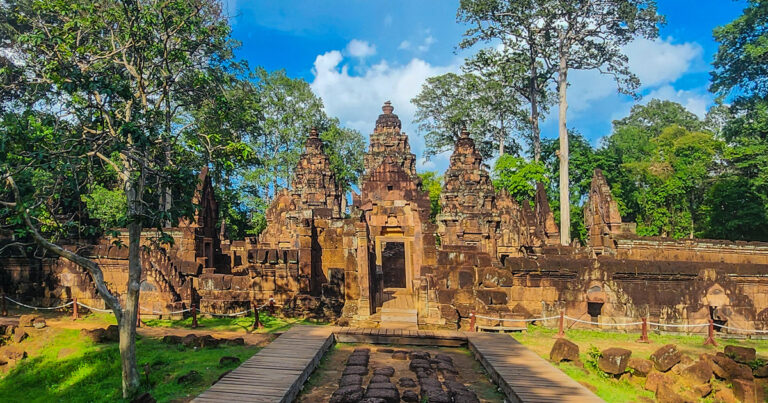
I had also recently returned from several days around Angkor, so I was coming from a completely different scale of Cambodian religious architecture.
Wat Phnom did not need to compete with Angkor. What interested me here was something else: a founding legend that is still part of the city, a working Buddhist temple and a small hill that Phnom Penh has continued to grow around for centuries.
Wat Phnom Quick Visit
| Best for | Phnom Penh’s founding story and a living Buddhist temple |
| Allow | Around 30–45 minutes |
| Best time | Early morning or late afternoon |
| Don’t miss | Main vihara, Daun Penh shrine and Ponhea Yat stupa |
| Watch for | Monkeys around the grounds |
| Easy to combine with | Central Phnom Penh and the riverfront |
What Is Wat Phnom?
Wat Phnom is a Buddhist temple complex built on an artificial hill about 27 metres high in central Phnom Penh.
For such a modest hill, it carries an unusual amount of meaning.
It is connected with the traditional story of the city’s foundation, with Cambodia’s royal history and with religious practices that continue today. Locals still come to pray and make offerings, so Wat Phnom is not simply an old monument preserved for visitors.
That mix of legend, history and ordinary religious life is what makes the place more interesting than its size initially suggests.
The Legend That Gave Phnom Penh Its Name
The traditional founding story dates Wat Phnom to 1372.
According to the legend, a woman named Daun Penh lived near the river. After flooding, she found a large tree floating in the water with sacred images inside, including Buddha statues.
Daun Penh is said to have had a mound of earth raised near her home and a sanctuary built on top to house the images.
That hill became associated with her name.
Phnom means hill, while Penh refers to Daun Penh. The city’s name is therefore traditionally understood as Penh’s Hill.
Whether every detail happened exactly as the legend describes is impossible to establish centuries later. What matters is how deeply the story became connected with Phnom Penh’s identity.
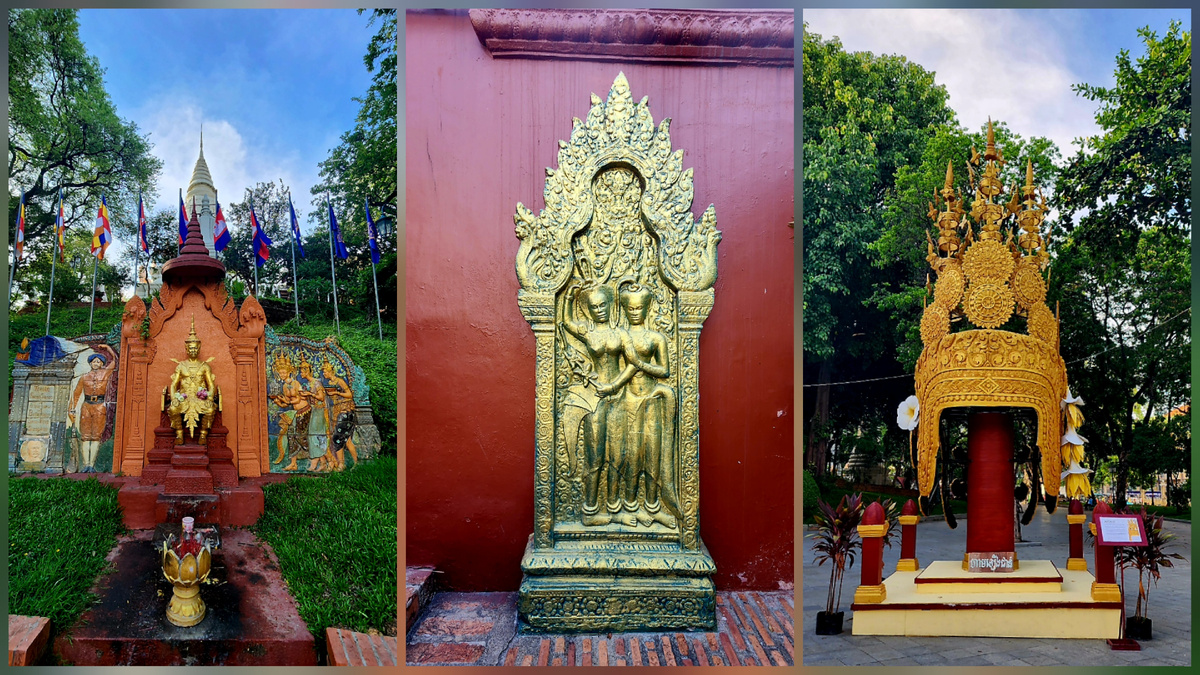
A shrine dedicated to Daun Penh still stands within the complex, and people continue to bring offerings there.
The city’s founding legend is not only something written on an information board. It remains part of the life of the temple.
From a Sacred Hill to Cambodia’s Capital
Phnom Penh did not develop from the legendary shrine directly into the modern capital in one continuous line.
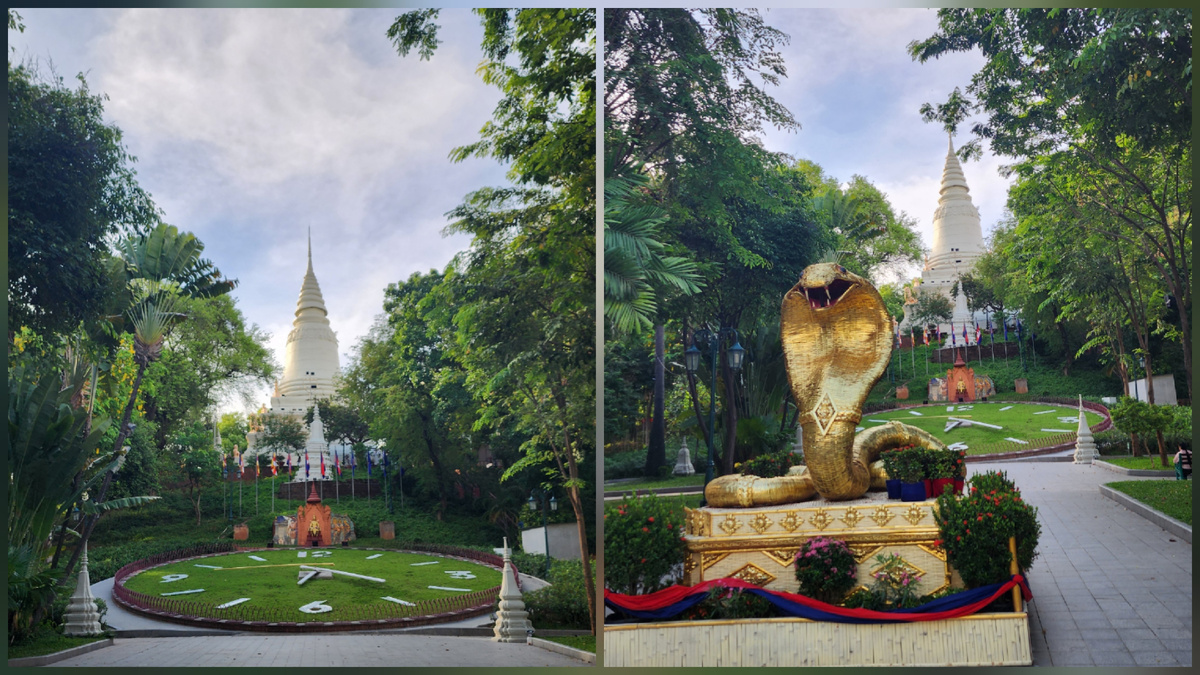
The city became particularly important in the fifteenth century under King Ponhea Yat, following the decline of Angkor as the royal centre. His large white stupa still stands behind the main temple at Wat Phnom.
The royal capital later moved elsewhere, including to Oudong.
In the nineteenth century, King Norodom moved the royal capital from Oudong back to Phnom Penh. By the end of that century, the city was developing into the political and administrative centre that would become modern Phnom Penh.
Wat Phnom had already been part of the landscape for centuries.
That gives the hill two overlapping roles. It belongs to the legendary beginning of the city, but it also sits inside the later history of Cambodia’s capital.
What to See at Wat Phnom
Wat Phnom is compact enough that you do not need a complicated route. Walk uphill, explore the main temple and then continue around the surrounding shrines and monuments.
The Main Vihara
The principal temple building contains a large Buddha image surrounded by smaller statues, offerings and decorative elements. Murals cover parts of the interior.
It is an active religious space, and people may be praying while visitors move through the building.
That immediately changes the way the temple feels. You are not entering a historic room maintained only for tourism. The space still has a religious function.
The Stupa of King Ponhea Yat
Behind the main vihara stands the large white stupa associated with King Ponhea Yat.
It is easy to focus entirely on the Daun Penh legend and overlook the royal history represented here. The stupa adds another layer to the story of the hill and its relationship with the development of Phnom Penh.
The Daun Penh Shrine
The shrine dedicated to Daun Penh is one of the most interesting parts of the complex precisely because people still use it.
Flowers and offerings connect the legendary founder of Phnom Penh with contemporary religious practice.
For me, that made the origin story feel much less distant than it would have if Daun Penh existed only in historical descriptions.
The Preah Chau Shrine
Another shrine in the complex is dedicated to Preah Chau.
People come here to ask for good fortune, including success in studies, business and other important parts of everyday life.
Together, these shrines make it clear that Wat Phnom is not primarily a museum about the city’s past. People continue to come here because the place still matters to them now.
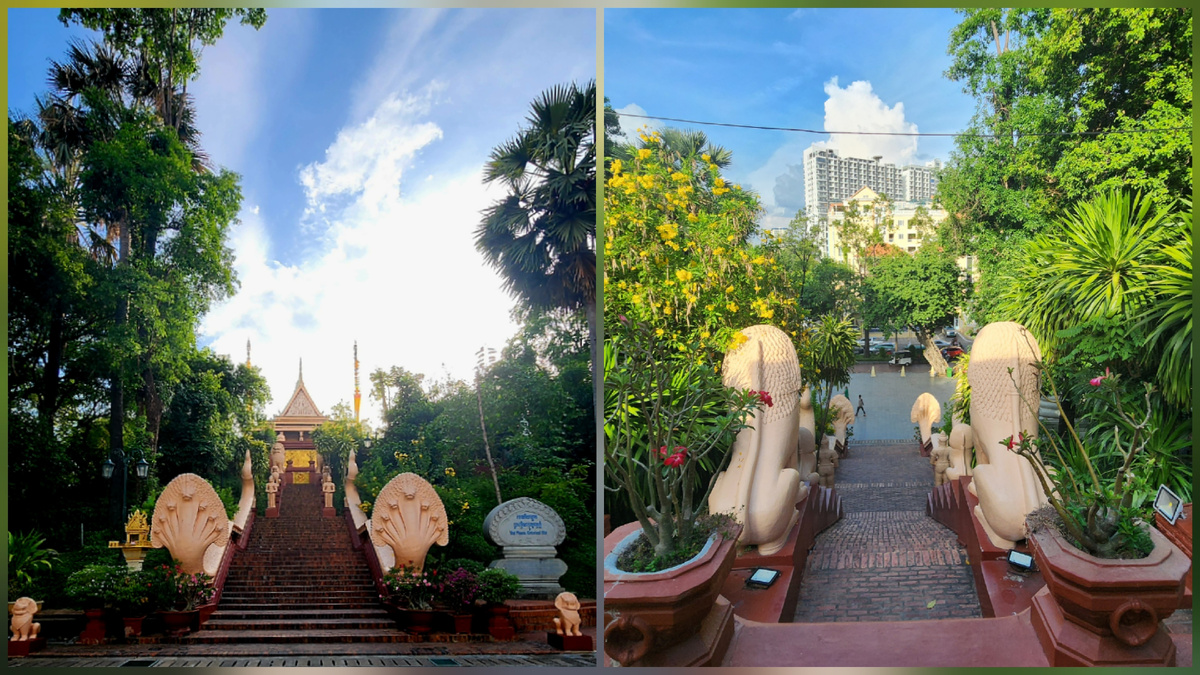
The Staircase, Lions and Nagas
The climb to Wat Phnom is short, but the atmosphere changes noticeably as you leave the road below.
Traffic, heat and tuk-tuks give way to more shade, trees and the smell of incense.
The staircase is decorated with lions and nagas, protective figures that appear throughout Cambodian religious architecture.
I found the climb less interesting as a physical ascent than as a transition from the busy streets around the hill into a quieter space above them.
Wat Phnom is not removed from Phnom Penh. It feels more like a small pause inside the city.
The Monkeys at Wat Phnom
Monkeys were also part of the grounds when I visited. They can look entertaining from a distance, but I would treat them as wild animals rather than potential photo companions.
A few basic precautions are enough:
- do not feed them;
- keep food out of sight;
- watch loose belongings;
- do not try to touch them.
They are quick and very interested in anything that might contain food, so paying attention is easier than dealing with a monkey that has already decided your bag looks interesting.
Wat Phnom After S-21: My Experience
I visited Wat Phnom late in the same day as Tuol Sleng.
After several hours of photographs, testimony and Khmer Rouge history, the temple gave me a completely different view of Phnom Penh.
At S-21, the city had been defined by one of the darkest periods of Cambodian history. Wat Phnom reminded me that Phnom Penh has a much longer memory: Buddhist worship, royal history, a founding legend and ordinary religious routines that continued beyond the twentieth-century catastrophe.
Wat Phnom did not somehow erase what I had seen earlier in the day, and I did not need it to.
For me, it simply widened the picture.
That was probably why I appreciated the place more than I expected.
Best Time to Visit Wat Phnom and How Long You Need
I came in the late afternoon, and I would choose that time again. The heat was beginning to ease, and it was comfortable to walk around the hill and temple grounds.
Early morning is another sensible option if you prefer cooler temperatures. Unless your itinerary requires it, I see little advantage in choosing the hottest part of the day.
For a straightforward visit, 30 to 45 minutes is usually enough to climb the hill, see the main temple and visit the principal shrines.
Allow closer to an hour if you want to sit for a while, spend more time around the shrines or simply avoid rushing.
Wat Phnom works particularly well toward the end of a day in central Phnom Penh, before continuing toward the riverfront or an evening cruise.
Prefer to Explore Phnom Penh with a Guide?
If you would rather visit the city’s main sights with more historical context instead of piecing everything together independently, you can compare current guided experiences.
Is Wat Phnom Worth Visiting?
Yes, particularly if you are already exploring central Phnom Penh.
It is not Cambodia’s grandest temple, and anyone arriving directly from Angkor should not expect monumental architecture on the same scale.
That is not why Wat Phnom matters.
Here you can stand on the hill associated with Daun Penh, visit a working Buddhist temple, see the stupa of a king connected with the city’s early history and then walk back down into modern Phnom Penh.
Few places in the capital compress so many layers of its identity into such a small area.
For me, the most interesting part was the connection between the city’s founding story and the way the temple is still used today. Centuries after the legend of Daun Penh, people continue to climb the hill to pray, make offerings or simply spend time beneath the trees.
Phnom Penh has become an enormous and complicated capital, but at Wat Phnom its story still begins with a hill.
Useful Travel Resources for Cambodia
Flights
Search flights
Hotels
Find hotels
Tours & Experiences
Browse Cambodia Tours & Experiences
eSIM
Get a Yesim eSIM
Transfers
Book a private transfer
Car Rental
Compare rental cars on Localrent
Travel Insurance
Check travel insurance with EKTA
Some links in this article are affiliate links. If you book through them, I may earn a small commission at no extra cost to you.