Beyond Angkor’s Temples: Hospitals, Healing & Education
Angkor is easy to imagine as a civilisation obsessed with temples.
That is what survives most visibly: towers, galleries, stone faces and enormous religious monuments.
But under Jayavarman VII, the Khmer state was also building something less spectacular and perhaps even more revealing: hospitals, centres of learning, reservoirs, roads and institutions supported by large networks of workers and settlements.
An inscription from his reign records 102 hospitals across the Khmer Empire. At Preah Khan, another inscription describes an institution supported by almost 100,000 officials, workers and dependants, including around 1,000 teachers.
And at Neak Pean, architecture, water, cosmology and ideas about healing were brought together in one of the strangest monuments in Angkor.
These places show a side of the Khmer Empire that is easy to miss if you look only at temples as religious ruins.
They show how religion, medicine, education and government could operate as parts of the same system.
If you are planning the main temples first, see my Angkor One-Day Itinerary: Sunrise at Angkor Wat, Angkor Thom & Ta Prohm.


Angkor Beyond the Temples at a Glance
| King | Jayavarman VII |
| Period | Late 12th to early 13th century |
| Religion | Mahayana Buddhism |
| Hospitals recorded | 102 across the Khmer Empire |
| Healing deity | Bhaiṣajyaguru, the Medicine Buddha |
| Neak Pean | Sacred water and healing complex |
| Preah Khan | Temple, institutional centre and place of learning |
| Preah Khan consecrated | 1191 |
| People attached to Preah Khan | 97,840 according to its foundation inscription |
| Teachers recorded at Preah Khan | About 1,000 |
Jayavarman VII and the Idea of Compassion
Jayavarman VII ruled during one of the most transformative periods in Khmer history.
He came to power after the conflict with the Cham that had shaken Angkor in the late 12th century. His reign then produced an enormous programme of construction.
Bayon became the state temple at the centre of Angkor Thom.
Ta Prohm honoured his mother.
Preah Khan was associated with his father.
Roads, rest houses and hospitals appeared across the empire.
These projects were connected with Mahayana Buddhist ideas of compassion and merit.
That does not mean Jayavarman VII created a medieval welfare state in the modern sense. Religious merit, royal authority and public works were deeply intertwined.
But his inscriptions make something clear: the state was supporting institutions that dealt with sickness, religious healing, education, administration and the movement of people across the kingdom.
The monumental temples were only the most visible part of that programme.
The 102 Hospitals of the Khmer Empire
One of the most remarkable numbers connected with Jayavarman VII is 102.
An inscription at Ta Prohm records that the king established 102 arogyasala, usually translated as hospitals, throughout his realm.
These were not modern hospitals filled with wards and surgical equipment.
They belonged to a very different medical world.
But they were organised institutions associated with treatment, staff, supplies and religious practice.
Each hospital was connected with a sanctuary containing an image of Bhaiṣajyaguru, the Medicine Buddha or Master of Healing.
That detail is important because it shows how differently illness was understood.
Medicine and religion were not separate systems.
Physical treatment, medicinal substances, Buddhist ritual and sacred protection could all belong to the same institution.
Several hospital chapels survive around the Angkor area today. They are small compared with monuments such as Angkor Wat or Bayon, but historically they represent something just as interesting: a network repeated across a huge empire.
What Did an Angkorian Hospital Actually Do?
The surviving inscriptions give us a glimpse of an organised medical system rather than simply a shrine where people prayed to recover.
They refer to personnel, supplies and medicinal substances associated with the hospitals.
Doctors and other attendants formed part of the organisation, while the institutions required regular provisioning.
At the same time, images of the Medicine Buddha occupied the sacred centre of the hospital complex.
So an Angkorian hospital cannot be understood using only a modern category such as “clinic”.
It combined things we would now separate into different fields:
medicine, pharmacy, religion, ritual and state administration.
That may be one of the most important things these sites tell us about Angkor.
The Khmer did not necessarily draw a line between treating the body and restoring spiritual balance.
Neak Pean: Healing Water, Not a Medieval Spa
Neak Pean is one of the easiest places in Angkor to misunderstand.
Today you approach it along a wooden walkway over water. At the centre is a small temple standing on an island, surrounded by pools.
It is peaceful enough that describing it as an ancient spa sounds tempting.
But that description is too modern.
Neak Pean was a sacred healing landscape where water, Buddhist belief and cosmology came together.
Its name is usually translated as “Entwined Serpents”, referring to the nagas wrapped around the base of the central sanctuary.
The island originally stood at the centre of the enormous Jayatataka reservoir, built during the reign of Jayavarman VII.
Preah Khan lies immediately west of that former reservoir.
The two monuments therefore belonged to the same much larger designed landscape.
The Sacred Lake Behind Neak Pean
The layout of Neak Pean was inspired by Lake Anavatapta, a mythical lake known from Indian religious traditions.
Its waters were believed to have purifying and healing properties.
At Neak Pean, that celestial geography was recreated in stone and water.
A large central pool is surrounded by four smaller pools aligned with the cardinal directions.
Water could pass from the central pool through sculpted outlets into the smaller basins.
Those outlets take four different forms:
- a human head in the east;
- a lion in the south;
- a horse in the west;
- an elephant in the north.
They were associated with the sacred rivers flowing from the mythical lake.
The result was not simply a clever hydraulic arrangement.
The architecture turned the act of water moving from one basin to another into part of a sacred cosmology.
Was Neak Pean Really a Hospital?
This is where the story needs a little caution.
Neak Pean is strongly associated with healing and purification, and some descriptions call it an ancient hospital.
But it should not be imagined as one of Jayavarman VII’s 102 hospitals with patients lying around the pools waiting for treatment.
The archaeological evidence is more complicated than that.
Neak Pean represents the religious and symbolic side of healing particularly clearly.
The hospital network represents the more institutional side.
Together they show why it can be misleading to divide Angkorian medicine neatly into “science” and “religion”.
For the people who created these places, sacred water, Medicine Buddha imagery, herbal remedies and physical treatment could belong to the same understanding of illness and recovery.
That makes Neak Pean far more interesting than the nickname “medieval spa”.

Four Pools, Four Directions and Several Meanings
There is another reason Neak Pean resists a simple explanation.
The same architecture could carry several meanings at once.
The pools reproduced the mythical landscape of Lake Anavatapta.
Their water was associated with purification and healing.
Researchers have also connected the arrangement with traditional Khmer concepts of the elements and bodily balance.
These interpretations do not necessarily contradict one another.
Angkorian architecture frequently worked on several levels simultaneously.
A reservoir could manage water and represent a cosmic ocean.
A temple could be a religious sanctuary and a statement of royal authority.
At Neak Pean, a system of pools could be hydraulic, therapeutic and cosmological at the same time.
Preah Khan: Much More Than a Temple
A short distance away, Preah Khan reveals another side of Jayavarman VII’s kingdom.
It was consecrated in 1191 and was connected with the king’s victory over the Cham.
The principal image honoured his father through the form of Avalokiteshvara, just as nearby Ta Prohm honoured his mother through Prajnaparamita.
But describing Preah Khan simply as a temple does not come close to explaining its scale.
Its foundation inscription describes an enormous organisation involving religious personnel, administrators, workers, dancers, teachers and dependent communities.
Preah Khan functioned simultaneously as a sacred complex, institutional centre, city and place of learning.
That is why it is often described as a Buddhist university.
Was Preah Khan Really a University?
Yes, with an important qualification.
Calling Preah Khan a “university” helps modern visitors understand that organised teaching took place there.
But it was not a university in the modern sense of lecture halls, academic departments and independent faculties.
Education was integrated into a much larger religious institution.
The Preah Khan inscription records around 1,000 teachers.
Recent Cambodian research also describes the complex as a major centre for the education of Buddhist monks and royal scholars.
So the educational role was substantial.
But learning, worship, administration and royal patronage were not separate organisations occupying the same neighbourhood.
They were parts of one enormous institution.
That distinction tells us more about Angkor than simply declaring that Cambodia had a university in the 12th century.
Nearly 100,000 People Behind Preah Khan
The numbers recorded at Preah Khan are extraordinary.
Its foundation inscription describes 97,840 attendants and servants associated with the institution, including approximately:
- 1,000 teachers;
- 1,000 dancers;
- a large body of religious and administrative personnel;
- workers and communities responsible for supporting the complex.
This does not mean almost 100,000 people lived inside the temple walls.
The institution depended on settlements, agricultural production and labour far beyond the central sanctuary.
That is precisely why the number is so revealing.
A major Angkorian temple was not simply a building.
It sat at the centre of an economic network.
Land, rice, labour, ritual specialists, teachers and administrators all supported the institution.
What visitors see today is the stone centre of something much larger that has mostly disappeared.

What the Preah Khan Inscription Tells Us
The inscription is unusually valuable because it gives the ruins an administrative dimension.
It records hundreds of shrines and sacred images.
Offerings included food, clothing and perfume.
The wealth attached to the institution included precious metals, gems and enormous numbers of pearls.
Even mosquito nets appear among the provisions assigned to sacred images.
That kind of detail is useful because it brings Angkor down from the level of kings and monuments.
A complex such as Preah Khan had to function every day.
People had to store food, maintain buildings, teach, perform rituals, organise supplies and administer the resources on which the institution depended.
The Khmer Empire was capable not only of constructing monumental architecture.
It was capable of maintaining enormous organisations around it.
The Mysterious Two-Storey Building at Preah Khan
There is one structure at Preah Khan that looks almost out of place.
It is a two-storey building supported by rows of round stone columns.
Its appearance is unusual enough that visitors sometimes compare it with Classical Greek architecture.
Its original purpose remains uncertain.
One influential theory identifies it as a granary, which would fit the enormous amount of food required to support an institution of this scale.
Other functions have also been proposed.
There is not enough evidence to label it confidently.
That uncertainty makes the building more interesting, not less.
It is a reminder that archaeologists can reconstruct surprisingly detailed parts of Angkorian administration from inscriptions while still being unable to explain exactly what a prominent surviving building was used for.
What Neak Pean and Preah Khan Tell Us About Angkor
Put the two places together and a very different picture of Angkor begins to emerge.
Neak Pean shows a culture in which healing could involve water, cosmology, purification and Buddhist belief.
The 102 hospitals show that Jayavarman VII’s government also created a geographically distributed medical network.
Preah Khan shows organised education on a substantial scale.
Its inscription reveals the labour, food and administration necessary to maintain a major royal institution.
None of this existed separately from religion.
That is perhaps the biggest difference from the way we would organise the same functions today.
A temple could also be an administrative centre.
A sacred image could stand inside a medical institution.
A monastery could also be a place of education.
A reservoir could provide water while simultaneously recreating a mythical landscape.
The categories overlap because the society that built Angkor understood them differently.

What to Notice When You Visit
At Neak Pean, look beyond the central shrine.
The important feature is the entire water arrangement: the central pool, the four smaller pools and the sculpted outlets that once carried water between them.
Also remember that the water surrounding the island today belongs to the landscape of the former Jayatataka reservoir.
At Preah Khan, do the opposite.
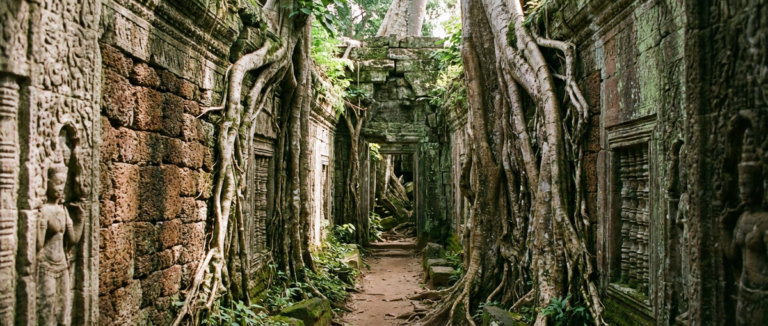
Do not focus only on one photogenic doorway or tree-covered corridor.
Look at the scale of the enclosures and imagine the institution extending outward into villages, fields and communities that supplied it.
Find the unusual two-storey columned building and remember that its purpose is still debated.
And think about what has disappeared.
Almost 100,000 people could be connected administratively and economically with Preah Khan, yet the part that survives most visibly is stone.
That is one reason Angkor can be deceptive.
Its temples survived much better than the society around them.
Angkor Was More Than a City of Temples
The spectacular architecture of Angkor can make everything else disappear.
Angkor Wat gives us the image of imperial engineering.
Bayon gives us monumental faces and royal Buddhist ideology.
Ta Prohm shows a vast religious institution transformed by centuries of vegetation.
But hospitals, healing sanctuaries and centres of learning reveal something else.
They show an empire trying to organise people as well as stone.
Jayavarman VII’s 102 hospitals required personnel and supplies.
Neak Pean translated ideas of healing into architecture and water.
Preah Khan depended on teachers, religious specialists, administrators, workers and supporting settlements on a scale that is difficult to imagine when walking through its quiet ruins today.
The temples were not separate from Khmer society.
They were where religion, government, economics, education and social organisation met.
Once you see that, Angkor stops looking like a collection of abandoned monuments.
It starts looking like a city and an empire again.
Affiliate disclosure: This article contains affiliate links. If you book through them, I may earn a commission at no extra cost to you.
Useful Travel Resources
Flights
Compare flights to Cambodia and other destinations in Southeast Asia.
Hotels
Compare accommodation in Siem Reap for your Angkor visit.
Tours & Activities
Browse Angkor tours and other Siem Reap activities.
Tours & Experiences
Compare guided Angkor experiences.
Airport Transfers
Arrange transportation between Siem Reap Angkor International Airport and your accommodation.
eSIM
Set up mobile data before arriving in Cambodia.
Travel Insurance
Check travel insurance options before your trip.
This post contains affiliate links. If you book or purchase through one of these links, I may earn a commission at no extra cost to you.