Champa Kingdom: The History Behind My Son and Central Vietnam
A stone altar in Da Nang and a brick tower at My Son can feel like separate sights until you understand who made them. Both belong to the world of Champa, whose rulers built sanctuaries along the coast of what is now central and southern Vietnam.
The Champa Kingdom developed through a changing network of coastal territories. Maritime connections, Hindu worship and periods of Buddhist patronage shaped its monuments. Cham communities and traditions continue today, long after the loss of their political autonomy.
That history gives you something useful to take into a museum or temple: a way to recognise the figures, understand the buildings and connect places that otherwise seem unrelated.
This article contains affiliate links. I may earn a commission if you book through them, at no extra cost to you.
What was Champa, and who were the Cham?
Cham is an Austronesian language, part of the broad language family that includes Malay and Indonesian. This helps explain why Champa’s cultural connections reach across maritime Southeast Asia as well as into mainland Vietnam.
Trade carried Indian religious ideas, artistic models and Sanskrit to the coast. Local rulers and craftspeople adapted them. The result was a Cham tradition with its own forms of worship and sculpture.
The familiar story gives Champa a founding date of AD 192, following a rebellion against Han rule and the emergence of Linyi, known in Vietnamese as Lam Ap. The relationship between Linyi and the later territories called Champa is disputed, however. Early coastal polities developed in different territories, and their relationship cannot be reduced to one uninterrupted state.
Champa developed over centuries, with different centres of power gaining and losing influence along the coast.
A coastal kingdom with several centres
Maps often divide Champa into five historical regions. They help locate the places you can visit, but should not be read as five permanent provinces with fixed borders and one government throughout Champa’s history.
Power shifted between coastal territories. Different centres could gain prominence, compete or form wider political relationships.
| Historical name | Geographic reference for a visitor | Place or connection to recognise |
|---|---|---|
| Indrapura | Dong Duong, in the wider central coastal region | An important Buddhist centre |
| Amaravati | The Thu Bon valley, including Tra Kieu and My Son | My Son’s temple sanctuary and the political centre at Tra Kieu |
| Vijaya | The Quy Nhon area | A major later centre of Cham power |
| Kauthara | The Nha Trang area | Po Nagar and the worship of its goddess |
| Panduranga | The Phan Rang area and neighbouring southern territories | Later Cham rule and continuing Cham traditions |
These names also explain the range of objects in Da Nang’s Museum of Cham Sculpture. Its collection brings material from different sites together; it does not represent one city or a single moment in time.
Planning to explore the coast around the Thu Bon valley? My Hoi An travel guide covers the modern town, its sights and accommodation.
Why the sea mattered, and what lay behind the ports
Champa’s coastal position connected it with trading routes across Southeast Asia and towards China and India. River routes linked the coast with inland communities and resources.
Ships are only part of that story. Agriculture, fishing and forest products also supported the economy. Describing Champa as a civilisation that lived entirely from the ocean would leave out the people and production that supplied its ports.
This is useful context when looking at a map of central Vietnam. A sanctuary inland, a settlement in a river valley and a trading coast could belong to the same regional economy. The temples were supported by a much larger inhabited world than the ruins alone reveal.
Shiva, royal patronage and the temples at My Son

Shiva was a major focus of royal worship. At My Son, successive rulers dedicated and renewed temples over centuries. UNESCO dates the sanctuary’s development between the fourth and thirteenth centuries.
The linga, a sacred emblem of Shiva, is one of the forms to recognise. It is often associated with a yoni base used in worship. Once you know the function, a carved stone basin or upright form becomes easier to understand as part of a ritual setting.
Royal patronage connected religion with authority: inscriptions recorded foundations and offerings, and rulers invested in sanctuaries. Temple building gave royal support a visible, lasting form.
The temple towers also expressed sacred geography. Their architecture evoked Mount Meru, the cosmic mountain of Hindu tradition. My Son’s setting in a mountain basin gives that idea a physical context you cannot get from an isolated sculpture.
For the route, transport and details to notice on site, use the separate My Son Sanctuary from Da Nang guide.
Put the history into a My Son visit
The ruins are easier to read when someone explains the altar positions, temple groups and surviving carvings. Compare an independent visit with a guided tour, then check whether transport, entrance fees and your preferred guide language are included.
The tour link opens Trip.com’s activities search. Search for My Son and confirm the pickup location before booking.
The Buddhist centre at Dong Duong
Champa’s religious art also includes a substantial Buddhist tradition. An inscription records King Indravarman II founding a monastery and temple complex at Dong Duong in 875, dedicated to Lakshmindra Lokeshvara, a form of the bodhisattva Avalokiteshvara.
Much of the complex has been destroyed. The sculptures preserved in Da Nang therefore matter particularly: they allow you to study the religious art of a place whose surviving buildings give a much less complete picture.
How to look at Cham sculpture without memorising every style
Museum labels can make Cham art seem like a sequence of names to learn. Start with what the objects depict and where they came from. Styles become easier to remember once you have a sculpture in mind.
My Son E1: people around a sacred altar
The My Son E1 altar dates to the seventh or eighth century. Its sandstone reliefs show ascetics engaged in activities including ritual, teaching, meditation and rest. There are dancers, architectural details and foliage to examine alongside the religious function of the pedestal.
Look around its sides before moving on. Those smaller scenes give you more to engage with than simply identifying an object as “an ancient altar.”
Dong Duong: forceful faces and guardians
Sculpture associated with Dong Duong has strongly marked facial features, including joined eyebrows and full lips. Compare a guardian with a quieter religious figure, then look at the stance and expression as well as the face.
The guardians helped define the entrances to a Buddhist sacred complex. Their forceful appearance belongs to that protective role.
Later sculpture: use the labels to make comparisons
The museum also groups objects under names such as Tra Kieu and Thap Mam. These labels relate to findspots and the comparison of forms, ornament and other features.
Treat them as tools for looking. Compare how a body is modelled, how a creature supports a pedestal or how decoration fills a surface. There is no need to turn a visit into a test of exact stylistic dates.
Continuing to Cambodia after Vietnam? My Angkor mythology guide explains figures such as Garuda, Nandin and temple guardians in their Khmer architectural settings.
Was Cham brickwork really a lost mystery?
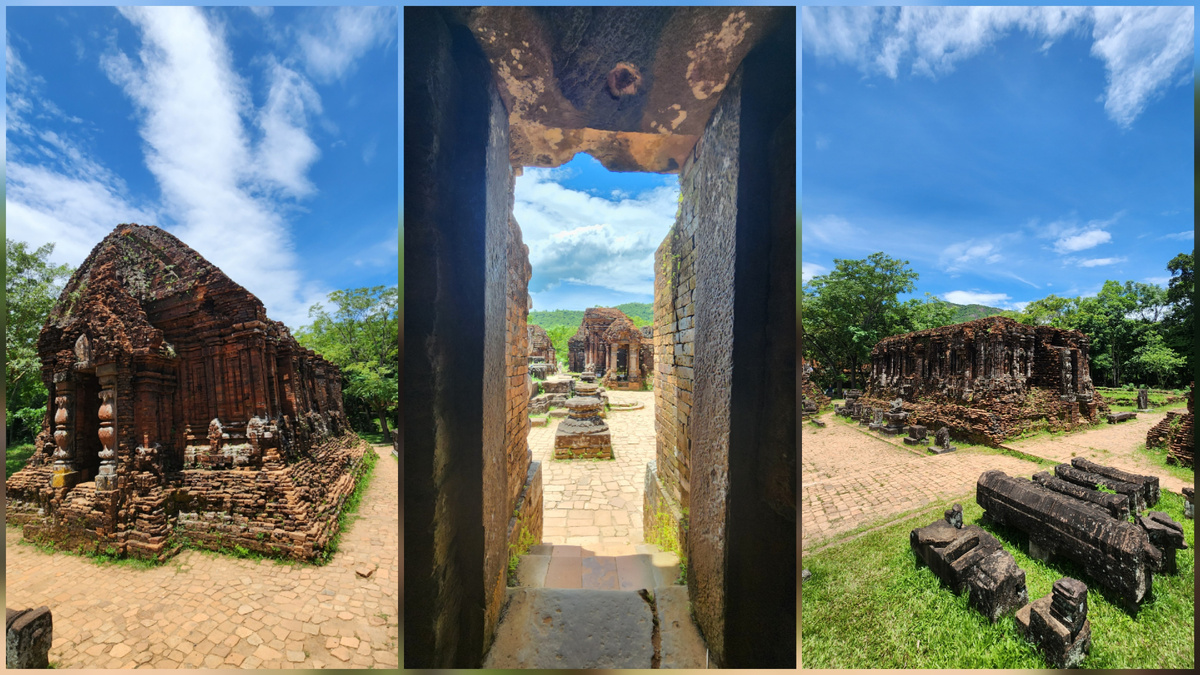
The closely fitted bricks are one of the first things to notice at a Cham tower. Sandstone supplied sculptural and architectural elements, while fired brick formed much of the building itself.
The construction techniques have required extensive study, particularly when conservators needed compatible materials to repair damaged structures.
UNESCO-supported conservation at My Son produced guidelines covering bricks, mortar and resin. The close joints reflect skilled building and material preparation, and the research has direct consequences for how the towers are repaired.
At a restored monument, examine the joints and the relationship between brick surfaces and stone details. Remember that conservation work is part of what you see today; an exposed wall is not necessarily an untouched medieval surface.
What happened to the Champa Kingdom?
Champa’s political history included conflict and diplomacy with both Đại Việt and the Khmer world. Its loss of territory took place over a long period, with different consequences for different regions.
The capture of Vijaya by the forces of Lê Thánh Tông in 1471 was a devastating turning point. It did not end all Cham political life. Southern territories, especially Panduranga, continued under changing arrangements of autonomy and dependence.
The remaining Cham territories were absorbed in 1832, under Emperor Minh Mạng.
Keeping those dates separate matters. Ending the story in 1471 removes several centuries of later Cham history. Ending it in 1832 still says nothing about the disappearance of Cham people, who continued to maintain and adapt their cultures.
For the history of the modern coastal city, including its later development as Tourane, continue with Da Nang’s history.
Where to see Cham heritage today
Da Nang: sculpture in close view
The Museum of Cham Sculpture lets you study works from My Son, Dong Duong, Tra Kieu and other sites in one place. The museum’s first building opened in 1919, following earlier collecting and plans for a permanent display.
For a visit focused on understanding Champa, pay attention to the objects’ original locations. A sculpture moved into a gallery has lost its architectural setting, but its label can help you reconnect it with a sanctuary or region.
For choosing a base around the museum, the river or the beach, read my guide to Da Nang’s areas and daily life before comparing accommodation.
My Son: the sanctuary in its setting
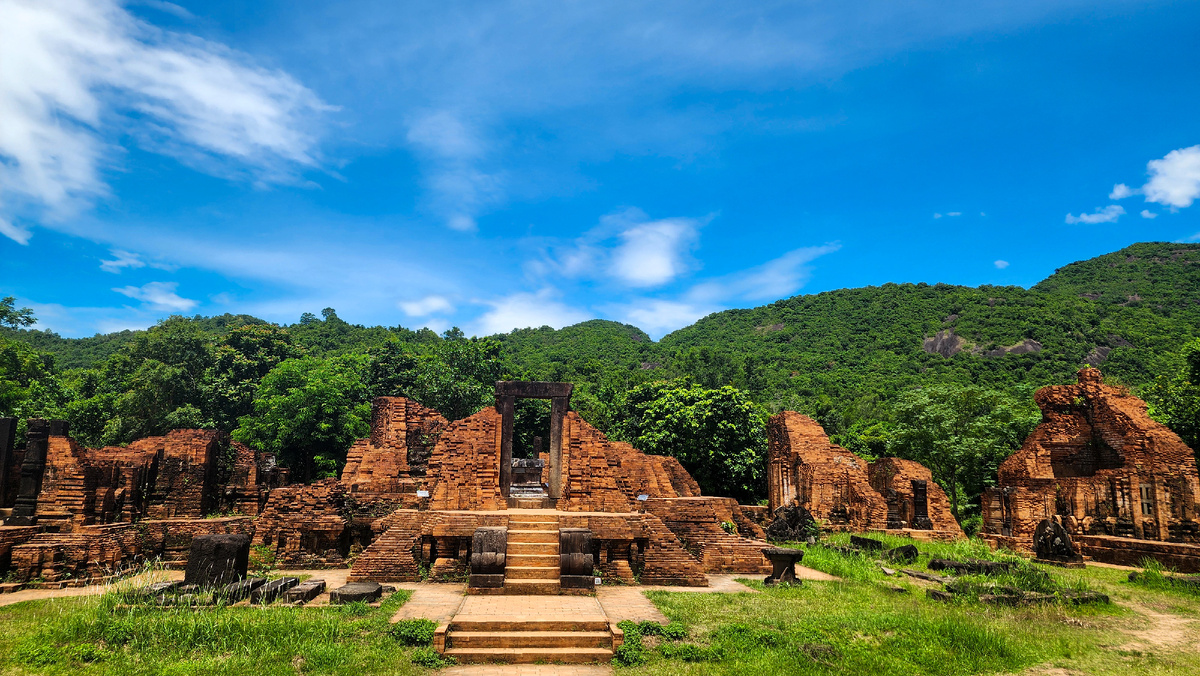
At My Son, the towers, foundations and surrounding hills restore the sense of place missing from museum displays. Weathering, war damage and conservation have all affected the complex.
For a longer ride beyond the sanctuary, my two-day motorbike trip from Da Nang combines My Son with VinWonders Nam Hoi An and Dong Giang.
Nha Trang: Po Nagar
Po Nagar provides another religious focus. Its towers honour Yang Ino Po Nagar, the Cham goddess described as the mother of the kingdom.
This expands the picture beyond My Son’s association with Shiva. Cham religious history cannot be understood through a single deity or sanctuary.
The Phan Rang area: living traditions
Cham heritage also includes skills practised and transmitted within communities. In 2022, UNESCO inscribed the art of pottery-making of the Cham people on its List of Intangible Cultural Heritage in Need of Urgent Safeguarding.
The pottery is made by women using knowledge passed on within the community; traditional production includes shaping pots without a potter’s wheel. UNESCO’s urgent safeguarding designation recognises the pressures on its continued transmission.
Give that living heritage the same attention as the towers. Ask permission before photographing people or ceremonies, and follow local guidance at places of worship.
You do not need to remember every ruler before visiting central Vietnam. Recognising an altar’s purpose, a sculpture’s original home or a temple’s place in a wider region is enough to make the next museum label worth stopping for.
Plan your Central Vietnam visit
Build the trip around the places you plan to explore. Choose your base in Da Nang or Hoi An, check your arrival time, then arrange the journeys that need advance planning.
Accommodation. Enter Da Nang or Hoi An and your dates on Trip.com. Compare the location, room conditions and cancellation policy before reserving.
Compare hotel prices for your dates
Flights and arrival. Search for Da Nang (DAD), check baggage allowances and note the arrival time. For a prebooked airport pickup, enter your airport, hotel address and flight details on Trip.com and review the vehicle, meeting point and booking terms.
Car rental. For a route with several stops, compare cars for your pickup city and dates. Check the driving requirements, deposit, insurance and pickup conditions before booking.
Compare Vietnam rental cars on Localrent
Mobile data. For maps and booking confirmations, compare a Vietnam eSIM with your existing roaming plan. Check device compatibility, data allowance, activation rules and validity before purchasing.