Angkor National Museum: Tickets, Galleries & Is It Worth It?
At Angkor, the difficult part is not finding spectacular temples. It is understanding what you are looking at.
After a few hours, names such as Suryavarman II and Jayavarman VII can start blending together. Shiva, Vishnu and Buddha appear across different monuments, sometimes within the same temple. Nagas, Garudas, Buddha images, royal figures and carved inscriptions are everywhere, but without some context they can easily become one long sequence of beautiful stone.
Angkor National Museum in Siem Reap is useful because it gives you that missing vocabulary. You do not need an entire day here. For most visitors, 1.5 to 2 hours is enough to make the next temple day considerably easier to understand.
If you only have one day in Siem Reap, I would still prioritise the temples. My Angkor One-Day Itinerary: Sunrise at Angkor Wat, Angkor Thom & Ta Prohm is the better place to start. With two or three days, however, the museum becomes a much more useful addition.
Angkor National Museum at a Glance
| Location | Siem Reap |
| Best for | Khmer art, religion, kings, sculpture and Angkor context |
| Typical visit | 1.5–2 hours |
| Detailed visit | 2.5–3 hours |
| Adult admission | Around $12 at the time of writing |
| Audio guide | About $5 |
| Russian audio guide | Yes |
| Angkor Pass | Not valid for museum admission |
| Photos | Phone photography without flash is generally allowed |
| Large bags | Free lockers available |
| Payment | Cards accepted |
| Open | Daily |
Opening hours are currently 8:30 AM–6:00 PM from April to September and 8:30 AM–6:30 PM from October to March. Check the museum website before a late visit in case the schedule changes.
Is Angkor National Museum Worth Visiting?
For most first-time visitors with at least two days around Angkor, yes.
The museum is strongest at explaining the things that are difficult to absorb while standing in a hot temple complex: who the major kings were, why Hindu and Buddhist imagery overlap, how to recognise important religious figures, what distinguishes Angkor Wat from Angkor Thom and how inscriptions help historians reconstruct Khmer history.
This is not a substitute for the temples. It is an interpretation layer that makes the temples easier to read.
Should You Visit Before or After Angkor?
Going before the temples makes the most sense if this is your first encounter with Khmer history, you are exploring independently or names such as Suryavarman II, Jayavarman VII, Shiva and Vishnu currently mean very little to you.
Going after your first temple day can work just as well if you prefer seeing the real monuments before learning the terminology. Once you have already walked through Angkor Wat or Bayon, museum objects and explanations stop feeling abstract because you recognise forms you have just seen in stone.
For a three-day Angkor itinerary, the museum between temple days can be the sweet spot. The first day provides the visual impact, the museum puts some of it into order, and the remaining temples become easier to interpret.
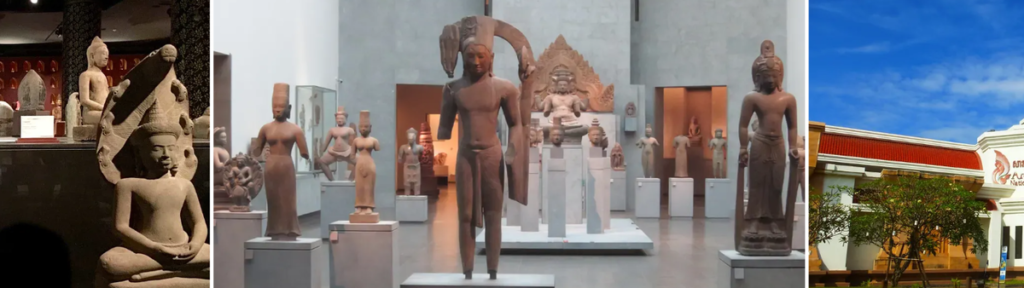
Five Things Worth Learning Before Your Next Temple Day
The museum has eight main galleries, but you do not need to memorise all of them. The most useful takeaways are simpler: how Buddha images differ, why Hindu and Buddhist imagery coexist at Angkor, which Khmer kings actually matter for a visitor, why Angkor Wat and Angkor Thom belong to different historical stories, and how inscriptions, clothing and jewellery help historians identify what they are looking at.
If you leave with those five ideas, the visit has already done its job.

Gallery of 1,000 Buddha Images: What to Look For
The Gallery of 1,000 Buddha Images is one of the museum’s signature spaces.
Do not try to memorise every statue. Look instead at posture, hand gestures, artistic style and surrounding attributes. Notice how the Buddha can be seated or standing, how the robes and facial proportions change and how particular symbols help identify different forms.
One especially useful image to recognise is the Buddha Protected by Naga, where the serpent rises behind the seated Buddha like a hood. Once you recognise that composition in the museum, related images around Angkor become much easier to identify.
That is one of the museum’s greatest strengths. Something that initially registers as “another Buddha statue” begins to look like part of a visual language.
Shiva, Vishnu and Buddha: Why They All Appear at Angkor
Angkor becomes confusing if you expect every temple to belong neatly to one religion forever.
The Khmer Empire drew heavily on Hindu and Buddhist traditions. Different rulers favoured different religious programmes, temples changed over time and later kings sometimes reinterpreted existing sacred spaces.
You do not need a full course in Hindu iconography before entering the archaeological park. Learning a few connections already helps enormously: Shiva and Nandin, Vishnu and Garuda, the Buddha, nagas and a handful of recurring mythological scenes.
After that, the carvings stop looking completely anonymous.
It also becomes easier to understand why a temple described as Hindu may contain later Buddhist imagery, or why Buddhist figures can show evidence of later modification or destruction.
Four Khmer Kings Worth Remembering
The museum’s Gallery of Great Khmer Kings helps reduce a very long royal history to something manageable.
| King | Remember him for |
|---|---|
| Jayavarman II | Beginning of the Angkorian imperial period |
| Yasovarman I | Establishing Angkor as a major royal centre |
| Suryavarman II | Angkor Wat |
| Jayavarman VII | Angkor Thom, Bayon and a major Buddhist building programme |
You do not need to memorise their reign dates.
The useful step is simply connecting Suryavarman II with Angkor Wat and Jayavarman VII with Bayon and Angkor Thom. Once those relationships stick, a large part of the archaeological landscape becomes easier to organise.
Angkor Wat and Angkor Thom Are Not the Same Story
One of the most useful things the museum does is give Angkor Wat and Angkor Thom separate galleries.
On a modern tourist map, they can feel like sections of one enormous attraction. Historically, they belong to different rulers, different religious programmes and different moments in Khmer history.
Angkor Wat is associated with Suryavarman II and began as a monumental Hindu temple strongly connected with Vishnu.
Angkor Thom was developed as the great fortified royal capital under Jayavarman VII, whose reign produced Bayon and an enormous Buddhist construction programme.
Understanding that difference before walking through the gates of Angkor Thom prevents a lot of confusion. You stop seeing everything as another part of “Angkor Wat” and begin recognising different phases of the Khmer capital.
Story from Stone: How Do Historians Know Any of This?
One of the most useful galleries is Story from Stone, devoted to inscriptions.
It answers a question that travel guides often skip: how do historians know who built a temple, which deity it honoured or what an institution was used for?
Much of Khmer history comes from inscriptions carved into stone. They preserve names, royal titles, religious foundations, dedications, language, historical events and details of social or institutional life.
This is also why the absence of an inscription matters. A temple with a surviving foundation inscription may have a remarkably detailed documented history, while another monument of similar size may require much more cautious interpretation.
Sometimes the evidence survives and sometimes it does not. Once you understand that distinction, archaeological uncertainty starts looking less like historians being vague and more like an honest reflection of what the evidence can support.
Ancient Costume: Why Jewellery and Headdresses Matter
The Ancient Costume gallery sounds less important than Angkor Wat or the thousand Buddhas, but it is surprisingly useful.
Clothing, jewellery, hairstyles and headdresses are not simply decorative details. They can indicate status and help specialists distinguish types of figures and different artistic periods.
After this gallery, look again at temple sculpture.
A crown, necklace or particular style of dress begins to look like evidence rather than ornament. You will not suddenly be able to date a sculpture from its jewellery, but you will understand why those small details matter.
Is the $5 Audio Guide Worth It?
The museum currently offers an audio guide for about $5, with around 40 audio stations.
Available languages include English, French, German, Japanese, Chinese, Korean, Thai, Spanish and Russian.
If you are comfortable reading English labels and want a relatively quick 90-minute visit, the audio guide is optional.
If you prefer listening, want to spend two or three hours in the museum or specifically want the explanations in Russian, the extra cost makes considerably more sense.
I would not treat it as mandatory. It mainly changes the depth and pace of the visit.
What the Museum Does Not Cover Particularly Well
Angkor National Museum is strongest on Khmer art, religion, sculpture, kings, inscriptions and the monuments of Angkor.
It is not a comprehensive political and social history of Cambodia. If you want a detailed account of wars, economics, everyday urban life and Cambodia’s entire history before and after Angkor, you will need other museums and sources as well.
That is worth knowing before buying a ticket. Come here to understand the temples better, not to get the entire history of Cambodia in two hours.
Angkor National Museum Tickets and Angkor Pass
No, Angkor National Museum is not included in the Angkor Pass. Museum admission is separate.
Adult admission is currently around $12, while the audio guide costs extra. Check the current price for your date before booking.
Tickets can be bought at the museum, and card payments are accepted. If you prefer to arrange admission in advance, you can compare the current online ticket price first.
How Long Do You Need?
For most visitors, 1.5 to 2 hours is enough.
If you mainly want the historical framework before visiting the temples, you can move through the museum efficiently without studying every object. If you use the full audio guide, read extensively or spend a long time with sculpture, allow 2.5 to 3 hours.
This is one reason the museum works well on an arrival afternoon or during the hottest part of a day in Siem Reap.
Photos, Cameras, Bags and Practical Details
Phone photography is generally allowed without flash. If you carry a larger camera, check the current camera policy at the entrance rather than assuming the rules are identical.
Large bags can be left in free lockers, and the museum accepts card payments.
The building is air-conditioned, which is useful in practical terms even if it should not be the main reason you visit. After a long morning around temples, two quiet indoor hours can also be a sensible way to use the hottest part of the afternoon.
Angkor National Museum vs National Museum of Cambodia: What’s the Difference?
These are two different museums and the names are easy to confuse.
Angkor National Museum is in Siem Reap and is focused specifically on Khmer civilisation and understanding the monuments of Angkor.
The National Museum of Cambodia is in Phnom Penh and has a broader collection of Khmer art and archaeology.
If you are about to spend several days visiting Angkor, the Siem Reap museum is the more directly useful preparation. If your Cambodia itinerary includes Phnom Penh as well, the two museums complement each other rather than duplicate each other.
Who Should Visit Angkor National Museum?
I would prioritise the museum if you are exploring Angkor without a guide, have a two- or three-day temple itinerary, enjoy sculpture or mythology, or keep wondering how the rulers, religions and different monuments connect.
You can probably skip it if you only have a single day in Siem Reap and must choose between the museum and the temples. A knowledgeable private guide can also provide much of the essential historical framework during a well-planned temple day.
For everyone else, the museum offers a useful return for around two hours of your trip. You leave with four kings worth remembering, the basic religious vocabulary, a clearer distinction between Angkor Wat and Angkor Thom, a better eye for sculpture and an understanding of why inscriptions matter.
You will not know the complete history of the Khmer Empire when you walk out.
You should, however, be much less likely to spend the next day looking at a succession of beautiful but disconnected ruins.
Useful Travel Resources
Flights
Compare flights to Cambodia and connections across Southeast Asia.
Hotels
Compare accommodation in Siem Reap by location, current price and guest reviews.
Tours & Activities
Browse museum tickets, Angkor tours and other things to do around Siem Reap.
Tours & Experiences
Compare guided Angkor tours and experiences.
Airport Transfers
Arrange transport between Siem Reap Angkor International Airport and your accommodation.
eSIM
Set up mobile data before arriving in Cambodia.
Travel Insurance
Check travel insurance options before your trip.
Affiliate disclosure: This article contains affiliate links. If you book through them, I may earn a commission at no extra cost to you.