Phnom Chhngok Cave Temple: History & How to Visit from Kampot
Phnom Chhngok is not remarkable because it is large. It is remarkable because the cave itself became part of the temple.
Inside a limestone hill near Kampot, a small pre-Angkorian brick sanctuary was built around a natural rock formation associated with a Shiva linga. The shrine is usually described as a 7th-century temple, although archaeological evidence suggests it may date from the mid-6th to early 7th century, centuries before the great monuments of Angkor.

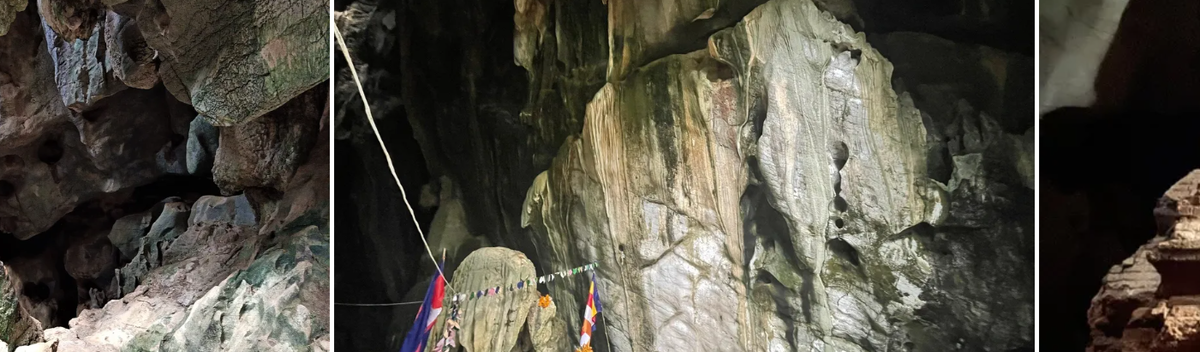
There are no enormous towers, long galleries or kilometres of bas-reliefs here. Instead, you climb into a limestone cave and find an early Khmer sanctuary enclosed by stalactites and rock.
That scale is exactly what makes Phnom Chhngok interesting. It shows another side of Cambodian religious architecture, from a period when sacred landscape and built architecture could be combined in a much more intimate way.
Phnom Chhngok is also commonly written Phnom Chhnork in English-language travel guides.
If you are planning more time in the region, see my Kampot Cambodia Travel Guide for ideas on how to combine the countryside, riverfront, pepper farms, Bokor and nearby Kep.
Phnom Chhngok at a Glance
| Location | Countryside near Kampot |
| Distance from Kampot | Around 12 km |
| Period | Pre-Angkorian |
| Probable date | Mid-6th to early 7th century |
| Religion | Brahmanical / Shaivite |
| Main feature | Brick sanctuary built around a natural linga inside a limestone cave |
| Also written as | Phnom Chhnork |
| Time needed | Around 1–1.5 hours |
| Entrance | Small local fee; bring cash |
| Best combined with | Kampot countryside, pepper farms and Kep |
| Footwear | Shoes with good grip recommended |
Why Phnom Chhngok Is Different
Cambodia has no shortage of old temples, but Phnom Chhngok belongs to a very different architectural world from Angkor Wat, Bayon or Ta Prohm.
The shrine is small enough to stand inside a natural cave chamber. Instead of trying to dominate the landscape with scale, the architecture works with what was already there.
A natural limestone formation inside the cave became part of the sanctuary itself, associated with a linga, the aniconic form of Shiva. A sandstone yoni was constructed beneath the natural linga as part of the ritual arrangement.
The cave was therefore not simply a convenient roof over a brick temple. The natural formation was incorporated into the sacred architecture.
That relationship between geology and religion is the main reason Phnom Chhngok deserves more attention than its size might suggest.
How Old Is Phnom Chhngok Really?
Most travel guides describe Phnom Chhngok as a 7th-century temple.
That is a useful shorthand, but the archaeological picture is a little more interesting.
The exact construction date is not known. Based on architectural style, the surviving brick lintel and the inscription associated with the site, Cambodian researchers have suggested a date from roughly the middle of the 6th century to the beginning of the 7th century.
That places Phnom Chhngok firmly in the pre-Angkorian period, before the political and architectural system that would eventually produce the great Angkorian capitals.
It may therefore be older than many visitors expect when they hear the phrase “Khmer temple”.
Southern Cambodia Before Angkor
Phnom Chhngok belongs to a complicated period in Cambodian history.
The centuries before Angkor are often simplified into a neat sequence of Funan → Chenla → Khmer Empire, but political change in mainland Southeast Asia was much less tidy than that.
The period around Phnom Chhngok’s probable date is often described as the transition from Funan to Chenla, although those labels simplify a much more complicated political landscape.
For a visitor, the important point is simpler: this sanctuary predates the monumental Angkorian world by centuries.
Jayavarman II’s traditional foundation of the Angkorian imperial period at Mahendraparvata is associated with 802 CE. Phnom Chhngok was already old by then.
That makes it useful as a reminder that Khmer religious architecture did not suddenly begin at Angkor.
A Temple Built Around a Natural Linga
The most interesting feature at Phnom Chhngok is easy to miss if you enter expecting a conventional temple.
The sanctuary was associated with Shaivism, the Hindu tradition centred on Shiva.
Instead of simply placing a carved linga inside an ordinary shrine, the builders incorporated a natural limestone formation into the sacred space. The formation functioned as a linga, while a sandstone yoni was constructed beneath it as part of the ritual arrangement.
This changes the way the entire cave should be read.
The brick structure is not an isolated building that happens to sit underground. Architecture, natural stone and religious symbolism were deliberately connected.
For early religious communities, mountains, caves, springs and unusual rock formations could already possess sacred significance. Phnom Chhngok shows how formal temple architecture could be added to that existing sacred landscape rather than replacing it.
What Survives Inside the Cave
The sanctuary itself is compact.
Its brick construction is much simpler than the elaborate stone architecture familiar from later Khmer temples, but several details make it archaeologically important.
The surviving elements include the brick sanctuary, the natural linga formation, a sandstone yoni and architectural decoration including an early lintel with opposed makara motifs.
Makara are composite mythological creatures that appear repeatedly in South and Southeast Asian sacred art. If you are already exploring Khmer iconography, my Angkor Mythology Guide explains some of the creatures and divine symbols that recur in later Cambodian temples.
At Phnom Chhngok, however, the attraction is not decorative abundance. The interest comes from seeing a very early combination of brick architecture, Hindu ritual and the natural cave environment.
The K.46 Inscription
Another important piece of evidence from the site is an inscription known as K.46.
The inscription survives in Sanskrit and Old Khmer, although parts of the text are damaged. It does not provide a convenient foundation date telling us exactly when the shrine was built.
It does, however, help place Phnom Chhngok within the early religious landscape of southern Cambodia.
The sanctuary has been associated through the inscription with Sri Utpannesvara, a form or name of Shiva. The Old Khmer text also records offerings connected with the sanctuary, including cattle, buffaloes, fields, palms, coconuts and temple servants.
That matters because it shows that Phnom Chhngok was not simply an isolated cave altar. It functioned as a religious institution with resources, land and people attached to it.
A monument does not need to be visually spectacular to tell us something important. Sometimes an inscription, a lintel and the relationship between a shrine and its natural setting reveal more about an early religious landscape than a much larger ruin with no surviving text.
Why the Temple Survived So Well
The cave has done more than provide the shrine with its unusual setting.
It also helped protect it.
Brick temples exposed to centuries of tropical rain, vegetation and erosion often deteriorate badly. At Phnom Chhngok, the surrounding limestone chamber shelters much of the structure from direct weather.
That does not mean the sanctuary is untouched or perfectly preserved, but the cave environment helps explain why such an early brick structure remains recognisable today.
Its survival owes much more to physical protection from the cave than to the fact that relatively few tourists visit.
What Is the Cave Like to Visit?
Do not expect a polished museum environment.
The attraction is partly the fact that you are visiting a natural cave.
The main approach involves about 200 steps, followed by uneven cave surfaces. Some sections can be damp or slippery even in the dry season, and certain passages may become muddy or partially flooded during the rains.
Wear shoes with decent grip rather than smooth sandals. A phone light or small torch can also be useful in darker sections, even if there is some lighting around the main visitor route.
If heavy rain has recently fallen, expect more moisture and take your time on the steps and cave floor.
This is not technical caving, but it is not a flat archaeological park either.
How to Get to Phnom Chhngok from Kampot
Phnom Chhngok lies roughly 12 km from central Kampot, in a rural landscape of rice fields, limestone hills and villages.
The drive is part of the appeal. Once you leave town, the surroundings change quickly from the compact streets of Kampot to agricultural countryside.
A tuk-tuk or private driver is the easiest option if you do not have your own transport. The site is also often included in wider Kampot countryside tours.
Allow roughly 30 minutes from central Kampot, depending on road conditions, your starting point and the exact route.
Best Time to Visit Phnom Chhngok
The dry season generally makes the visit easier.
Roads are simpler, cave surfaces are less slippery and there is less chance of dealing with muddy or waterlogged passages.
That does not mean you cannot visit during the wet season. The countryside is beautifully green then, and Kampot’s karst landscape can look particularly dramatic.
You just need to expect wetter conditions.
For photography and a more comfortable climb, morning or later afternoon can also be more pleasant than the hottest part of the day.
How Long Do You Need?
For the cave and temple itself, around 1 to 1.5 hours is usually enough.
There is no reason to rush through in 15 minutes, because the interesting part is looking at how the shrine fits into the rock rather than simply taking a photograph of the brick structure.
At the same time, Phnom Chhngok does not require half a day on its own.
Its real value for most travellers comes from combining it with the wider Kampot countryside.
Combine Phnom Chhngok with Pepper Farms and Kep
Phnom Chhngok works particularly well as part of a countryside route rather than as a single out-and-back attraction.
A logical day can look something like:
Kampot → Phnom Chhngok → pepper farm → Kep
That gives you three completely different layers of southern Cambodia in one route: pre-Angkorian history, agricultural landscape and the coast.
Kampot’s pepper farms are especially easy to combine with the cave because they already take you through the same wider rural region. If you are deciding which farm to visit or want to understand why the product is internationally protected, see my Kampot Pepper Guide.
You can then continue toward Kep or return to Kampot depending on how much time you have.
Is Phnom Chhngok Worth Visiting?
It depends on what you expect.
If you want a monumental Khmer temple with elaborate carvings and a dramatic skyline, this is not it.
Phnom Chhngok is small, quiet and visually modest compared with Angkor.
Its value lies somewhere else.
You are looking at an early pre-Angkorian sanctuary built inside a limestone cave, probably dating from the mid-6th to early 7th century. A natural formation became part of a Shaivite shrine, while an early inscription records the religious and economic world attached to the sanctuary.
That makes Phnom Chhngok much more than a countryside curiosity.
For me, the best reason to include it in a Kampot itinerary is not that it is a “hidden gem”. It is that it reveals a much earlier chapter of Cambodian religious architecture, one in which the boundary between temple and landscape was barely a boundary at all.
Useful Travel Resources
Flights
Compare flights to Cambodia and connections across Southeast Asia.
Hotels
Compare accommodation in Kampot and elsewhere in Cambodia.
Tours & Activities
Browse organised sightseeing and activities around Cambodia.
Tours & Experiences
Compare guided tours and experiences.
Airport Transfers
Arrange private transport for your Cambodia itinerary.
eSIM
Set up mobile data before arriving in Cambodia.
Travel Insurance
Check travel insurance options before your trip.
Affiliate disclosure: This article contains affiliate links. If you book through them, I may earn a commission at no extra cost to you.