Banteay Samré Temple: A Quiet Angkor Wat-Style Temple
Banteay Samré belongs to roughly the same architectural period as Angkor Wat and uses many of the same visual ideas, but everything is compressed into a much smaller space. Galleries, naga balustrades, carved pediments and sanctuary architecture are all here, yet the temple is compact enough that you can understand how the different parts fit together without being overwhelmed by scale.
When I visited, it also felt dramatically quieter than the headline temples. I came here on a route that continued from Pre Rup to Banteay Samré, then Banteay Srei and Phnom Krom, and the slower rhythm worked much better than trying to squeeze another major monument into an already packed classic circuit.

For a first trip with only one day, I would still prioritise Angkor Wat, Angkor Thom, Bayon and Ta Prohm. But if you have more time, Banteay Samré is one of the easiest places around Angkor to study 12th-century Khmer architecture at a human scale.
If you are planning the major temples first, my Angkor One-Day Itinerary: Sunrise at Angkor Wat, Angkor Thom & Ta Prohm shows how the classic circuit fits together.
Banteay Samré at a Glance
| Location | East of the main Angkor circuits, on the route toward Banteay Srei |
| Period | 12th century |
| Style | Angkor Wat style |
| Religion | Hindu, with strong Vaishnavite imagery |
| Known for | Compact layout, galleries, naga causeways and richly carved pediments |
| Restoration | Major anastylosis led by Maurice Glaize |
| Ticket | Included in the Angkor Pass |
| Opening hours | 7:30 AM–5:30 PM |
| Time to allow | Around 1 hour; 1–1.5 hours if you like architecture and carving |
| Good route | Pre Rup → Banteay Samré → Banteay Srei |
Why Visit Banteay Samré?
The main reason to visit is not that it is a secret copy of Angkor Wat. It is that the architectural language of the Angkor Wat period is unusually easy to see here.
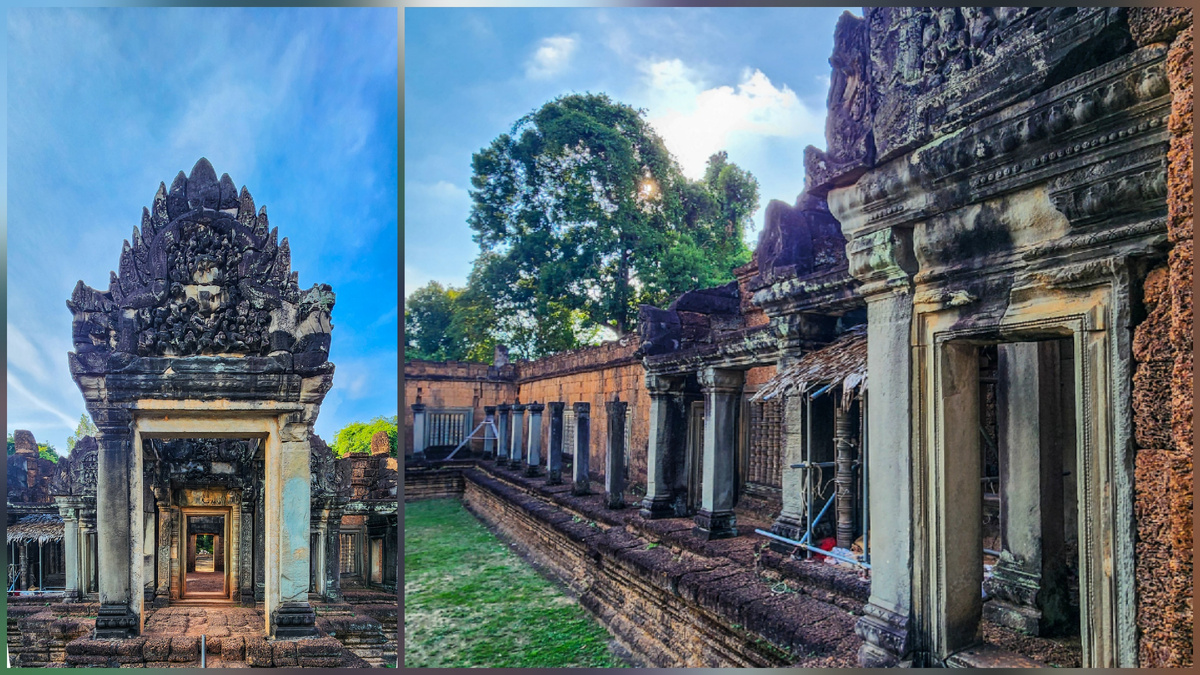
The monument is compact, enclosed and richly decorated. You can move from gateway to causeway, gallery and sanctuary without losing track of the plan, while pediments and lintels remain close enough to study properly.
Banteay Samré is also interesting because the temple visitors see today owes a great deal to modern conservation. Its coherent appearance is not simply the result of unusually good survival. A major 20th-century restoration reconstructed large parts of the complex and became an important chapter in the history of Angkor conservation.
A 12th-Century Temple from the Age of Angkor Wat
Banteay Samré is generally dated to the 12th century and belongs stylistically to the same broad architectural period as Angkor Wat.
Its exact foundation history is less certain than that of monuments with detailed dedicatory inscriptions. No surviving foundation inscription gives us a complete account of the original patron, exact construction date and ceremonial programme, so historians rely heavily on architecture and sculpture to place the temple in context.
The monument is usually associated with the age of Suryavarman II, the king who built Angkor Wat, although later modifications also took place.
Its religious programme is Hindu and contains strong Vaishnavite imagery, particularly scenes involving Vishnu and Krishna. Other Hindu deities also appear, and some later or additional imagery includes Buddhist subjects, which makes the sculptural programme more complex than a simple one-deity temple.
Why Is It Called Banteay Samré?
The word banteay is usually translated as fortress or citadel, which suits the enclosed appearance of the monument. High walls surround the complex, and once you pass through the gate, the temple feels much more contained than the open approaches of Angkor Wat.
The second part of the name is traditionally associated with the Samré, a population connected in historical accounts with the area around Phnom Kulen. Beyond that, the story becomes less certain.
Older accounts preserve legends linking the Samré with a cucumber farmer who unexpectedly became king, but this belongs to folklore rather than the documented construction history of Banteay Samré. There is no solid basis for presenting the monument as the personal temple of a Samré warrior or as a regional cult centre built specifically for local nobility.

Why Banteay Samré Looks So Complete Today
One of the most important facts about Banteay Samré is that its appearance today is partly the result of anastylosis.
From 1936 to 1946, French conservator Maurice Glaize led an extensive restoration of the temple. Anastylosis is a method in which fallen architectural elements are documented, identified and returned to their original positions when sufficient evidence survives.
Before that work, Banteay Samré was far more ruined and overgrown. Glaize’s project reconstructed large sections of the monument and became one of the major early restoration efforts at Angkor.
That makes the temple especially useful for understanding conservation. The clean architectural lines and complete-looking galleries are not evidence that the site somehow escaped centuries of damage. They show what careful reconstruction can achieve when enough of the original material survives.
Conservation has also continued in recent years. Work in 2025–2026 has included restoration of the front terrace and naga balustrades, showing that Banteay Samré remains an actively managed archaeological monument rather than a finished restoration frozen in time.
How Banteay Samré Is Laid Out
The temple is compact enough that its structure becomes clear during a single visit.
A walled enclosure surrounds the sacred core, while gateways, or gopuras, organise movement through the complex. Inside are enclosed galleries, a central sanctuary and two smaller buildings traditionally called libraries.
The plan is controlled and symmetrical without becoming monumental on the scale of Angkor Wat. That is exactly what makes Banteay Samré useful as an architecture lesson: you can follow the transition from outer boundary to ceremonial approach and inner sanctuary without losing the overall logic of the site.
The Eastern Causeway and Naga Balustrades
The eastern approach is one of the details worth slowing down for.
A causeway originally extended for roughly 200 metres, with naga balustrades marking the processional route toward the temple. Surviving and restored sections still create the ceremonial approach familiar from larger Khmer monuments.
Nagas are among the most recognisable beings in Angkorian art. Their long bodies often become architectural balustrades, while the fan of cobra heads marks bridges, stairs and sacred approaches.
Naga-lined causeways are often interpreted as marking a transition toward sacred space, although the motif should not be reduced to one single meaning. In Khmer art, nagas can also be associated with water, protection, mythology and specific religious narratives depending on context.
The Walls, Gateways and Enclosed Interior
Banteay Samré has a strong sense of enclosure.
Laterite and sandstone walls define the complex, while entrances align with the cardinal directions. The eastern approach is the most elaborate, but the other gateways help create the balanced geometry typical of Khmer religious architecture.
Look upward as you pass through them. Much of the best sculpture is concentrated on pediments and lintels, and the reduced scale makes those carvings easier to examine than similar decoration placed high above the visitor at larger temples.
This is one of the places where looking above the doorway can be more rewarding than rushing toward the central tower.
The Central Sanctuary
At the centre of Banteay Samré stands the principal sanctuary.
It is elevated, but the temple should not be described simply as a miniature temple-mountain. Its composition is much more compact and horizontal than the enormous symbolic mountain created by Angkor Wat.
Still, familiar Khmer architectural ideas are easy to recognise. Steep stairs control access to raised sacred space, guardian lions protect important approaches, and false doors create formal symmetry around sanctuary walls even where no physical passage exists.
Those false doors are particularly useful to notice. They allow the sanctuary to appear formally oriented in several directions while maintaining a controlled practical entrance.
What Were the “Libraries”?
Two smaller buildings stand near the eastern side of the central complex and are traditionally called libraries.
The term is conventional, and their exact original function is uncertain. Similar structures appear at many Khmer temples, but there is not enough evidence to say confidently that they stored manuscripts, ritual objects or images of gods.
Architecturally, their role is easier to understand. They balance the approach to the central sanctuary and form part of the carefully ordered composition of the inner enclosure.
Sometimes the most accurate explanation at Angkor is simply that a building’s purpose remains unknown.
The Carvings to Look For
Banteay Samré deserves much more attention for its sculpture than it usually receives.
Its pediments and lintels preserve a wide range of mythological subjects. Rather than treating them as generic Hindu decoration, it is worth trying to identify individual stories.
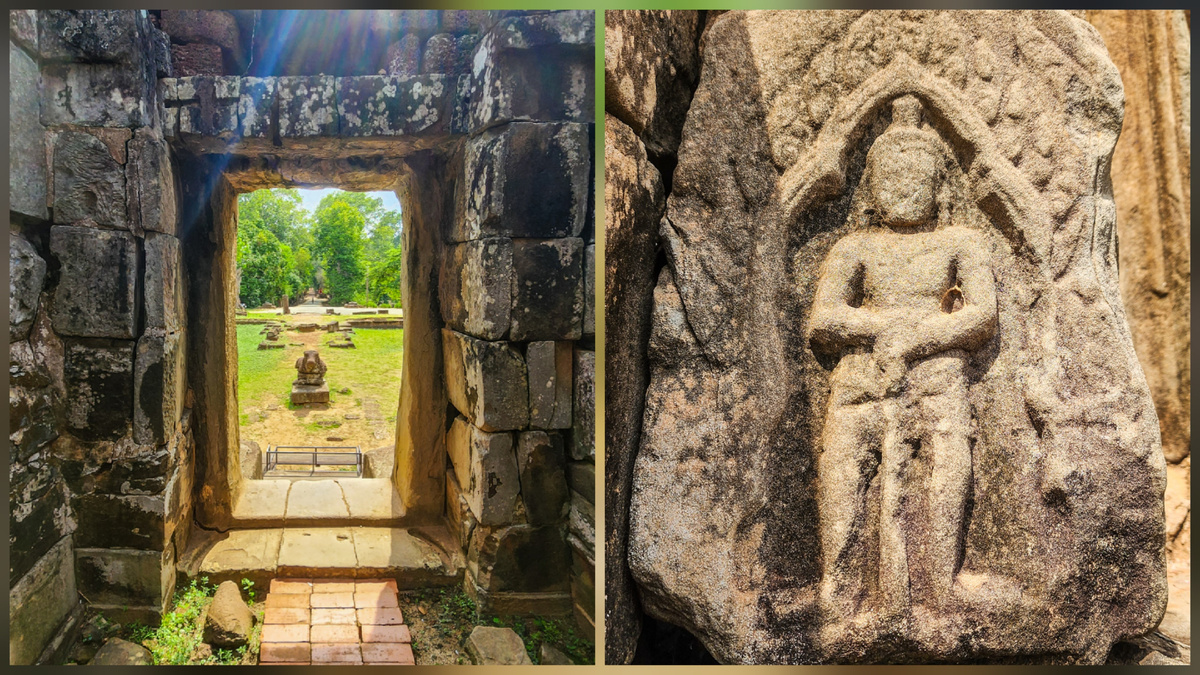
Among the scenes associated with the temple are episodes involving Krishna, including his battle with the serpent Kaliya and the lifting of Mount Govardhana. Other imagery includes Vishnu on Garuda, the Churning of the Ocean of Milk, and Shiva and Uma associated with the sacred bull Nandin.
The iconography is not exclusively Vaishnavite. Some pediments have been identified with episodes from the Vessantara Jataka, a Buddhist story about one of the Buddha’s previous lives.
That mixture matters because Khmer monuments were not always frozen within one simple religious identity throughout their entire history. Banteay Samré is a good place to look closely at how different stories and deities could coexist within the sculptural programme of one temple.
Is Banteay Samré Really a “Mini Angkor Wat”?
The nickname is useful, but only up to a point.
Both monuments belong to a closely related architectural period and share several visual characteristics: sandstone construction, axial planning, enclosed galleries, Hindu imagery and the vocabulary of the Angkor Wat style.
But Banteay Samré is not simply Angkor Wat reduced in size.
Angkor Wat is an enormous royal state temple surrounded by a vast moat and conceived on an imperial scale. Its towers, galleries, bas-reliefs and processional approaches form one of the most ambitious architectural programmes in Southeast Asia.
Banteay Samré is much smaller and has a different history.
The better comparison is that Banteay Samré lets you study Angkor Wat-period architecture without the scale of Angkor Wat getting in the way.
Is Banteay Samré Crowded?
When I visited, it felt dramatically quieter than Angkor Wat, Bayon or Ta Prohm.
That does not mean you should expect to have the entire temple to yourself. Visitor numbers change with season, time of day and tour patterns, and Banteay Samré is well known enough to appear on organised itineraries.
But the calmer atmosphere changed the experience for me. There was more time to stop inside the galleries, look at pediments and understand the plan without constantly moving around large groups.
That slower pace is one of the strongest reasons to include it after the major temples.
Opening Hours, Angkor Pass and How Long to Spend
Banteay Samré is currently open from 7:30 AM to 5:30 PM and is included in the regular Angkor Pass, so there is no separate entrance ticket.
| Angkor Pass | Price | Validity |
|---|---|---|
| 1-day | $37 | 1 day |
| 3-day | $62 | Any 3 days within 7 days |
| 7-day | $72 | Any 7 days within 30 days |
Around one hour is enough for a comfortable first visit. If you enjoy photographing architecture, identifying reliefs or moving slowly, I would allow 1 to 1.5 hours.
Morning is the easiest time in terms of heat, while late afternoon can give the sandstone a warmer colour. I would avoid arriving too close to closing time if the carvings are the main reason for your visit.
If you are arranging the temple days at the same time as your Angkor Pass, this is also a useful point to decide whether you want an independent driver or a guided route.

The Best Route: Pre Rup → Banteay Samré → Banteay Srei
This is how I visited Banteay Samré, and the sequence worked very well.
Start with Pre Rup, a 10th-century state temple with a completely different brick-and-laterite character. Then continue to Banteay Samré before heading farther toward Banteay Srei.
The contrast is useful. Pre Rup gives you an earlier temple-mountain associated with Rajendravarman II, while Banteay Samré moves forward into the mature Angkor Wat period and becomes much more compact and enclosed. Banteay Srei changes the emphasis again toward exceptionally detailed decorative carving.
On my own day, the route continued afterward toward Phnom Krom, which added a landscape stop after several architecture-heavy visits.
For a three-day Angkor Pass, this kind of route makes much more sense to me than repeating slightly different versions of the Small Circuit.
If you want to compare Banteay Samré with an earlier stage of Khmer architecture, Bakong is especially useful. Bakong belongs to the 9th century and shows the development of the temple-mountain tradition, while Banteay Samré demonstrates how refined Khmer temple planning had become several centuries later.
For a completely different experience from roughly the same broad architectural age, Beng Mealea shows a much more heavily ruined monument. Koh Ker takes you into an earlier Khmer capital with a very different monumental landscape.
Is Banteay Samré Worth Visiting?
Yes, if you have more than one day around Angkor.
I would not remove Angkor Wat or Bayon from a first itinerary to make space for it. Banteay Samré works best after you already understand the major monuments and want a quieter temple where the architecture becomes easier to study.
Its strength is the combination of compact Angkor Wat-period planning, rich sculpture, naga approaches, enclosed galleries and a restoration history that explains why the complex appears so coherent today.
When I visited, the calmer atmosphere made those details much easier to notice. That is what I would come here for: not an empty “secret temple” and not a miniature copy of Angkor Wat, but a place where the architectural language of 12th-century Angkor becomes unusually easy to read.
If you are planning other stops around Siem Reap, compare the available temple routes and activities before deciding how much to fit into the same day.
Useful Travel Resources
Flights
Compare flights to Cambodia and connections across Southeast Asia.
Hotels
Compare accommodation in Siem Reap by location, current price and guest reviews.
Tours & Activities
Browse attraction tickets, Angkor tours and other things to do around Siem Reap.
Tours & Experiences
Compare guided tours and experiences around Angkor.
Airport Transfers
Arrange transport between Siem Reap Angkor International Airport and your accommodation before arrival.
eSIM
Set up mobile data before arriving in Cambodia.
Travel Insurance
Check travel insurance options before your trip.
Affiliate disclosure: This article contains affiliate links. If you book through them, I may earn a commission at no extra cost to you.