Angkor Wat Bas-Reliefs: How to Read the Temple Walls
Most visitors arrive at Angkor Wat looking up. The lotus-shaped towers dominate the skyline, the moat creates the first dramatic view, and the scale of the temple makes it easy to keep moving toward the centre. But some of the most interesting stories at Angkor Wat are not above you. They are on the walls.
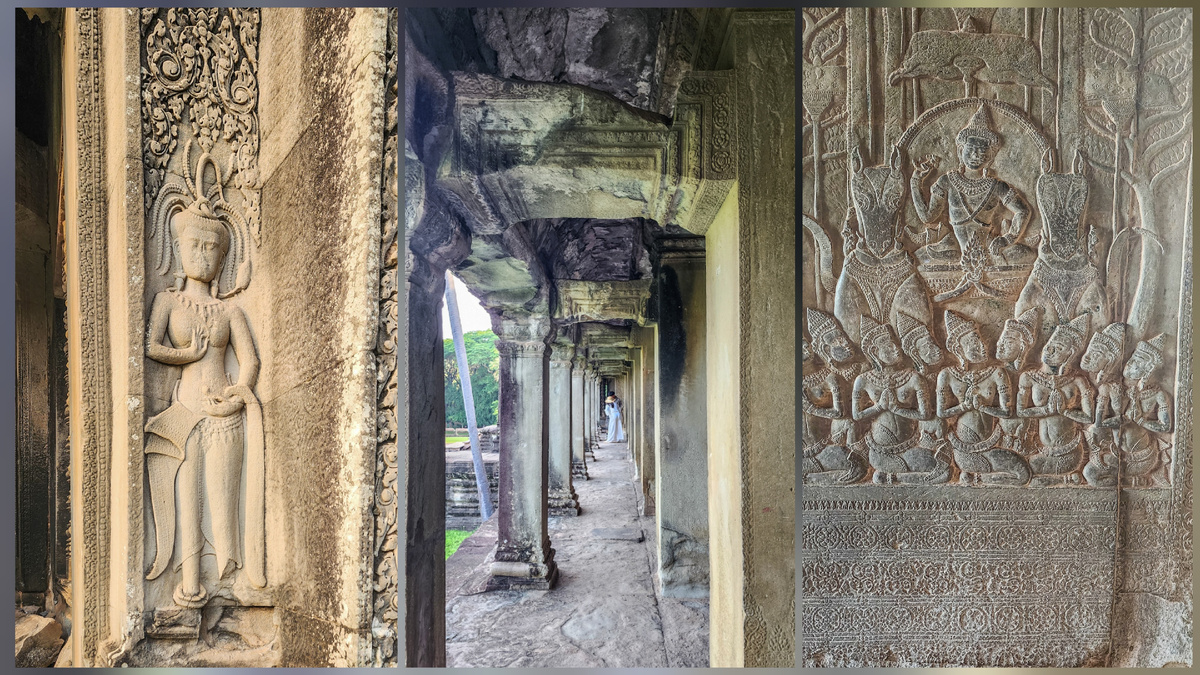
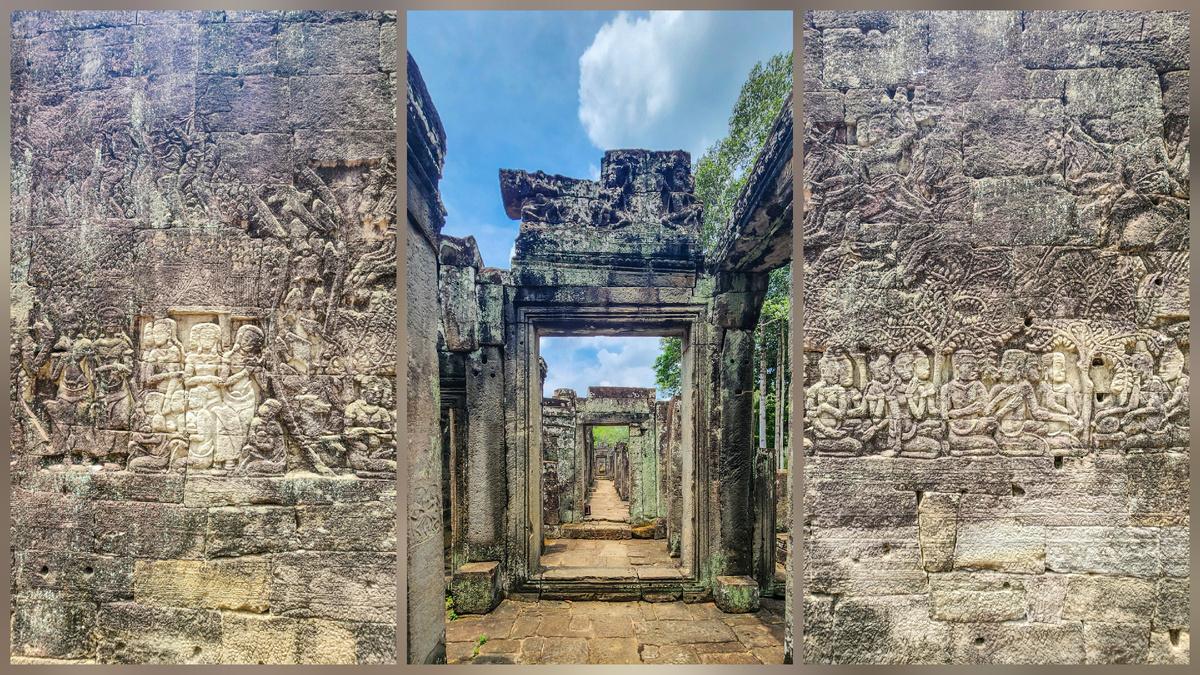
The galleries contain more than 1,000 square metres of narrative bas-reliefs, filled with gods, demons, battles, royal processions, heavens, hells and scenes from Hindu epics. Elsewhere across the temple, thousands of female figures appear in elaborate jewellery, clothing and hairstyles that preserve details of Khmer visual culture from almost 900 years ago. Once you know what to look for, the stone stops feeling like decoration. It becomes a book.
If you are planning the temples themselves, start with my Angkor One-Day Itinerary: Sunrise at Angkor Wat, Angkor Thom & Ta Prohm. This guide is about something different: how to slow down inside Angkor Wat and actually read its walls.


What to Look for at Angkor Wat
| Detail | Why it matters |
|---|---|
| Churning of the Ocean of Milk | One of Angkor Wat’s most famous Hindu mythological scenes |
| Suryavarman II and his army | A rare historical image of the king who built the temple |
| Heaven and Hell | A graphic vision of judgment, reward and punishment |
| Apsaras | Celestial dancers appearing in mythological scenes |
| Devatas | Standing female figures with elaborate clothing, jewellery and hairstyles |
| Western entrance figures | Includes some of the temple’s most unusual devata details |
| Later reliefs | Not everything visible today was carved in the 12th century |
Angkor Wat Is an Illustrated Book in Stone
The great narrative reliefs run along the galleries of Angkor Wat’s lower level. They were not designed as isolated pictures. Each long panel tells a story through sequences of figures, gestures, weapons, animals, clothing and changes in composition. Characters repeat across a scene, armies move through the stone, and different levels of a panel can represent completely different worlds.
Some stories come from the Mahabharata and Ramayana, while others show Hindu cosmology. One extraordinary panel brings Suryavarman II, the historical king who commissioned Angkor Wat, directly into the visual programme of the temple. This mixture matters because Angkor Wat does not separate mythology from kingship as neatly as a modern history book would. The divine world and the political world appear on the same walls.
The Churning of the Ocean of Milk
The most famous relief at Angkor Wat is the Churning of the Ocean of Milk, found in the eastern gallery. At first it looks like an enormous stone tug-of-war, but it is actually one of the central creation myths of Hindu tradition.
The gods, or devas, and their rivals, the asuras, need the nectar of immortality, known as amrita. To obtain it, they churn the cosmic ocean using the giant serpent Vasuki as a rope and Mount Mandara as a churning stick. The serpent is wrapped around the mountain, with gods pulling from one side and asuras from the other.
At the centre stands Vishnu, the deity to whom Angkor Wat was dedicated. Below the mountain is Vishnu’s tortoise incarnation, Kurma, supporting its weight while the churning takes place. Above, celestial beings appear as the cosmic process unfolds, while below the water is filled with creatures caught in the chaos.
Once you understand the story, the panel becomes much easier to read. Instead of hundreds of repetitive figures, you begin to see two opposing groups, movement and a central axis around which the entire scene is organised.
Travel guides often turn the panel into a numbers game and give exact totals for devas and asuras. The traditional figures most commonly repeated are 88 devas and 92 asuras, although counts vary. The exact number is less useful than understanding what is happening: find the two sides, follow Vasuki toward the centre, locate Vishnu and then look down for Kurma beneath Mount Mandara. That is when the relief starts functioning like a story rather than a wall of figures.

Suryavarman II: When the King Enters the Story
Not every major relief at Angkor Wat belongs to mythology. One of the most fascinating panels shows Suryavarman II himself, surrounded by courtly and military imagery as the scene develops into a large royal procession and army.
This is worth stopping for because it changes the way the temple feels. Suddenly the man responsible for Angkor Wat is no longer just a name in a guidebook. He has entered the monument.
Look at how rank is shown. Important figures can be distinguished by position, costume, parasols and the way other people are arranged around them. The relief therefore tells us about more than warfare. It presents hierarchy and royal authority, reminding us that Angkor Wat was both a sacred monument to Vishnu and a statement about the ruler who had the resources and power to build it.
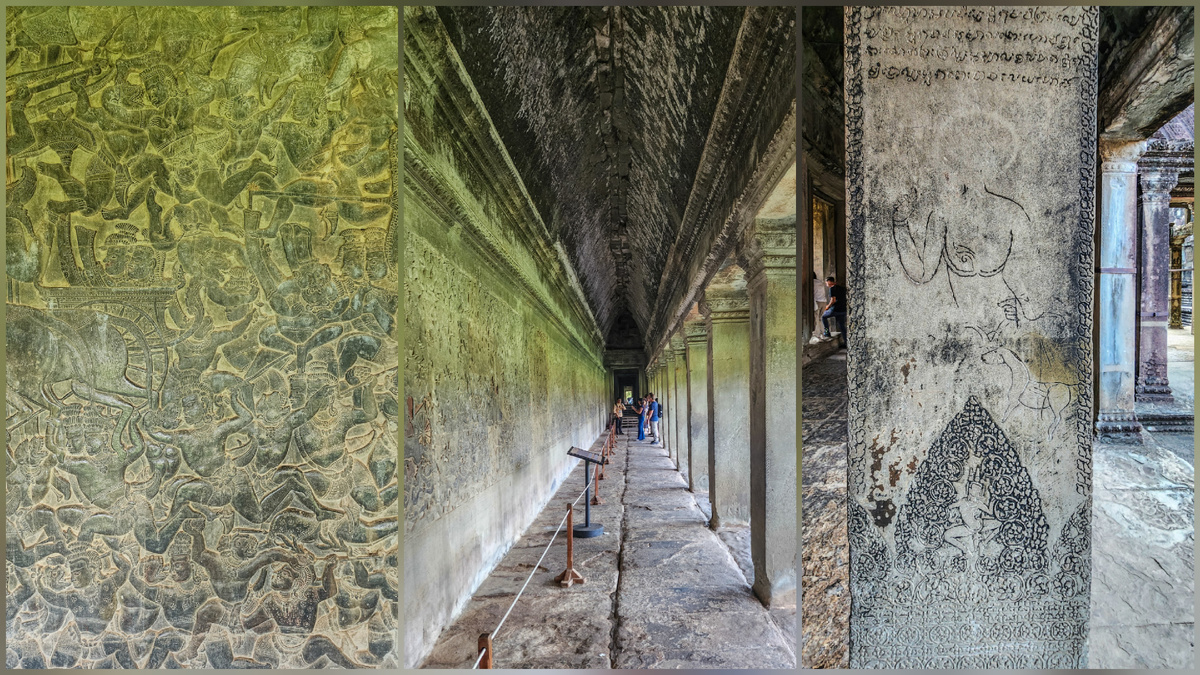
Heaven and Hell at Angkor Wat
Another gallery takes the visitor somewhere much darker. The Heaven and Hell relief presents judgment after death, with Yama, the god associated with death and judgment, at the centre of the scene.
From there, human destinies separate. The upper zones show heavenly rewards, while below them the sculptors created vivid scenes of punishment. People are dragged, pierced, crushed or tormented according to their fate.
These scenes were not simply decoration. They communicated ideas about behaviour, morality and cosmic order to people who understood this visual language far more easily than most visitors do today.
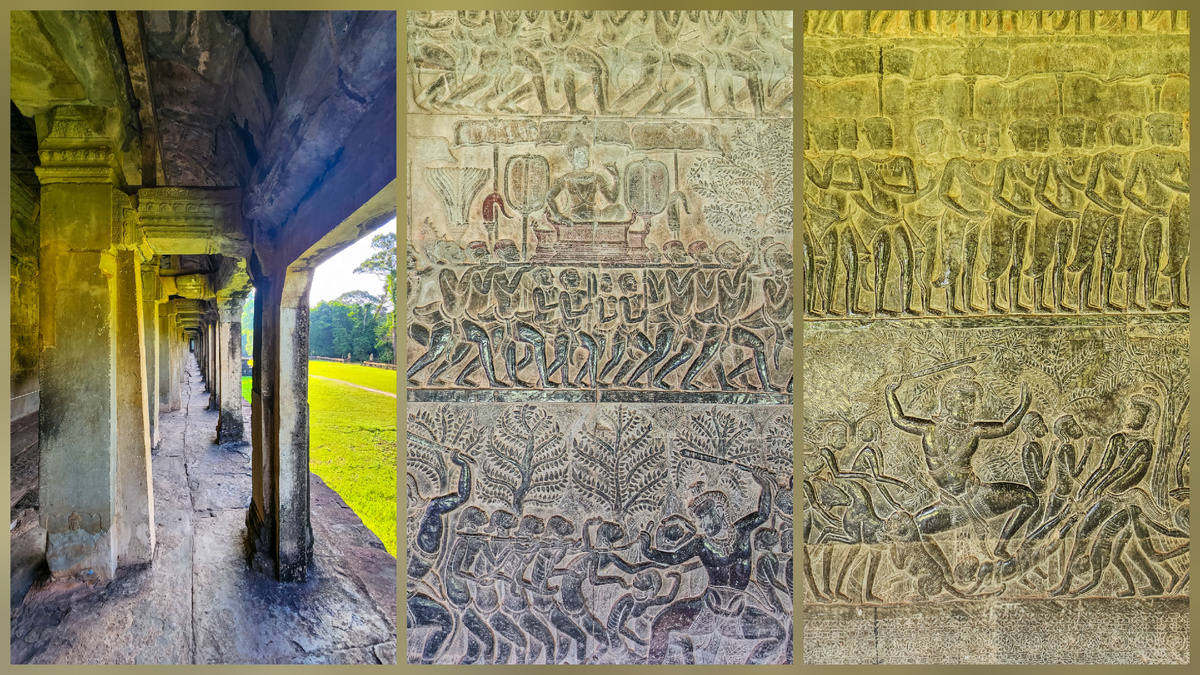
Apsaras and Devatas: What Is the Difference?
One of the most common mistakes at Angkor Wat is to call every carved female figure an apsara. The distinction is not completely rigid in every modern description, but it is useful.
Apsaras
Apsaras are celestial female beings associated with dance, beauty and the divine world. At Angkor Wat, they often appear within narrative or mythological scenes, where they may dance, float or participate in a larger supernatural event. The Churning of the Ocean of Milk is a good place to see them as part of a story.
Devatas
The large standing female figures seen throughout Angkor Wat are more accurately described as devatas. They usually stand frontally or almost frontally, occupying their own architectural spaces rather than participating in a narrative scene.
This is where looking closely becomes rewarding. Compare two figures and look at the hair, jewellery, clothing and ornaments. They are much less repetitive than they initially appear.
What Sappho Marchal Learned from 1,737 Devatas
In 1927, Sappho Marchal carried out one of the most fascinating studies of Angkor Wat’s female figures. Rather than treating the devatas as decorative background, she systematically studied 1,737 standing figures, recording details of their clothing, jewellery, flowers and hairstyles.
Marchal grouped hairstyles into several broad types, with many variations inside those categories. This is more accurate than the popular travel claim that researchers discovered exactly “37 hairstyles”. The real story is better: Angkor Wat contains an enormous visual catalogue of different arrangements of hair, ornaments and clothing.
Some women have high, complicated hairstyles, while others wear buns, flowers, crowns or decorative elements. Their jewellery includes earrings, necklaces, upper-arm ornaments, bracelets and belts, and the garments also change from figure to figure.
This does not mean every devata is a portrait of a specific woman from Suryavarman II’s court. There is no evidence that allows us to identify them as individual queens, wives or court ladies. But the artists did not create their visual world from nothing. The clothing, jewellery and hairstyles almost certainly drew at least partly from the material culture and artistic conventions familiar to the people who built Angkor Wat.
Stone has survived where textiles, flowers and hairstyles could not. That makes these figures unusually valuable because they preserve not only religious imagery, but traces of how elite beauty and ornament were imagined in Angkorian Cambodia.
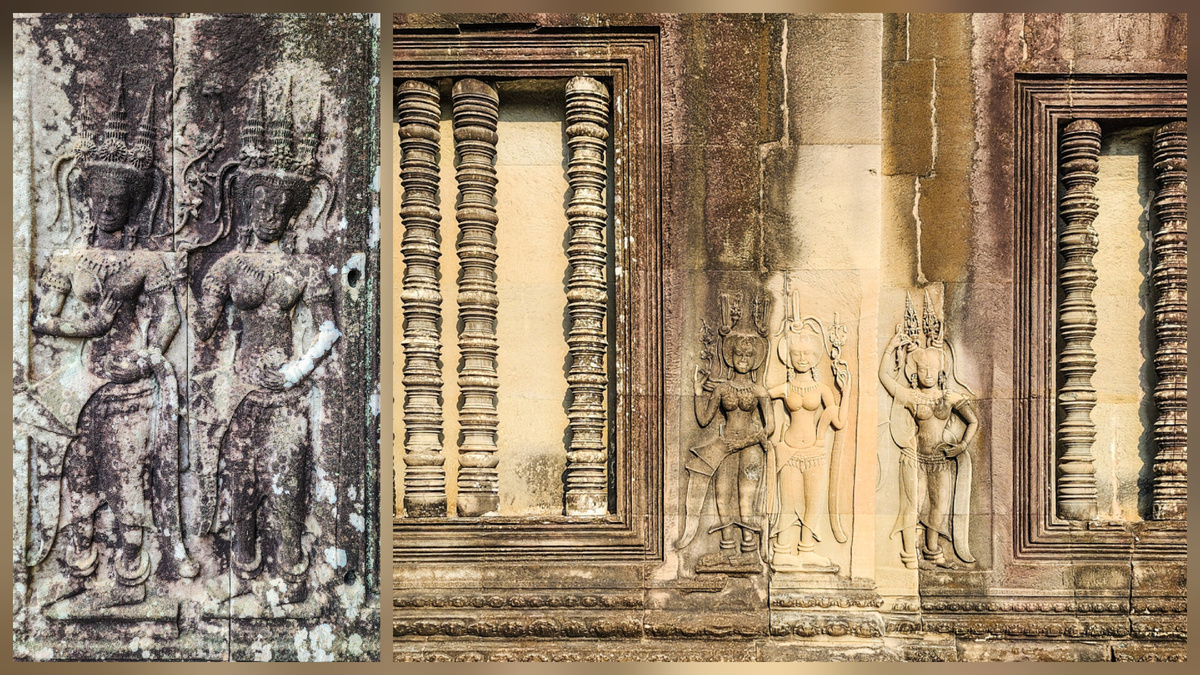
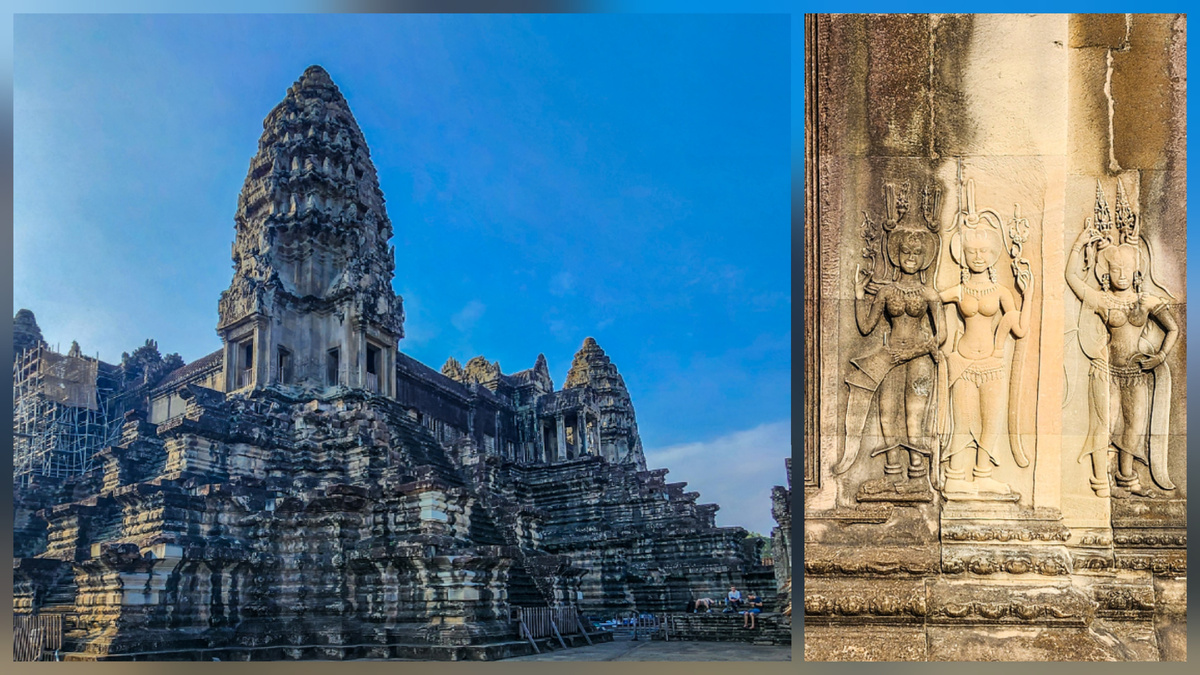
Find the Devata Who Shows Her Teeth
There is one detail around the western entrance that is worth turning into a small Angkor Wat treasure hunt. Most devatas have the restrained expression associated with classical Khmer sculpture, with their lips closed. But there are unusual figures whose smiles reveal their teeth.
One has become particularly famous among guides and visitors. You may hear that she is the only tooth-showing woman at Angkor Wat, but that claim is too neat because researchers have identified more than one figure with visible teeth.
The famous smiling devata is still worth looking for. After seeing dozens of controlled, formal expressions, the open smile feels surprisingly different. Why did the sculptor make her this way? We do not know, and there is no need to invent a story about a rebellious stone carver or a secret lover. The unexplained detail is interesting enough on its own.

Not Every Bas-Relief Is From the 12th Century
Angkor Wat feels like one complete monument created during the reign of Suryavarman II, but it is not quite that simple. Most of the famous narrative programme belongs to the original 12th-century temple, while parts of the relief decoration in the northeastern galleries were completed or added centuries later, probably in the 16th century.
That tells us something important about Angkor Wat. The temple did not simply stop existing when Cambodia’s political centre shifted elsewhere. It continued to be used, its religious identity changed, and later generations repaired, altered and added to it. Even the stone book of Angkor Wat contains pages written in different centuries.
How to Read a Bas-Relief Without Knowing the Whole Myth
You do not need to memorise the Mahabharata before visiting Angkor Wat. Start with a few simple questions.
First, find the centre of the composition. There is often a king, deity or major event organising everything around it. Then look at hierarchy: who is larger, who sits higher, who has a parasol, and who wears the most elaborate crown?
Next, look at repetition. Rows of soldiers, gods or demons often create movement through the scene. Finally, look below the main action, where animals, servants, ordinary soldiers and secondary figures often contain some of the best details.
Once you start doing this, the panels become much easier to follow. You can absolutely enjoy the galleries without a guide, but Angkor Wat is one of the places where knowing the story changes what you see. Without context, the Churning of the Ocean of Milk can look like two enormous rows of people holding a snake. With context, you can find Vasuki, Mount Mandara, Vishnu, Kurma, the devas, the asuras and the celestial beings created by the churning.
The stone has not changed. Your ability to read it has.
Affiliate disclosure: This article contains affiliate links. If you book through them, I may earn a commission at no extra cost to you.
From Stone Apsaras to Cambodian Dance
The female figures at Angkor Wat did not remain only in stone. Cambodia’s classical court dance tradition is much older than modern tourism, while the modern Apsara role developed in the 20th century using Angkorian imagery as an important visual reference.
Its crowns, jewellery, costumes and image of the celestial dancer make the connection immediately recognisable. That does not mean Apsara dance was simply reconstructed from temple bas-reliefs, because the Royal Ballet of Cambodia is a living court tradition with its own long history. But seeing an Apsara performance after spending time with the carvings makes the relationship between ancient Khmer art and modern Cambodian performance much easier to recognise.
The Walls Are Part of the Story
You do not need to inspect every carved surface at Angkor Wat. Choose a few things and look properly: find the Churning of the Ocean of Milk, the royal imagery of Suryavarman II and the scenes of Heaven and Hell. Then stop looking at enormous narratives for a moment and find individual devatas.
Compare their hairstyles, look at earrings and necklaces, notice the folds and decoration of their clothing, and try to find a figure showing her teeth near the western entrance. That approach works much better than rushing past hundreds of metres of carving and trying to absorb everything at once.
Angkor Wat is famous because of its scale, but scale is only half of what makes it extraordinary. The walls preserve mythology, royal power, ideas about judgment after death, celestial dancers and details of clothing that disappeared from the physical world centuries ago.
A fifty-metre mythological scene and the hairstyle of a single devata can both tell us something about the people who created the temple. The towers tell you how ambitious Angkor was. The walls tell you what its people wanted to say.
Useful Travel Resources
Flights
Compare flights to Cambodia and other destinations in Southeast Asia.
Hotels
Compare accommodation in Siem Reap for your Angkor visit.
Tours & Activities
Browse Angkor tours and other Siem Reap activities.
Tours & Experiences
Compare guided Angkor experiences.
Airport Transfers
Arrange transportation between Siem Reap Angkor International Airport and your accommodation.
eSIM
Set up mobile data before arriving in Cambodia.
Travel Insurance
Check travel insurance options before your trip.