Laughing Buddha Meaning: Budai, Di Lac & the Big Belly
The round belly and broad smile are easy to recognise. The identity takes a little more untangling. The Laughing Buddha is the smiling, round-bellied figure of Budai, a Chinese monk who became identified with Maitreya, the Buddha of the future. His image brings together generosity, good fortune and hope. In Vietnam, the familiar smiling figure is usually called Di Lac, written Di Lặc in Vietnamese.
He is not a portrait of Siddhartha Gautama, the historical Buddha. Nor does every image of Maitreya have a large belly. Understanding that distinction changes how you look at the statues in a pagoda courtyard, and at the small versions sold as souvenirs.
Laughing Buddha meaning: the names behind the smile
Three names often appear in explanations of the same smiling figure, but they describe different parts of the story.
| Name | What it refers to |
|---|---|
| Budai | The Chinese cloth-sack monk behind the round-bellied image |
| Hotei | The Japanese name for Budai; he is also one of Japan’s Seven Lucky Gods |
| Maitreya / Di Lac | The future Buddha with whom Budai became identified; Di Lac is the Vietnamese name for Maitreya |
The popular English labels “Laughing Buddha” and “Happy Buddha” describe his appearance. “Fat Buddha” also appears in searches and souvenir shops, although it tells you little about the figure’s religious background.
The monk with the cloth sack
Budai is traditionally identified with Qici, a wandering Chinese monk who lived around the tenth century. His name means “cloth sack”, referring to the bag he carried. Stories remember his laughter, simple life and generosity, especially towards children and people in need.
The account mixes a historical monk with later religious storytelling. It is more accurate to describe him as a figure remembered through tradition than to treat every anecdote as a documented event.
His association with Maitreya gave that approachable image a larger religious role. A monk carrying a bag of gifts could also express hope for a future Buddha and a better age.
Why Maitreya does not always look like this
In Buddhist tradition, Maitreya is the Buddha who will appear in a future age. He is also represented as a bodhisattva awaiting that future Buddhahood. In Indian, Himalayan and other Buddhist art, he can be slender, richly adorned or seated in a contemplative pose.
The smiling Budai form is one East Asian way of depicting him. It is not a universal visual definition of Maitreya, and it does not replace the historical Buddha’s life or teachings.
Di Lac in Vietnam
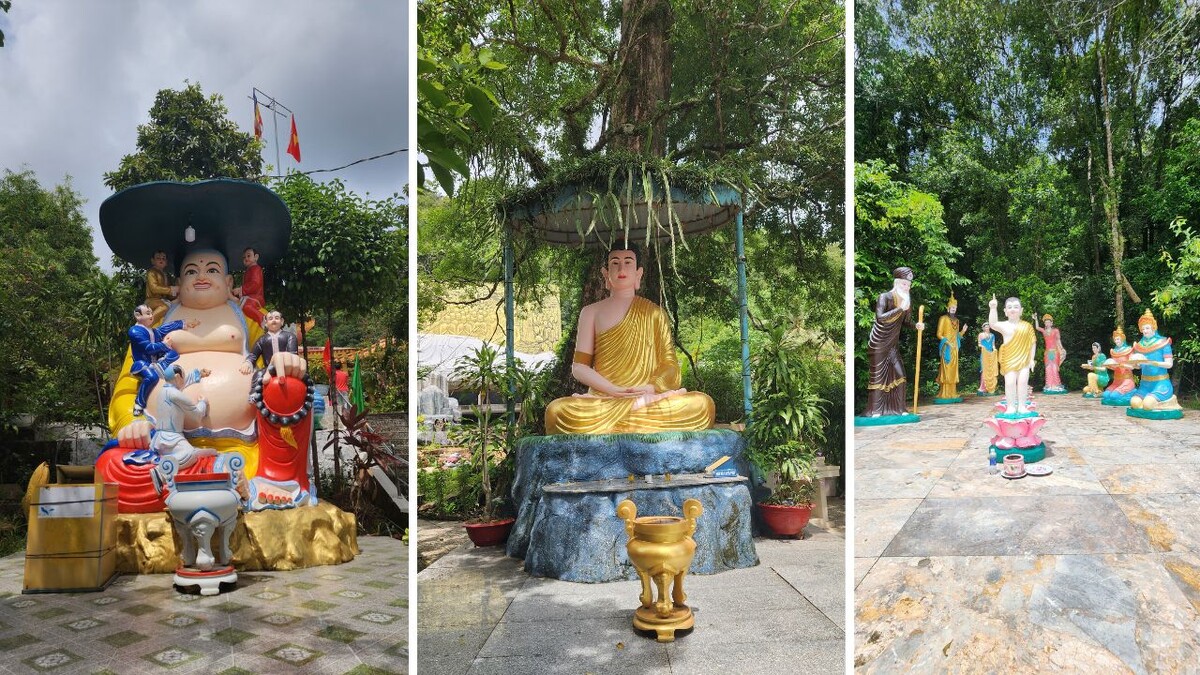
In Vietnamese pagodas, Di Lac is recognisable by his open robe, exposed belly and cheerful face. He may sit, stand or recline. Children, prayer beads, a fan or objects associated with prosperity can appear beside him.
The image makes room for a warmer response than solemn attention alone. You notice the smile before you understand the name. To me, that is part of its appeal when travelling: a religious figure can catch your attention through an expression you recognise, then lead you into a story you did not know.
That does not mean every worshipper sees him simply as a symbol of money or positive thinking. Devotion, hopes for good fortune and local customs overlap, with different emphases in different settings.
What the belly, bag and other details suggest
A statue is worth looking at closely, but it is not a code in which every object has one fixed translation. The setting and local explanation matter.
The round belly and smile
Budai’s ample body and laughter are his most familiar identifying features. In popular imagery, they suggest contentment, plenty and good fortune. The figure looks comfortable in the world rather than withdrawn from it.
The idea that his belly can “hold” other people’s troubles is an evocative popular interpretation. It should not be mistaken for a rule that explains every sculpture. The same applies to reading the smile as a lesson in meeting difficulties without becoming bitter: it is a way of responding to the image, rather than a full statement of Buddhist doctrine.
The cloth bag
The bag has the clearest link to his name and story. Budai is remembered carrying a sack and sharing its contents with others. That makes generosity an essential part of the image, alongside the prosperity often emphasised in souvenir versions.
A ball, gourd or gold ingot should not automatically be read as a substitute for the same sack. Their meanings depend on the object and the particular composition. An ingot may emphasise wealth; a rounded object may be harder to identify from a distance. Look before assigning it a story.
Children and companions
Children often cluster around Budai, climbing on him or playing nearby. They connect with stories of his kindness and give the scene an affectionate, playful character. Popular readings may emphasise family happiness and prosperity.
Companions are not always interchangeable, however. Their number, clothing and gestures may belong to a specific local arrangement. A group of figures around one statue does not establish the meaning of every other group you encounter.
Beads, a fan and hand gestures
Prayer beads recall religious practice. A fan is another familiar attribute in Budai and Hotei imagery. These details help identify the figure, but a fan does not always mean “cooling anger”, just as an upturned palm does not automatically identify a particular blessing.
For a specific statue, a temple label or an explanation from the people who care for it is more useful than a universal souvenir-symbol chart.
The statue that caught my attention at Su Muon
At Su Muon Pagoda on Phu Quoc, I noticed a variation that felt unusually close to everyday life. Around the smiling figure were smaller male figures in clothing that looked contemporary to me, rather than the familiar scene of children playing.
I read it as a meeting between the future Buddha and ordinary human concerns: work, money, status and the wish for some peace among them. That was my impression of the scene. I would not assign the figures professions or claim to know the sculptor’s intention without a local explanation.
For the setting around the statue, my Su Muon Pagoda guide covers the temple grounds and my visit. It is a different kind of island stop from a beach afternoon, with time to look at individual figures instead of moving straight to the next viewpoint.
Recognising the figure on a temple visit
An exposed round belly, broad smile and sack are useful clues to the Budai form. Do not rely on posture or location alone. A seated figure in meditation may be someone else, and a reclining Buddha is not automatically a reclining Budai.
Di Lac may appear in a courtyard or near an entrance, while other Buddhas and bodhisattvas occupy the main worship spaces. Arrangements vary. There is no single floor plan that explains every Vietnamese pagoda.
Treat the statue as part of an active religious setting. Follow signs about shoes and photography, give worshippers space and ask before touching an image. Rubbing the belly for luck should never be assumed to be acceptable at a temple.
Adding a pagoda stop to a Phu Quoc trip
Place Su Muon within a manageable day rather than crossing the island for one photograph. My Phu Quoc itinerary groups outings by zone, and my drive around Phu Quoc shows how temple stops fitted into a longer island outing.
A car lets you combine the pagoda with other stops at your own pace. Select your pickup location and dates, then check the rental conditions before booking.
Compare Vietnam car rentals on Localrent
For organised sightseeing, compare the actual itinerary before booking. A general activity listing is not a promise that Su Muon is included.
For a wider Vietnam trip, compare arrival airports and flight times before arranging the days you will spend on Phu Quoc.
What stays with me beyond the souvenir
The smile is what makes this figure easy to remember. The sack gives it a more demanding idea: abundance includes having something to share. Knowing the story also leaves room for the religious meaning of Maitreya, and for the different hopes people bring to the same statue.
At Su Muon, I was drawn to the human scale of the scene around that large belly. It made me stop and look. That is what I would take into the next pagoda visit: recognise Di Lac, then notice what is particular to the statue in front of you.
This article contains affiliate links. I may earn a commission if you book through them, at no extra cost to you.