2 Days in Hue, Vietnam: Imperial City, Royal Tombs & the Perfume River
Planning 2 days in Hue gives you enough time to experience the city at a different pace from most stops in Central Vietnam. Hue grew around the Perfume River and the former imperial capital of the Nguyen Dynasty, with palaces, pagodas and royal tombs spread well beyond the walls of the Imperial City.
Two full days work well for a first visit. You can spend one day exploring the Imperial City, Thien Mu Pagoda and the riverfront, then use the second for the royal tombs south of the centre. You will still need to choose rather than see everything, but that is a much better way to experience Hue than trying to squeeze the entire city into a rushed day trip.
This itinerary focuses on what fits together geographically, what deserves your time and where booking transport or a tour can genuinely make the trip easier.

Prices and practical information in this guide were checked in September 2026.
How Many Days Do You Need in Hue?
For most first-time visitors, 2 full days in Hue is a good balance.
| Time in Hue | What fits comfortably |
|---|---|
| 1 day | Imperial City plus Thien Mu Pagoda or one royal tomb |
| 2 days | Imperial City, Thien Mu, Perfume River, two royal tombs and an evening in central Hue |
| 3 days | Add Ho Thuy Tien, Tam Giang Lagoon, more tombs or a slower day outside the centre |
A day trip from Da Nang is possible, but you will spend a significant part of the day getting there and back. If Hue is more than a box to tick, staying overnight makes much more sense.
2 Days in Hue: A Realistic Itinerary
Day 1: Imperial Hue and the Perfume River
Start at Hue Imperial City
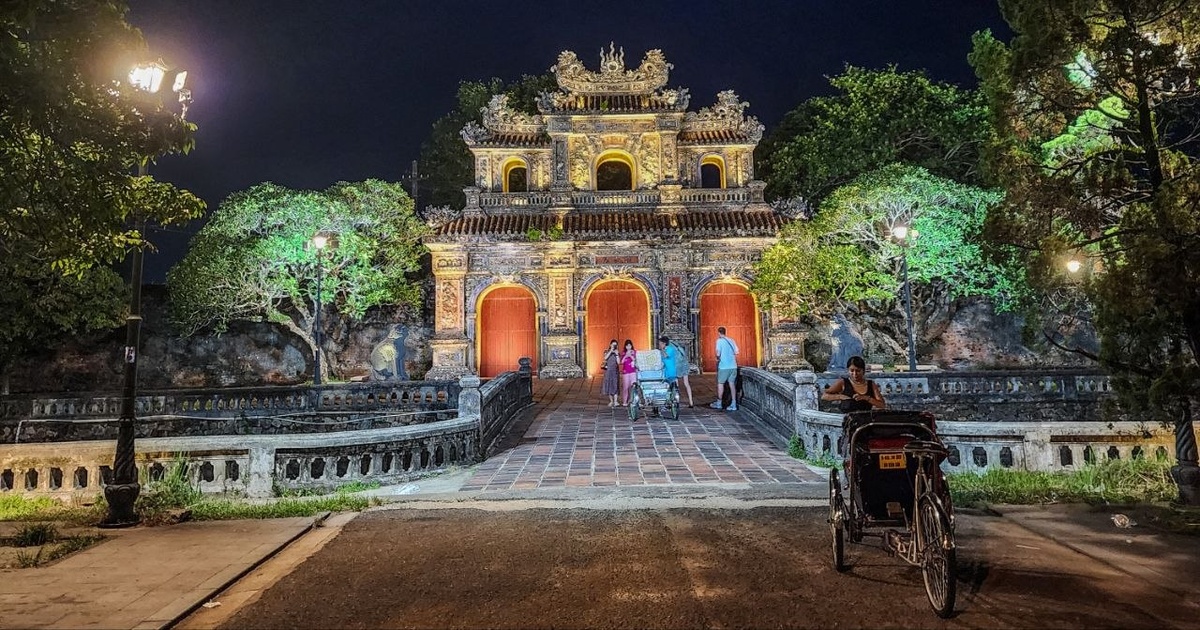
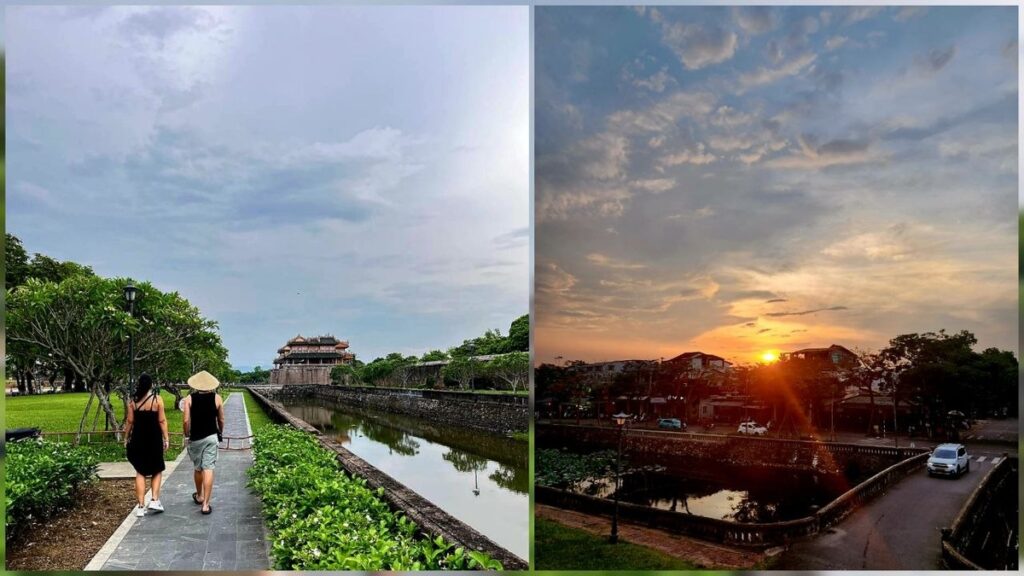
The obvious place to start is Hue Imperial City (Đại Nội), the political centre of the Nguyen Dynasty from the early 19th century until the end of imperial rule in 1945.
Do not underestimate its size. This is not a single palace that you walk through in 30 minutes. Behind Ngo Mon Gate are ceremonial halls, courtyards, temples, gates, gardens and the remains of the Purple Forbidden City.
For a first visit, allow at least 2 to 3 hours rather than trying to inspect every structure.
Some of the main places to look for include:
- Ngo Mon Gate, the monumental southern entrance
- Thai Hoa Palace, one of the main ceremonial spaces
- the Purple Forbidden City, once reserved for the emperor and royal household
- the Nine Dynastic Urns and temple areas
- the contrast between reconstructed buildings and the more fragmentary parts of the complex
The current adult entrance fee is 200,000 VND, and the complex is currently listed as open from 07:30 to 17:30.
Going early is still the best option, especially in hotter months. There is a lot of open ground between buildings, and the visit involves considerably more walking than the entrance view suggests.
Visiting independently? You can check the current Hue Imperial City ticket on Trip.com.
If you would rather understand what you are looking at instead of simply walking through the complex, this Hue Imperial City Walking Tour: Citadel & Forbidden City is a more focused option.

Continue to Thien Mu Pagoda
After the Imperial City, head west along the Perfume River to Thien Mu Pagoda.
Its seven-storey Phuoc Duyen Tower is one of the most recognisable landmarks in Hue, but the site extends beyond the tower itself. The pagoda was founded in 1601 and remains one of the city’s best-known Buddhist sites.
One unusual historical object is kept within the complex: the car associated with monk Thich Quang Duc, who travelled to Saigon before his self-immolation in 1963 during protests against the treatment of Buddhists under the Ngo Dinh Diem government.
You can reach Thien Mu by road or make the journey part of the experience by travelling along the Perfume River.
Spend the Evening Along the Perfume River
This is the part of Hue that easily gets lost when an itinerary focuses only on monuments.
The Perfume River (Sông Hương) gives central Hue much of its atmosphere once the sightseeing sites begin to close. Its riverfront has promenades, parks and open spaces, while the area around Trang Tien Bridge becomes livelier after dark.
Walk beside the river, cross Trang Tien Bridge and continue towards Nguyen Dinh Chieu Walking Street. Depending on the evening, you may find food stalls, small markets, music and plenty of people simply spending time by the water.
Traditional Ca Huế music is closely associated with evening performances on the river. If that sounds more interesting than another night in a restaurant, you can book a Perfume River dinner cruise with a folk music show.
For something quieter and more focused on the river itself, there is also an electric boat cruise along the Perfume River and hidden canals.
Day 2: Hue’s Royal Tombs
Hue’s royal tombs are much more than graves. Several were designed as landscaped complexes with temples, pavilions, lakes and spaces that emperors used while still alive.
That is also why trying to see four or five in one day is not necessarily the best plan. After a while, even impressive complexes can start to blur together.
For a first visit, choose two.
Which Hue Royal Tombs Should You Visit?
| Tomb | Best for |
|---|---|
| Minh Mang | Classical symmetry, gardens and a traditional imperial layout |
| Khai Dinh | Dramatic contrast between a severe exterior and highly decorative interior |
| Tu Duc | A more romantic, park-like complex with water and pavilions |
| Gia Long | A quieter and more spread-out site away from the most common first-time circuit |
These four complexes feel very different from one another: Minh Mang is formal and symmetrical, Tu Duc feels more like a landscaped retreat, Khai Dinh is dramatically different in concrete and mosaic, while Gia Long is the quieter, more remote option.
Best Pair for a First Visit: Minh Mang + Khai Dinh
If you only want two, Minh Mang and Khai Dinh make the clearest pair because they show two very different approaches to royal architecture.
Minh Mang is about order, symmetry, water and landscape.
Khai Dinh is almost the opposite. Its exterior rises in grey concrete on the hillside, while the interior is dense with colourful decorative work and mosaic.
That contrast makes the second tomb feel like a genuinely different experience.
Hue Tomb Ticket Prices in 2026
Current adult prices are:
- Minh Mang: 150,000 VND
- Tu Duc: 150,000 VND
- Khai Dinh: 150,000 VND
- Gia Long: 150,000 VND
If you are also visiting the Imperial City, the combination tickets are worth checking.
The Imperial City + two of the three main tombs combination costs 420,000 VND.
The package covering the Imperial City + Minh Mang + Tu Duc + Khai Dinh costs 530,000 VND.
The broader all-monuments ticket costs 600,000 VND.
For this two-day itinerary, the 420,000 VND option is likely to make the most sense if your chosen pair is Minh Mang, Tu Duc or Khai Dinh.

DIY, Driver or Guided Tour?
This is one part of Hue where paying for transport can make sense.
The tombs sit outside the compact central area and are not grouped into one walkable district. Visiting independently is perfectly possible, but you need to organise transport between the sites.
If you would rather have transport, sightseeing and lunch handled together, this Hue Imperial City Full-Day Guided Tour from Hue combines several of the city’s major sights.
Another option is this Hue full-day or half-day city tour with the Citadel and a royal tomb.
If you are comfortable arranging transport yourself, there is no need to book a tour just for the sake of it.
Optional Stop: Thuy Xuan Incense Village
Thuy Xuan Incense Village is commonly combined with the royal tomb route.
Treat it as an optional stop rather than one of Hue’s essential historical sights. It works well if you are already passing through the area and want a shorter, colourful break between larger monument complexes.
If time is tight, spend the extra time at the tombs instead.
What About Ho Thuy Tien?
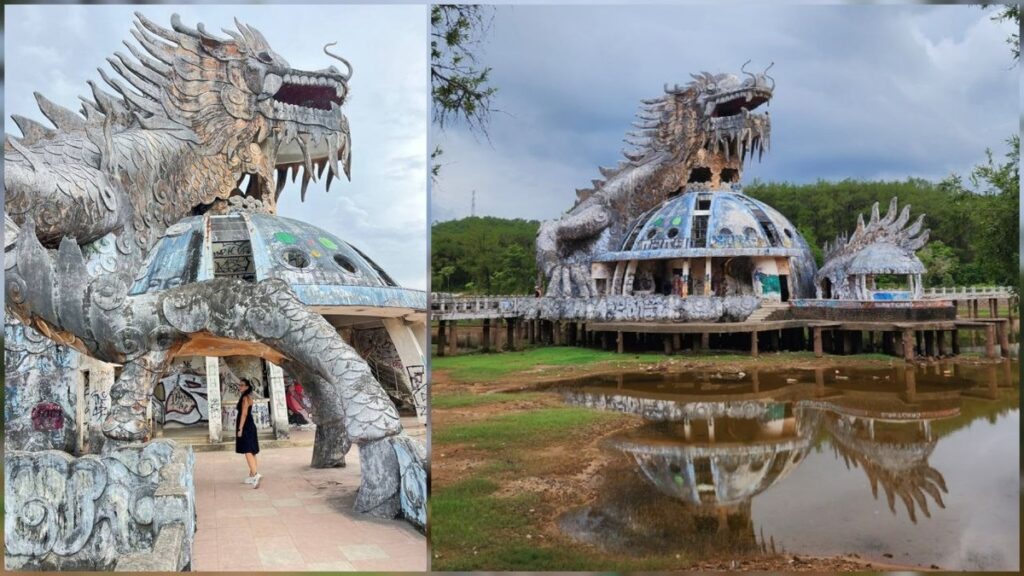
Ho Thuy Tien became internationally known as Hue’s abandoned water park, especially because of the enormous dragon structure rising beside the lake.
I visited when the abandoned atmosphere was still a major part of the experience. Inside the dragon were concrete staircases and narrow passages leading upwards towards the head. Around the site were empty pools, graffiti and deteriorating structures that made the whole place feel very different from Hue’s restored imperial monuments.
That older experience is still part of the story, but the practical information has changed.
In 2026, it is misleading to simply repeat older blog advice about an unofficial abandoned attraction. The city now manages the area as Ho Thuy Tien Park, with improvements to the grounds, organised parking and visitors continuing through parts of the site on foot.
So if you find old posts telling you to sneak in, negotiate with a guard or pay an unofficial entrance fee, treat that information as outdated.
For a two-day first visit, Ho Thuy Tien is an optional extra rather than a must-do. It makes more sense if abandoned architecture and unusual places particularly interest you, or if you have a third day.
You can open Ho Thuy Tien in Google Maps.
What to Do in Hue at Night
Hue is quieter than Da Nang, but that does not mean there is nothing to do once the monuments close.
For a first evening, keep it simple:
- walk beside the Perfume River
- cross Trang Tien Bridge after dark
- explore Nguyen Dinh Chieu Walking Street
- try local food or salted coffee
- watch a Ca Huế performance or take an evening boat trip
That is also one of the reasons staying overnight makes more sense than treating Hue purely as a long day trip.

What to Eat in Hue
Hue cuisine deserves more than one bowl of bún bò before leaving town.
Bún Bò Huế
The city’s most famous dish is a spicy noodle soup traditionally built around beef, lemongrass and the deep savoury flavour of fermented shrimp paste.
Versions are now found all over Vietnam, but Hue is the obvious place to try it in context.
Cơm Hến
A very different local dish, usually built around rice and small clams with a mixture of crunchy, fresh and savoury ingredients.
Bánh Bèo
Small steamed rice cakes served in individual dishes and topped with savoury ingredients such as dried shrimp.
Bánh Khoái
A crisp local pancake worth looking for if you want to go beyond the few dishes that appear in every Hue checklist.
Cà Phê Muối
And then there is salted coffee.
Cà phê muối originated in Hue and has since spread far beyond the city. The salt is not there to make the drink taste salty. It balances the bitterness of the coffee and the sweetness of the creamy layer.

If food is going to be a substantial part of your time in Hue, a guided tasting route can also make sense. This Hue local food tour includes eight tastings and local food stops.
Where to Stay in Hue for 2 Days
For a short first stay, location matters more than having a resort-style hotel.
The central area south of the Perfume River is convenient for restaurants, cafés, Trang Tien Bridge and the evening riverfront, making it an easy choice if you only have two days.
White Lotus Hue Hotel: Best All-Round Choice
White Lotus Hue Hotel is the practical option of the three. It has a central location close to the Perfume River and works well if you want a comfortable hotel without turning accommodation into the main event.
Melia Vinpearl Hue: Best for Modern Comfort
Melia Vinpearl Hue makes more sense if you want a modern upscale hotel, city views and the facilities of a larger international property while remaining central.
Azerai La Residence: Best for Character
Azerai La Residence is the most distinctive option.
The Art Deco property occupies a former French colonial residence beside the Perfume River. If the hotel itself is part of the experience you want from Hue, this is the one to look at first.
Hotel rates vary significantly by date, so it is more useful to compare current prices than to hard-code nightly rates into an itinerary.
How to Get to Hue
Hue works naturally as part of a Central Vietnam route and can be reached by train, road or air.
From Da Nang
The most scenic public transport option is the Heritage Connection train, which crosses the Hai Van Pass and passes Lang Co on the journey between Da Nang and Hue.
Regular trains, vans, private transfers and organised day tours are alternatives.
If you only want to visit Hue for the day, this Hue Imperial City day trip from Da Nang via the Hai Van Pass by train combines the journey with sightseeing.
There is also a Da Nang to Hue day trip with the Hai Van train and lunch.
If you only need the train rather than a complete tour, you can also check this Hue to Da Nang Heritage Train ticket via the Hai Van Pass.
Flying to Hue
Hue has its own airport, Phu Bai International Airport (HUI).
For domestic flights from cities such as Hanoi or Ho Chi Minh City, you can compare flights to Hue on Trip.com.
If you prefer to have the journey from the airport arranged before arrival, you can also compare airport transfers on Trip.com.
How Much Should You Budget for Hue Sightseeing?
A single fixed figure for a two-day Hue budget is not especially useful because transport, food and tours vary too much.
A better starting point is the cost of the main imperial attractions:
- Imperial City alone: 200,000 VND
- Imperial City + two main tombs: 420,000 VND
- Imperial City + three main tombs: 530,000 VND
- broader monument pass: 600,000 VND
Then add local transport, food, coffee and any tour or river activity you choose.
For many first-time visitors following this itinerary, 420,000 VND is the most relevant core sightseeing-ticket cost, before transport and meals.
Is One Day in Hue Enough?
One day is enough to see part of Hue, but not enough to cover everything comfortably.
If you have one day, choose the Imperial City plus either Thien Mu Pagoda or one royal tomb.
Trying to add two tombs, the river, Ho Thuy Tien and several photo stops turns the day into a sequence of rides and rushed entrances.
If you are travelling through Central Vietnam and can spare the night, stay.
Can You Visit Hue as a Day Trip from Da Nang?
Yes.
A day trip works if your priority is the Imperial City and perhaps one additional major site.
It becomes much less attractive if you want to include several royal tombs, the evening riverfront and a slower look at the city.
Which Two Royal Tombs Are Best for a First Visit?
For the strongest contrast, choose Minh Mang and Khai Dinh.
Choose Tu Duc instead if you prefer a landscaped, more reflective complex and are less interested in dramatic architectural contrast.
Is Ho Thuy Tien Still an Abandoned Water Park?
Not in the way older travel articles describe it.
The dragon and remains of the former water park are still the reason many travellers know the site, but the area is now being actively managed and improved.
Older firsthand accounts are still interesting for understanding what Ho Thuy Tien used to be like, but they should not be relied on for current access information.
Is Hue Worth Staying Overnight?
For most first-time visitors, yes.
Staying overnight gives you an evening along the Perfume River and allows you to separate the Imperial City from the royal tombs instead of squeezing everything into one long sightseeing day.
For a first trip, two days and one or two nights is a good balance.
Plan Your Hue Trip
Stay in Hue: Compare current hotel rates on Trip.com, including White Lotus Hue Hotel, Melia Vinpearl Hue and Azerai La Residence.
Imperial City tickets: Check Hue Imperial City tickets on Trip.com.
Hue tours: For a full sightseeing day, compare the Hue Imperial City Full-Day Guided Tour or Hue city and royal tomb tour.
Flights: Compare flights to Hue on Trip.com.
Airport transfers: Book or compare Hue airport transfers on Trip.com.
Vietnam eSIM: Compare Asia and Vietnam eSIM options on Trip.com.
Some links on this page are affiliate links. If you make a booking or purchase through one of them, I may earn a small commission at no extra cost to you.