Pre Rup Temple in Siem Reap: History, Architecture & How to Visit
Pre Rup is one of the temples that is easy to underestimate when planning a trip around Angkor. It often appears as another stop on the Grand Circuit, somewhere between larger names on a long list of temples, and many visitors spend only twenty or thirty minutes here before moving on.
It deserves more attention than that.
Built in the 10th century as the state temple of King Rajendravarman II, Pre Rup is one of Angkor’s most impressive temple-mountains. Its steep pyramid, brick towers and reddish laterite look particularly striking in the low afternoon light, while the upper terrace gives a much better sense of the surrounding landscape than you get from many of the flatter temples nearby.
I visited Pre Rup during a day exploring the temples independently, together with Banteay Samré and Banteay Srei before continuing south later in the day. You can see how I fitted these places into my three-day Siem Reap and Angkor itinerary.
Pre Rup Temple Quick Guide
| Location | Angkor Archaeological Park, east of the main Angkor complex |
| Date | Consecrated in 961 |
| King | Rajendravarman II |
| Religion | Hindu |
| Main deity | Shiva |
| Temple type | Temple-mountain / state temple |
| Main materials | Brick, laterite and sandstone |
| Time needed | Around 40–60 minutes |
| Ticket | Angkor Pass required |
| Best time to visit | Morning or late afternoon |
| Good to combine with | East Mebon, Ta Som, Srah Srang and the Grand Circuit |
Where to Stay in Siem Reap
Pre Rup is easily visited from Siem Reap and there is no reason to stay near the temple itself. Central Siem Reap is generally the most practical base if you are spending several days exploring Angkor, especially if you also want restaurants and transport within easy reach in the evenings.
What Is Pre Rup?
Pre Rup was constructed during the reign of Rajendravarman II, who ruled the Khmer Empire from 944 to 968. The temple was consecrated in 961 and dedicated to the Hindu god Shiva.
Rajendravarman’s reign came after a period in which the royal capital had shifted away from Angkor to Koh Ker. After returning the political centre to the Angkor region, the king launched a major building programme that included East Mebon and, several years later, Pre Rup. Cambodia’s Ministry of Tourism describes Pre Rup as the king’s state temple and notes its importance as one of the major monuments built after the capital returned from Koh Ker.
At the centre of the upper sanctuary stood a Shiva linga called Rajendrabhadreshvara, whose name was directly associated with the king. This combination of royal authority and the worship of Shiva was central to the religious and political meaning of the temple.
Pre Rup therefore was not simply another shrine outside the capital. It was one of the principal royal monuments of its period.
A Temple-Mountain Built as Mount Meru
Pre Rup belongs to the Khmer tradition of the temple-mountain, in which architecture was used to represent Mount Meru, the sacred mountain at the centre of Hindu cosmology.
The effect becomes obvious as soon as you approach the temple. Instead of entering a largely horizontal complex, you move gradually upward toward a group of sanctuaries raised above the surrounding countryside.
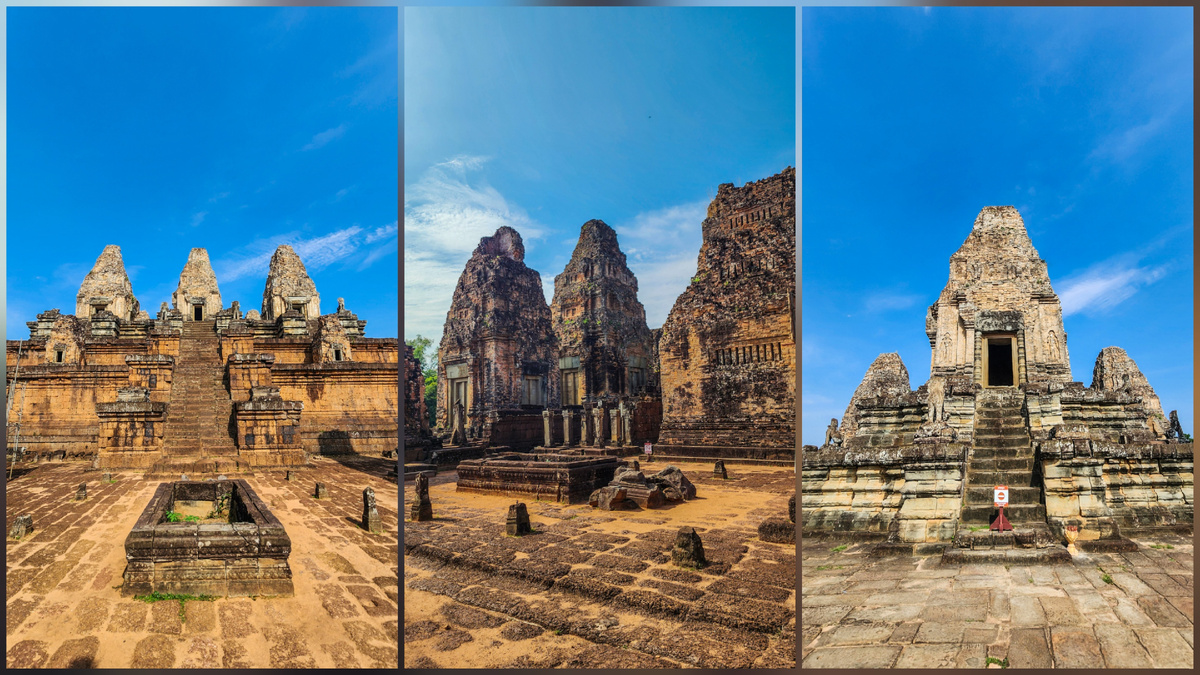
The central pyramid has three tiers, with five brick sanctuary towers arranged on the highest platform: one in the centre and four at the corners. The central tower represents the dominant summit, while the overall composition evokes the sacred geography of Mount Meru.
APSARA’s description of the site also records five large brick sanctuaries on the lower level and twelve sanctuaries on the next level, so the five towers at the summit were only the most prominent part of a much more extensive architectural composition.
The climb is part of the experience. From ground level the temple feels massive and compact, but the proportions change as you move up through its terraces.

Brick, Laterite and Sandstone
One of the most distinctive features of Pre Rup is its colour.
The temple combines brick, laterite and sandstone, each used for different structural purposes. APSARA’s recent conservation material explains that brick was used extensively in the sanctuary structures, laterite in foundations, walls and stairways, and sandstone for elements that required greater strength or more elaborate finishing, including floors, door frames and columns.
This mixture gives Pre Rup its reddish-brown appearance. In direct midday sun the surfaces can look dry and harsh, but early or late in the day the brick and laterite take on much warmer tones.
That is one reason Pre Rup photographs particularly well in lower light. The effect comes from the materials themselves rather than from elaborate surface decoration.
There is still decorative work worth looking for, however. APSARA specifically highlights the devatas on the south-west sanctuary, while the upper towers preserve carved false doors, lintels and other sandstone details despite centuries of weathering.
What You See as You Climb Pre Rup
Pre Rup is easiest to understand as a sequence of increasingly elevated spaces.
The main approach is from the east. Once inside the outer enclosure, the scale of the central pyramid becomes much clearer, and the stairways immediately draw your attention upward.
Around the lower sections are brick sanctuaries and remains of other structures that once formed a much denser architectural setting than the relatively open monument we see today.
The pyramid rises through three main tiers toward the five sanctuary towers at the summit. Stone lions guard several of the stairways, a familiar feature at Khmer temples, while the steep steps reinforce the vertical character of the monument.
At the top, the five towers are arranged in a quincunx, with four corner sanctuaries surrounding the larger central sanctuary.
The central tower once housed the royal Shiva linga, Rajendrabhadreshvara. Standing here makes the temple’s original hierarchy very easy to read: everything below ultimately leads toward the principal sanctuary at the highest point.
How Difficult Is the Climb?
The stairs at Pre Rup are steep, and this is worth knowing before you arrive.
It is not a long hike, but the final ascent is much more vertical than walking around temples such as Ta Prohm or Banteay Kdei. The descent usually requires more concentration than the climb, particularly after rain when the surfaces can become slippery.
Shoes with reasonable grip are much more comfortable than loose sandals. If you are travelling with young children, have limited mobility or dislike steep exposed stairways, there is no need to force the climb simply because other visitors are doing it.
You can still appreciate much of the architecture from the lower levels.
If you do go to the top, take your time on the way down rather than trying to match the pace of people behind you.

Why Is It Called Pre Rup?
The modern name Pre Rup is commonly translated as something close to “turn the body”.
This led to one of the best-known stories about the temple: that it was used for royal cremations and that the body or ashes of the deceased were ritually turned during the ceremony.
The idea became so closely associated with Pre Rup that it is still frequently described as a funerary or cremation temple.
The historical evidence is much less certain.
Cambodia’s Ministry of Tourism explicitly describes the funerary interpretation as a traditional belief and identifies Pre Rup as the state temple of Rajendravarman II. Older archaeological guides also caution that the modern name and the supposed cremation associations are based largely on folklore rather than evidence for the temple’s original function.
This does not mean cremation rituals could never have taken place in or around the site. Cremation was practised in Angkorian Cambodia, and archaeological evidence for funerary activity exists elsewhere in the region. It simply means that the popular explanation of Pre Rup as a purpose-built royal crematorium goes further than the evidence allows.
For visitors, the useful distinction is straightforward: Pre Rup was a royal Shiva temple first; the cremation story belongs to a later tradition attached to its modern name.
The “Stone Sarcophagus” at Pre Rup
One feature near the base of the pyramid has helped keep the funerary interpretation alive.
A large rectangular sandstone structure is sometimes described as a sarcophagus or cremation basin. Earlier visitors naturally connected it with the meaning of the name Pre Rup and assumed it had been used during funerary rituals.
Archaeologists have been much more cautious about that interpretation. Early archaeological guides already noted that the object was unlikely to have been a sarcophagus in the conventional sense and warned against treating local folklore as proof of the monument’s original function.
It is a good example of why Pre Rup is more interesting once you separate what is known from what has accumulated around the site through later stories.
Pre Rup and East Mebon
If you visit Pre Rup on the Grand Circuit, it makes sense to pay particular attention to East Mebon as well.
Both temples were built during the reign of Rajendravarman II and they share architectural features, materials and religious associations. East Mebon was constructed earlier, on an artificial island in the enormous East Baray reservoir, while Pre Rup was built several years later to the south. The two monuments lie on the same north-south axis.
Today the East Baray is dry, so the relationship between the temples is much harder to recognise than it would have been in the 10th century.
Originally, East Mebon stood surrounded by water. Pre Rup, farther south, rose as a much more pronounced temple-mountain associated with the king’s renewed capital at Angkor.
Seeing both on the same day gives much more context than visiting either one as an isolated stop.
Is Pre Rup a Good Sunset Temple?
Pre Rup has long been promoted as a sunset location, and APSARA itself recommends the temple for the late afternoon when the surrounding rice fields catch the warm light.
The attraction is not only the sunset itself.
Late afternoon light works particularly well on the brick and laterite surfaces, making the temple appear warmer and more textured. From the upper platform you also have broad views across the relatively flat countryside surrounding Angkor.
It is usually a more architectural sunset experience than Phnom Krom. At Phnom Krom, the attraction is the huge landscape toward Tonle Sap; at Pre Rup, the temple itself remains the main subject.
There is one practical complication: the official APSARA page currently lists Pre Rup’s visiting hours as 7:30 AM to 5:30 PM, while Angkor Enterprise lists broader Angkor Park access from 5:00 AM to 6:30 PM. Because sunset times and access arrangements can vary, I would not build an itinerary around being on the upper terrace after the temple’s official closing time.
Late afternoon is still an excellent time to visit even if you leave before the sun actually reaches the horizon.
Pre Rup on the Angkor Grand Circuit
For most visitors, the easiest way to include Pre Rup is as part of the Grand Circuit.
A typical route can combine it with places such as:
- Preah Khan
- Neak Pean
- Ta Som
- East Mebon
- Pre Rup
Depending on the direction of your route, you can also include Srah Srang and Banteay Kdei.
Pre Rup works particularly well after East Mebon because the historical connection between the two becomes much easier to understand when you see them close together.
If you prefer a slower itinerary, there is no requirement to complete every temple on the Grand Circuit in one day. Temple fatigue is very real at Angkor, and Pre Rup is much more enjoyable when you still have enough energy to climb the pyramid and actually look at the architecture.
Angkor Pass for Pre Rup
Pre Rup is inside the Angkor Archaeological Park and is covered by the standard Angkor Pass. You do not need a separate ticket for the temple.
Current official prices are:
| Angkor Pass | Price | Validity |
|---|---|---|
| 1 Day | $37 | 1 day |
| 3 Days | $62 | Any 3 days within 7 days |
| 7 Days | $72 | Any 7 days within 30 days |
The three-day ticket is particularly useful if you want to split the main temples, Grand Circuit and more distant sites across separate days instead of trying to fit everything into one exhausting itinerary. Current ticket prices and validity periods are published by Angkor Enterprise.
Best Time to Visit Pre Rup
There are two especially useful times to visit.
Morning
Morning is a good choice if you want cooler temperatures and a quieter climb. It also works naturally if Pre Rup appears early in your Grand Circuit route rather than at the end of the day.
Late Afternoon
Late afternoon gives the brick and laterite their warmest colour and is the time I would choose primarily for photography.
It can be busier than the morning, particularly when tour itineraries converge on Pre Rup toward the end of the day, but the temple is spacious enough that the experience is still very different from the crowds at Angkor Wat or Ta Prohm.
The worst time for comfort is around the middle of the day, when the exposed terraces receive very little shade.
What to Wear and Bring
Pre Rup is an active heritage and religious site, so clothing that covers shoulders and knees is the safest choice for visiting Angkor temples in general.
More importantly here, wear shoes that are comfortable on steep stone steps.
I would also bring:
- drinking water;
- a hat or cap;
- sunscreen;
- shoes with good grip;
- a small amount of patience for the descent from the upper terrace.
There is little shade on the higher levels, so even a relatively short visit can feel much hotter than expected.
How Much Time Do You Need?
APSARA suggests around 40 minutes for Pre Rup, which is realistic for a straightforward visit.
I would allow closer to an hour if you want to climb to the upper level, look at the details rather than simply photograph the main façade, and spend some time taking in the view.
If Pre Rup is one of many temples in the same day, an hour is probably enough. It is not a huge complex in the way Angkor Wat or Preah Khan is.
Is Pre Rup Worth Visiting?
Yes, particularly if you are already doing the Grand Circuit.
Pre Rup gives you something that several of Angkor’s more famous temples do not: a very clear temple-mountain structure that you can physically climb from its lower enclosure to the sanctuary level at the summit.
Its historical importance is also easy to overlook. This was the state temple of Rajendravarman II, built after royal power returned to Angkor from Koh Ker and closely connected with the development represented by East Mebon nearby.
The warm brick, steep terraces and five towers make it visually different from the sandstone monuments many visitors associate most strongly with Angkor. It also takes relatively little time to visit, so there is little reason to rush past it if your route already brings you this way.
I would not make a special trip to Pre Rup instead of Angkor Wat, Bayon or Ta Prohm on a very short first visit. On a two- or three-day Angkor itinerary, however, it is one of the Grand Circuit temples I would keep rather than cut.
Useful Travel Resources
These are the services I use or check when planning trips and comparing travel options.
Flights
Compare routes and fares for Cambodia and the rest of Southeast Asia.
Hotels
Search accommodation in Siem Reap and compare locations, prices and guest ratings.
Tours & Activities
Useful for attraction tickets, local activities and organised sightseeing.
Tours & Experiences
Compare guided Angkor tours, private day trips and other experiences around Siem Reap.
Airport Transfers
Pre-book a transfer between Siem Reap Angkor International Airport and your hotel.
eSIM
Get mobile data before arriving in Cambodia without looking for a physical SIM card.
Car Rental
Compare local car rental options for destinations where self-driving makes sense.
Travel Insurance
Check travel insurance options before your trip.
This post contains affiliate links. If you book or purchase through one of these links, I may earn a commission at no extra cost to you.