Phu Quoc Pepper: Farms, Varieties, Prices & What to Buy
A Phu Quoc pepper farm is an easy way to see a different side of the island beyond beaches, fish sauce and sunsets. Pepper has been grown here for generations, and visiting a farm lets you see how black, white, red and green pepper are produced, taste different varieties and buy directly from local growers.
Pepper has been grown on Phu Quoc for generations, and it is still one of the island’s most recognizable local products. A pepper farm is also an easy stop to add to a day of exploring the island. You don’t need half a day for it, and you don’t need to be particularly interested in agriculture to enjoy seeing how black, white and red pepper all come from the same plant.
This guide explains what makes Phu Quoc pepper different, what actually happens on a farm visit, which type to buy and how to fit a plantation into your route.
Why Phu Quoc Is Known for Pepper
Black pepper comes from Piper nigrum, a climbing vine originally associated with India’s Malabar Coast. Over time, pepper cultivation spread across Southeast Asia and became an important crop in both Vietnam and Cambodia.
Vietnam later became one of the world’s major pepper-producing and exporting countries. Phu Quoc is only a small part of that industry, but its pepper developed a strong reputation of its own.
Vietnam’s official tourism site also highlights Phu Quoc’s pepper farms as one of the island’s traditional agricultural experiences.
On the island, pepper growing has traditionally been concentrated away from the main beach resorts, particularly around Cua Duong and Cua Can. The total cultivated area has changed significantly over the years as prices and farming conditions changed, so old hectare figures are best treated as historical snapshots rather than current numbers.
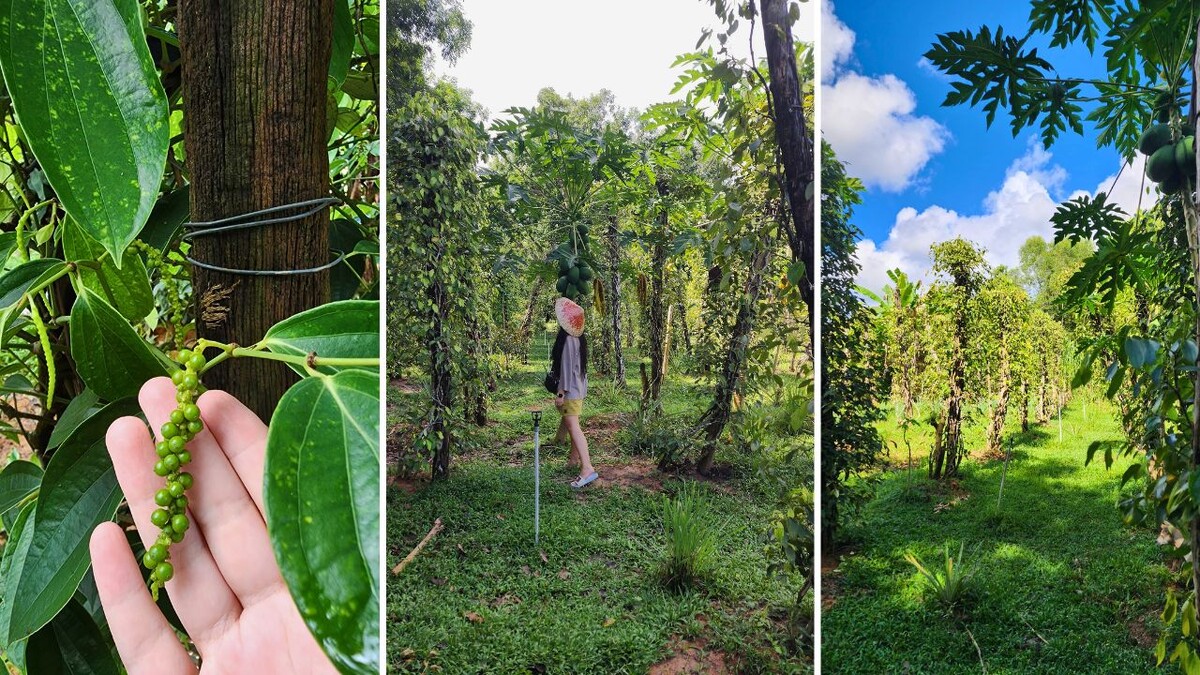
For a traveler, the important part is simpler: pepper farms are still part of the landscape, and some have developed small visitor areas where you can walk between the vines, learn how the berries are processed and taste different products.
What Makes Phu Quoc Pepper Different?
The appeal isn’t that Phu Quoc grows some completely different species of pepper. It is still Piper nigrum.
What changes is the growing environment, harvesting stage and processing.
Pepper farms on Phu Quoc are typically arranged in rows of climbing vines, with each vine trained around a post or living support. The island’s hot, humid climate suits the plant well, while good drainage is important because pepper does not like permanently waterlogged roots.
Traditional cultivation and processing are also part of Phu Quoc pepper’s identity. Sun-drying, small-scale production and direct farm sales are still common, although farming methods naturally vary from one plantation to another.

For travelers, the difference is most obvious when you taste several types side by side. Freshly opened whole pepper has a much stronger aroma than the pre-ground pepper most of us keep in a kitchen cupboard.
Black, White, Red & Green Phu Quoc Pepper
One of the most useful things I learned about pepper is that black, white, red and green pepper are not four different plants.
They all come from the same vine.
What changes is when the berries are harvested and what happens to them afterward.
Black pepper
Black pepper is the familiar version most people use at home.
The berries are harvested before they are fully ripe and then dried. As they dry, the skin darkens and wrinkles and the flavor becomes concentrated.
When buying it, I would look for whole peppercorns that feel dense and dry, with a strong aroma and no visible mold or excessive dust.
White pepper
White pepper comes from ripe berries.
The outer skin is removed after soaking, leaving the pale seed inside, which is then dried.
Its flavor is usually softer and less earthy than black pepper, which is why it works well in soups, light-colored sauces and fish dishes where you don’t necessarily want visible black specks.
Red pepper
Red pepper is made from fully ripened berries and is one of the more interesting souvenirs to look for on Phu Quoc.
It tends to be more aromatic, with a slightly sweeter and fruitier character than standard black pepper.
If you already use ordinary black pepper at home, this is probably the variety I’d choose for something noticeably different.
Green pepper
Green pepper is simply the unripe berry.
You may see it fresh, preserved in brine or processed in other ways. It has a fresher, brighter heat than dried black pepper.
On Phu Quoc, tourists are more likely to come across black, white and red pepper sold as souvenirs, but green pepper is common in Vietnamese cooking.
What a Phu Quoc Pepper Farm Looks Like
Once you know what you’re looking for, pepper farms are easy to recognize.
The vines climb vertically around posts, forming tall green columns arranged in neat rows. Between them are narrow paths, and on some farms you’ll also see fruit trees growing alongside the pepper.
A young vine starts at the base of its support and gradually climbs upward. Over time several stems create a dense column of leaves.
Some plantations are specifically prepared for visitors, with signs, tasting tables and packaged products. Others are simply working family farms.
That’s one reason I wouldn’t obsess too much over finding the “best pepper farm on Phu Quoc.” If you’re already driving through the interior of the island and see a plantation that welcomes visitors, stopping spontaneously can be just as interesting as visiting one of the better-known names.
Where to Find Pepper Farms on Phu Quoc
You are most likely to see pepper plantations along inland roads rather than in the main resort zones.
Good areas to look include:
- Cua Duong
- Cua Can
- roads heading toward the north of the island
- rural roads toward Bai Thom
- villages and farming areas away from the coast
Some well-known farms are set up for organized visits and tastings, while smaller family farms may have little more than a sign and a small sales area.
If you are visiting independently, don’t assume every plantation is open to walk-ins. Stop where visitors are clearly welcomed or ask before entering a working farm.
Best Time to Visit a Phu Quoc Pepper Farm
Pepper vines are evergreen, so you can visit a plantation at any time of year and still see the characteristic green rows.
The experience changes depending on the farming cycle.
During harvest and processing periods you have a better chance of seeing ripe clusters, berries being sorted and pepper drying in the sun. Outside the main harvest period, the farm can still be worth visiting because the vines themselves remain green and the basic growing process is easy to see.
For most travelers, I wouldn’t plan an entire trip around pepper season. I’d simply add a farm when it fits naturally into the rest of the route.
What to Expect at a Phu Quoc Pepper Farm
The exact experience varies, but the basic format is usually straightforward.

You walk between the rows while the owner or guide explains how the vines grow. You may see berries at different stages of ripeness and learn how black, white and red pepper are produced.
If processing is happening at the time, you may also see pepper laid out to dry.
Then comes the useful part: tasting.
Many visitor-oriented farms sell several varieties of whole pepper, pepper-and-salt mixtures and other seasoned products. Some have small gift packs designed specifically for tourists.
At the farm I visited, the experience was simple rather than theatrical, which I actually preferred. You see the plants, understand what you’re buying and then decide whether you want to take anything home.
Allow roughly 40–60 minutes for an ordinary visit. That’s enough time to walk around, listen to the explanation, taste a few products and browse the shop without turning a pepper plantation into the main event of the day
How Much Does Phu Quoc Pepper Cost?
Prices change, so I wouldn’t treat any old blog price as a fixed current rate.
When I collected the original notes for this article, guides and local sources commonly quoted around 150,000–200,000 VND for 500 g at farms. Consider that a reference from that period, not a guaranteed current price.
Price depends on:
- the type of pepper
- packaging
- whether it is a plain product or a flavored blend
- the farm
- whether you arrive independently or as part of a tour
- quantity
You don’t need to buy a huge bag. Pepper lasts a long time when stored properly, and a smaller bag of something you actually like is a better souvenir than half a kilo bought only because it looked cheap.
What Pepper Should You Buy?
If I were choosing only one product, I’d buy whole peppercorns rather than ground pepper.
Ground pepper loses aroma much faster, while whole peppercorns can be ground as needed at home.
For black pepper
Look for peppercorns that are:
- dark rather than dusty gray
- whole rather than cracked
- dry
- strongly aromatic when the bag is opened
- free from visible mold or excessive debris
For red pepper
Look for a deep red to brick-red color. Some variation is normal.
This is the type I’d choose if you want a more distinctive Phu Quoc souvenir.
For white pepper
The kernels should be pale and clean, without dark patches or a musty smell.
Packaging
A sealed bag is much more practical for luggage than loose pepper.
Once home, I would transfer it to an airtight container and keep it away from heat, moisture and direct sunlight.
What to Do With Phu Quoc Pepper at Home
One reason pepper works so well as a souvenir is that it doesn’t just sit on a shelf.
Seafood and fish
A very Vietnamese combination is pepper, salt and fresh lime juice.
Use it as a dipping mixture for shrimp, squid or fish, or spoon a little over seafood after cooking.
Meat and poultry
Freshly ground black or red pepper works with grilled meat, roast chicken and simple marinades.
Eggs and vegetables
A basic omelet is actually a good way to taste the difference between an aromatic pepper and the supermarket powder you’ve been using for years.
It also works well with roasted vegetables.
Coffee and chocolate
Some farms play with less obvious combinations, including pepper with coffee or dark chocolate.
You don’t need much. A very small amount adds warmth rather than making the drink or dessert taste aggressively spicy.
How to Fit a Pepper Farm Into Your Phu Quoc Route
I wouldn’t build a whole sightseeing day around pepper unless you’re particularly interested in agriculture.
It works best as an extra stop between bigger destinations.
Phu Quoc Without a Scooter: 6-Day Itinerary, Transport Tips and Best Areas
If you’re heading north
Combine a farm around Cua Duong or Cua Can with places farther north on the island.
If you’re exploring around Duong Dong
A pepper farm can fit between the town, inland roads and an evening at the market.
If you’re driving around the island
This is probably the easiest option.
On my longer drive around Phu Quoc, pepper worked naturally as one of several stops rather than as a destination that needed its own half-day.
Budget around 40–60 minutes for one plantation.
Is a Phu Quoc Pepper Farm Worth Visiting?
I wouldn’t put a pepper farm in the same “must-see” category as Phu Quoc’s major attractions.
But that’s also why I like it.
It shows you something that actually belongs to the island’s everyday economy and agricultural history, rather than another attraction built specifically for visitors.
You get to walk through the vines, understand how the different pepper types are made and leave with a souvenir you’ll probably still be using months later.
And every time you grind it over dinner, Phu Quoc comes back for a second.
Plan Your Phu Quoc Trip
Where to stay: Find hotels and resorts on Phu Quoc with Trip.com
Tours & activities: Browse Phu Quoc tours and experiences on GetYourGuide
Flights: Compare flights to Phu Quoc on Trip.com
Rent a car: Check car rental options with Localrent
Private transfers: Book a private transfer with Kiwitaxi
eSIM: Get mobile data with Yesim
Travel insurance: Check travel insurance with EKTA
Some links in this article are affiliate links. If you book through them, I may earn a small commission at no extra cost to you.