Topkapi Palace Istanbul: Tickets, Harem & Visiting Tips
Topkapi Palace in Istanbul is much easier to understand once you stop thinking of it as a single palace building.
For almost four centuries, it functioned as the center of Ottoman government, court life, education and imperial residence. The complex developed as a sequence of courtyards, gates, council rooms, private apartments, collections, gardens and pavilions rather than one monumental residence.
The official National Palaces description divides Topkapi into four connected worlds: the outer service area, the Imperial Council and administrative center, the Enderun palace school and inner court, and the Harem, where the sultan and imperial family lived.
That scale is why visitors often underestimate both the time they need and what their ticket actually includes.
If this is your first Istanbul trip, see my 22 Best Things to Do in Istanbul to decide how Topkapi fits with the rest of Sultanahmet.
Practical information was checked in September 2026. Ticket prices, room access and opening arrangements can change, so confirm current information before visiting.
Topkapi Palace at a Glance
| Location | Sultanahmet, beside Gülhane Park |
| Allow | Around 3 hours, or 4 hours with the Harem and a slower visit |
| Closed day | Tuesday |
| Best arrival | Near opening time |
| Current foreign combined ticket | 2750 TL for Topkapi Palace + Harem + Hagia Irene |
| Do not miss | Harem, Imperial Council, Treasury and Fourth Courtyard |
| Main mistake | Trying to see the palace in one hour |
Topkapi Palace is currently closed on Tuesdays. The official National Palaces site also lists ticket-office hours from 09:00 to 17:00, although holiday arrangements can differ.
Who Will Get the Most From Topkapi Palace?
Topkapi is particularly worthwhile if you are interested in:
- Ottoman history;
- court life;
- imperial government;
- decorative arts;
- historic collections;
- architecture that reveals hierarchy and protocol;
- Bosphorus views.
The palace does not work like Versailles or Dolmabahçe, where a sequence of lavish interiors provides the main spectacle.
Its meaning comes from moving deeper into increasingly restricted spaces.
The First Courtyard belonged to the outer palace. The Second was associated with administration and ceremony. The Third led into the inner palace and Enderun. The Harem formed the private residential world of the dynasty.
If you dislike large museum complexes or have only a few hours in Istanbul, you may prefer to prioritize Hagia Sophia and the Basilica Cistern instead.
Topkapi Palace Tickets in 2026
The current official foreign-visitor structure is considerably clearer than many older travel articles suggest.
As of September 2026, National Palaces lists:
- Topkapi Palace Combined Ticket: 2750 TL
- Harem separately: 1050 TL
- Hagia Irene separately: 1050 TL
The combined foreign ticket includes Topkapi Palace + Harem + Hagia Irene and is valid for one day from the date of purchase.
Prices can change, so treat these as the current September 2026 tariffs rather than permanent figures.
What Does the Combined Ticket Include?
The combined ticket is the simplest option if you want the full first-time visit:
- main palace areas;
- Harem;
- Hagia Irene.
If you are buying through a third-party platform or joining a guided tour, do not assume the product includes exactly the same access.
Check:
- whether admission is included;
- whether the Harem is included;
- whether Hagia Irene is included;
- whether the guide stays with you inside;
- whether independent time is allowed afterward.
A “skip the ticket line” product also does not mean that mandatory security screening disappears.
Should You Visit the Harem?
If you want to understand Topkapi as a lived royal residence rather than only an administrative complex, the Harem is one of the most useful parts of the visit.
It contained spaces associated with:
- the sultan;
- the Queen Mother;
- members of the imperial family;
- women of the court;
- servants and officials;
- baths;
- private apartments;
- ceremonial and administrative rooms.

Allow around 45 to 60 minutes if you want to look at the interiors properly rather than moving straight through.
If your time is extremely limited and your priority is the Treasury or palace courtyards, the Harem is the easiest major section to treat as optional.
But for a normal first visit, it adds an important part of the story.
What to See Inside Topkapi Palace
First Courtyard and Hagia Irene
The First Courtyard functions as the transition between the city and the palace.
Historically, it contained service and administrative buildings and was much more accessible than the inner palace.
Hagia Irene stands within this outer section. The Byzantine church predates the Ottoman palace and survived within the complex after the conquest.
Under the current ticket structure, Hagia Irene is included in the foreign combined ticket and is also listed as a separate paid section.
Second Courtyard and Imperial Council
The Second Courtyard was the administrative heart of the palace.
This is where the Imperial Council met and where the relationship between the sultan, senior officials and the machinery of government becomes easier to understand.
Look for:
- Imperial Council Chamber;
- Tower of Justice;
- palace kitchens;
- Harem entrance;
- ceremonial layout of the courtyard.
The official palace description identifies this courtyard as the center of state administration.
Third Courtyard and Enderun
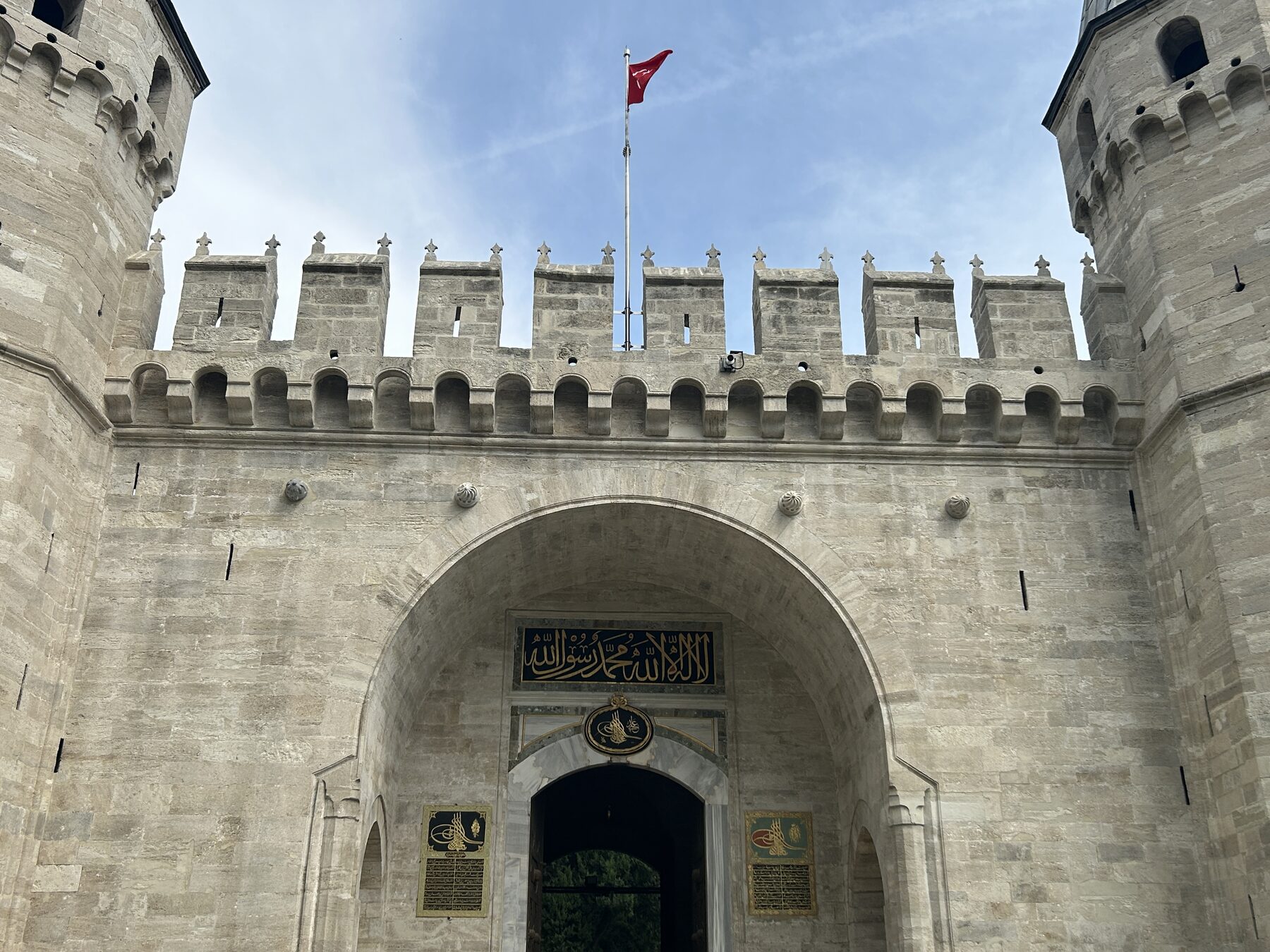
Passing through the Gate of Felicity marks another change in access.
The Third Courtyard formed part of the Enderun, the palace school and inner court.
This area includes or historically contained spaces such as:
- Audience Chamber;
- Treasury;
- Privy Chamber;
- sacred relic collections;
- palace-school rooms.
This is where Topkapi feels less like a public administrative center and more like the inner world of the court.
Imperial Treasury
The Treasury is one of the sections most likely to attract queues.
Its best-known objects include the Topkapi Dagger and Spoonmaker’s Diamond, along with ceremonial weapons, jewels and imperial objects.
If the Treasury has a short queue when you pass it, take the opportunity rather than assuming it will be equally quiet later.
Small rooms can become congested quickly.
Fourth Courtyard and Bosphorus Views
The Fourth Courtyard is where the visit opens up again.
Terraces, gardens and imperial pavilions overlook the Bosphorus and surrounding city.
Buildings include the Baghdad and Revan pavilions and other structures associated with the later private and ceremonial life of the palace.
After several hours of collections and interiors, this is also one of the best places to slow down.
A Sensible Route Through Topkapi Palace
You do not need to follow every room in perfect historical order.
A practical first visit could look like this:
- Enter through the First Courtyard.
- Cross the Gate of Salutation.
- Visit the Harem relatively early.
- Continue through the Second Courtyard and Imperial Council.
- Move into the Third Courtyard.
- Prioritize the Treasury and collections that matter to you.
- Finish with the Fourth Courtyard, pavilions and views.
- Visit Hagia Irene before leaving if you have not already done so.
If a major collection has almost no queue when you reach it, change the order.
Avoiding a 30-minute bottleneck is more useful than following an imaginary perfect route.
Best Time to Visit Topkapi Palace
Arrive close to opening if Topkapi is one of your priority attractions.
The palace becomes noticeably harder to navigate once tour groups fill the smaller rooms and gateways.
Morning
Best for:
- Treasury;
- Harem;
- photography in courtyards;
- avoiding the heaviest indoor congestion.
Midday
Usually the busiest period, particularly in summer and during high tourism periods.
Late Afternoon
Can become calmer, but only choose this if you still have enough time for the areas you care about before admissions begin closing.
Do not arrive late assuming that “three hours” simply means the palace will remain open long enough for you.
How Long Do You Need at Topkapi Palace?
For planning purposes:
2 hours: rushed highlights only.
3 hours: reasonable main-palace visit.
4 hours: better for the Harem, Treasury, courtyards and time to stop for views.
More than 4 hours: possible if you enjoy museums, decorative arts and historical collections.
Trying to visit the entire palace in 60 to 90 minutes usually means seeing courtyards while rushing through the sections you paid to enter.
How to Get to Topkapi Palace
Topkapi Palace is on the Historic Peninsula beside Gülhane Park.
The T1 tram is the most useful public transport option for most visitors.
Two practical stops are:
- Sultanahmet, especially if you are also visiting Hagia Sophia or the Blue Mosque;
- Gülhane, useful when approaching through the park or from Sirkeci.
The surrounding streets are walkable but not flat everywhere.
Taxis are often less useful than they appear because road access and traffic around Sultanahmet can make short journeys surprisingly slow.
For wider transport and trip-planning information, see my Istanbul Travel Guide.
Accessibility and Comfort
Topkapi covers a large area.
Expect:
- long walking distances;
- cobbled and uneven surfaces;
- historic thresholds;
- periods of standing;
- exposed courtyards;
- crowded interiors.
Not every historic section is equally easy to access.
If step-free access is essential, check the latest official accessibility arrangement before your visit because room openings and circulation routes can change.
During hot weather:
- carry water;
- use shaded areas when possible;
- avoid rushing between courtyards;
- wear comfortable shoes.
Large bags can also make security and crowded indoor areas less convenient.
Guided Tour or Independent Visit?
Topkapi is one of the Istanbul attractions where a good guide can add genuine value.
The architecture is not designed to impress you through one enormous façade or ballroom.
The interesting part is understanding who was allowed where.
A guide can help explain:
- palace hierarchy;
- Ottoman government;
- court ceremony;
- the role of the Imperial Council;
- Enderun;
- Harem organization;
- how the courtyards changed from public to private.
An independent visit works well if you already understand the basic structure and want more freedom with collections.
An audio guide is another reasonable middle ground.
For other Istanbul experiences where a guide can add meaningful context, see my 9 Best Istanbul Tours & Experiences.
What to Combine With Topkapi Palace
Topkapi sits within walking distance of many of Istanbul’s major sights, but that does not mean you should try to visit all of them in one morning.
Hagia Sophia
Geographically, the combination is easy.
In practice, both are major attractions involving security, queues and substantial time.
If you combine them, start early and treat them as the two anchors of the day.
Basilica Cistern
The cistern is easier to combine because the visit is more compact.
Topkapi plus Basilica Cistern can work well if you do not want another several-hour monument afterward.
Blue Mosque
The Blue Mosque is nearby and can be fitted around the palace more easily than another ticketed museum.
Remember that prayer times affect tourist access.
Istanbul Archaeological Museums
This is an excellent pairing for people who genuinely enjoy museums.
For everyone else, doing both in one day may create museum fatigue.
Gülhane Park
This is the easiest place to slow down after Topkapi.
Walk through the park instead of immediately entering another major interior.
Eminönü
From the palace area, continue downhill toward Sirkeci and Eminönü for ferries, the Spice Bazaar and Galata Bridge.
For a realistic sightseeing sequence, use my Istanbul itinerary.
Staying Near Topkapi Palace
If your first few days are focused on the Historic Peninsula, staying nearby can make early starts considerably easier.
Sultanahmet puts Topkapi, Hagia Sophia, the Blue Mosque and Basilica Cistern within walking distance.
Sirkeci keeps those sights close while giving you stronger tram, ferry and Marmaray connections.
The trade-off is atmosphere.
Sultanahmet is extremely convenient for morning sightseeing but much quieter in the evening than areas such as Karaköy, Galata or Kadıköy.
Read my full guide to where to stay in Istanbul.
Common Topkapi Palace Mistakes
- Arriving around midday in peak season. Smaller rooms and gateways become much less pleasant when tour groups overlap.
- Buying a ticket without checking exactly what it includes. Third-party tours do not necessarily match the official combined ticket.
- Planning only 60 to 90 minutes. Topkapi is a palace complex, not one building.
- Skipping the Harem without understanding what it adds. The main courtyards explain government; the Harem adds the residential side of the palace.
- Spending too long in the first sections. Leave enough time for the Treasury and Fourth Courtyard.
- Assuming every collection is permanently open. Individual rooms and displays can change.
- Combining every Sultanahmet attraction into one morning. Walking distance does not equal realistic visiting time.
- Forgetting that Topkapi is closed on Tuesday. This is the current official weekly closing day.
Topkapi Palace FAQ
Is Topkapi Palace Worth Visiting?
For travelers interested in Ottoman history and first-time Istanbul sightseeing, it is one of the city’s most important historic sites.
It is particularly valuable because it explains how the Ottoman court and government functioned, not simply how the sultans decorated their rooms.
How Long Do You Need at Topkapi Palace?
Allow about three hours for a reasonably complete main-palace visit.
Allow closer to four hours if you want the Harem, Treasury, collections and terraces without rushing.
Is the Harem Included in the Topkapi Palace Ticket?
The current official foreign-visitor combined ticket includes Topkapi Palace, Harem and Hagia Irene.
As of September 2026, National Palaces lists that combined ticket at 2750 TL. Separate Harem and Hagia Irene tickets are also listed at 1050 TL each.
Check current tariffs before visiting.
Is Topkapi Palace Closed on Tuesday?
Yes.
The official National Palaces visitor information currently lists Tuesday as Topkapi Palace’s weekly closing day.
Can You Visit Topkapi Palace and Hagia Sophia on the Same Day?
Yes.
They are very close geographically.
Start early, make them the two main attractions of the day and avoid adding several other major ticketed interiors.
Is a Guided Tour Worth It?
It can be, particularly if you want to understand palace hierarchy, court protocol and how the different courtyards functioned.
If you already know the historical background and prefer spending more time with individual collections, an independent visit may suit you better.
Should You Buy Topkapi Palace Tickets in Advance?
Buying ahead can simplify the day during busy periods, particularly if you are also booking a guide.
But check exactly what the ticket includes.
Third-party products may combine admission and guiding differently from the official National Palaces ticket.
Last checked: September 2026. Ticket prices, opening arrangements and individual room access can change.
Some links in this article are affiliate links. If you book through them, I may earn a small commission at no extra cost to you.