Avanos Old Town: A 1-Hour Walk Through Historic Avanos
Avanos Old Town is a quiet historic quarter above the modern centre of Avanos, filled with stone houses, wooden balconies, narrow lanes and old workshops.
I visited at the end of June and was surprised by how empty it felt. Despite being in one of Cappadocia’s popular towns, I saw only a handful of people during much of my walk.
At first, I assumed most visitors simply never made it this far uphill. Avanos is better known for its pottery workshops and the Kizilirmak River, while the older residential quarter can easily be missed on a short visit.
Later I discovered there was another reason for the silence.
Several decades ago, residents began leaving Old Avanos as parts of the historic housing deteriorated. Many homes stood empty for years. Today some have been restored as residences, restaurants and small hotels, while others are still waiting for restoration.
That history completely changed the way I looked at the streets.
This is not a perfectly restored open-air museum.
It is a historic neighborhood still somewhere in the middle of its transformation.
If you’re planning a broader visit to town, start with my Avanos Cappadocia guide for the riverfront, pottery and an easy two-hour route.

Why did Avanos Old Town become so quiet?
By the middle of the 20th century, parts of the old housing stock were already in poor condition.
Buildings had deteriorated, and erosion, movement in the ground and structural damage made some homes increasingly difficult to use.
In 1968, residents of affected houses were moved to newly constructed housing on the opposite side of the Kizilirmak River. After that, parts of the historic quarter emptied more quickly and many buildings continued deteriorating for decades.
The official Avanos district website tells essentially the same story: many traditional houses had become unusable through erosion, movement and collapse, and owners were relocated to disaster housing across the river in 1968.
Knowing that made the almost empty streets feel very different.
What initially looked like a lucky opportunity to photograph Avanos without crowds was actually part of a much longer story of abandonment and recovery.
Restoration began changing Old Avanos in 1998
The turning point came in 1998, when a conservation development plan came into force.
Historic buildings began to be repaired, demand for old properties returned and some houses gained new uses as accommodation, restaurants and private homes.
The official district site says the old quarter had been largely neglected for around 30 years before the 1998 conservation plan created an opportunity for restoration.
But the neighborhood never became a polished tourist district where every façade looks freshly restored.
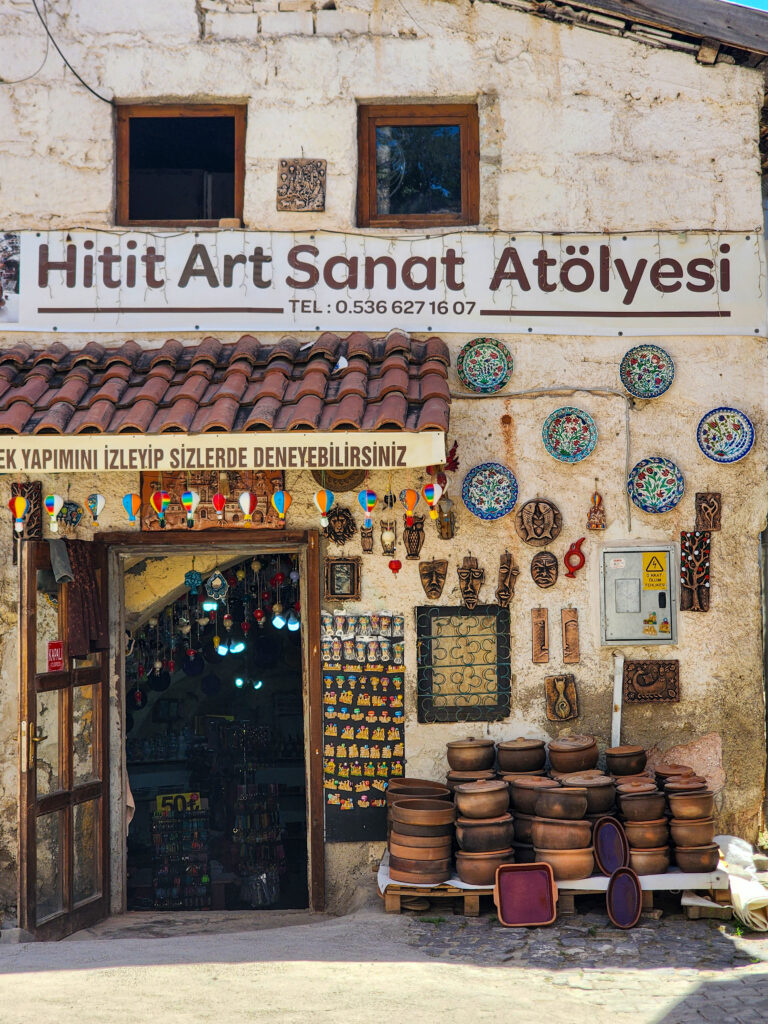
And I think that is exactly what makes it interesting.
You can see:
- a beautifully restored mansion;
- a working craft studio;
- an ordinary family home;
- and a crumbling building that still shows decades of neglect;
sometimes within the same short stretch of street.
The restoration story is still continuing.
In 2025, traditional street names were officially brought back in the historic areas of Orta, Yukari and Alaaddin, replacing numbered names that had been introduced earlier. Avanos Municipality described the change as a way of protecting local memory and cultural identity.
So preservation here now goes beyond restoring individual houses.
It also includes the identity of the neighborhood itself.
Why does Avanos Old Town feel like a maze?
Walk uphill for a few minutes and the layout starts making sense.
Old Avanos was built directly into the slope.
Instead of a regular street grid, houses sit above and beside one another, connected by:
- narrow lanes;
- steep little stairways;
- arches;
- passages beneath buildings;
- unexpected turns between stone walls.
Some streets even continue beneath overhanging sections of houses.
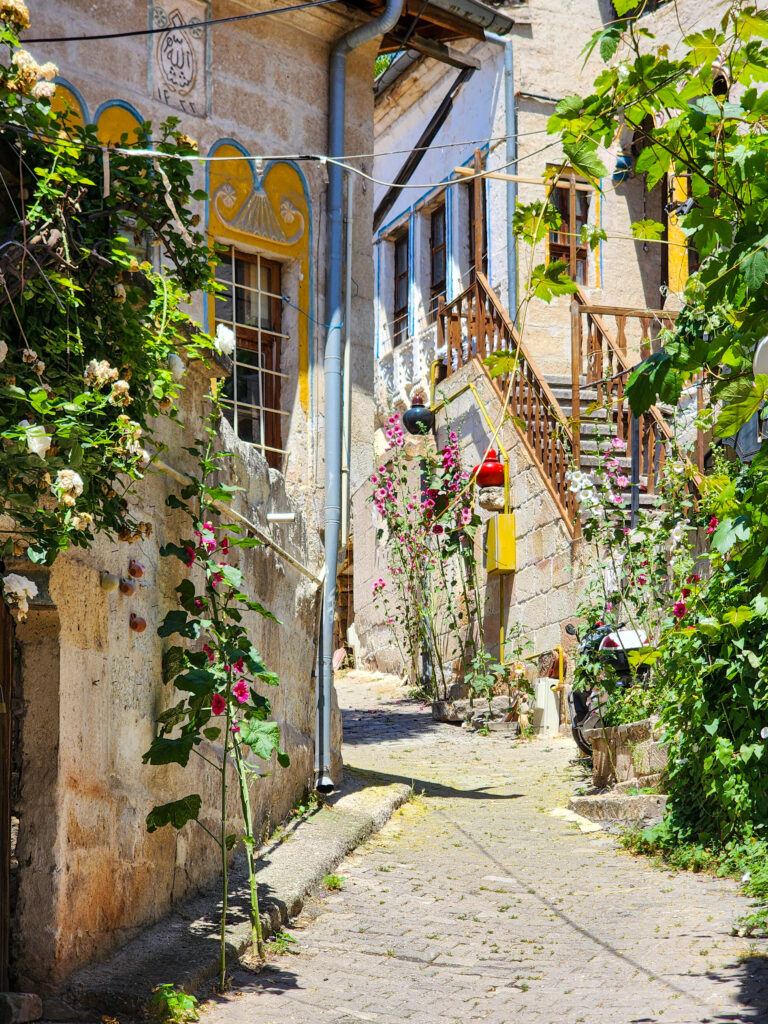
Traditional homes were generally built using locally quarried stone. Many surviving examples also have carved stone details, substantial wooden doors, balconies and stone vaulting.
Official descriptions of the old quarter specifically mention its narrow winding streets, dense hillside construction and passages running beneath parts of buildings. Traditional houses were commonly two storeys, with service and everyday spaces below and guest rooms above.
This is why I wouldn’t approach Avanos Old Town as a checklist of individual monuments.
The neighborhood itself is the attraction.
Look for small details:
a date above a door, an old balcony, a stone arch, a stairway disappearing uphill, a courtyard glimpsed through an open entrance.
The longer you walk, the more you begin to understand how the quarter was built.

How old are the houses in Avanos Old Town?
Avanos itself has a history stretching back thousands of years. The municipality describes settlement history in the area going back at least 4,000 years.
The houses you see today are much younger.
Most surviving traditional homes in the old quarter are roughly 100–150 years old, with much of the visible residential architecture dating from the 19th and early 20th centuries.
So there are two different timelines:
Avanos as a settlement: thousands of years.
Most of the surviving houses: roughly one to one-and-a-half centuries.
Older layers survive in individual monuments, including the Seljuk-era Alaaddin Mosque.
That mix is part of what makes the area interesting. Old Avanos is not one perfectly preserved “ancient city” from a single period.
Different eras sit on top of one another.
Historic mansions to notice while walking
Once you know a little of the history, individual houses stop looking like anonymous stone façades.
One particularly useful example is Haci Nuri Bey Mansion, built in 1902.
Today it houses the Cappadocia Living Heritage Museum, operated by Nevsehir Haci Bektas Veli University. The museum focuses on regional traditions and intangible heritage rather than archaeological finds, including storytelling, traditional arts, customs and performance.
A Turkish government education resource also dates the mansion to 1902 and confirms its current use as the Living Heritage Museum.
I didn’t visit the museum on this trip, so I can’t review it from personal experience.
But if you want to extend a simple Old Town walk into a two- or three-hour visit, it is one of the most logical additions.
Other historic mansions and façades are worth noticing simply for their dates, balconies, stonework and later reuse.
Once I started looking for those details, my walk changed.
Instead of photographing another pretty lane, I began checking the next doorway for a date or architectural detail.
Look for the potter statue before walking uphill
Near the entrance to the old quarter, you’ll also notice the Canakci Heykeli, or Potter Statue.
Pottery is one of the strongest symbols of Avanos, and the monument serves as a kind of visual introduction to the town before you start climbing into the historic streets.
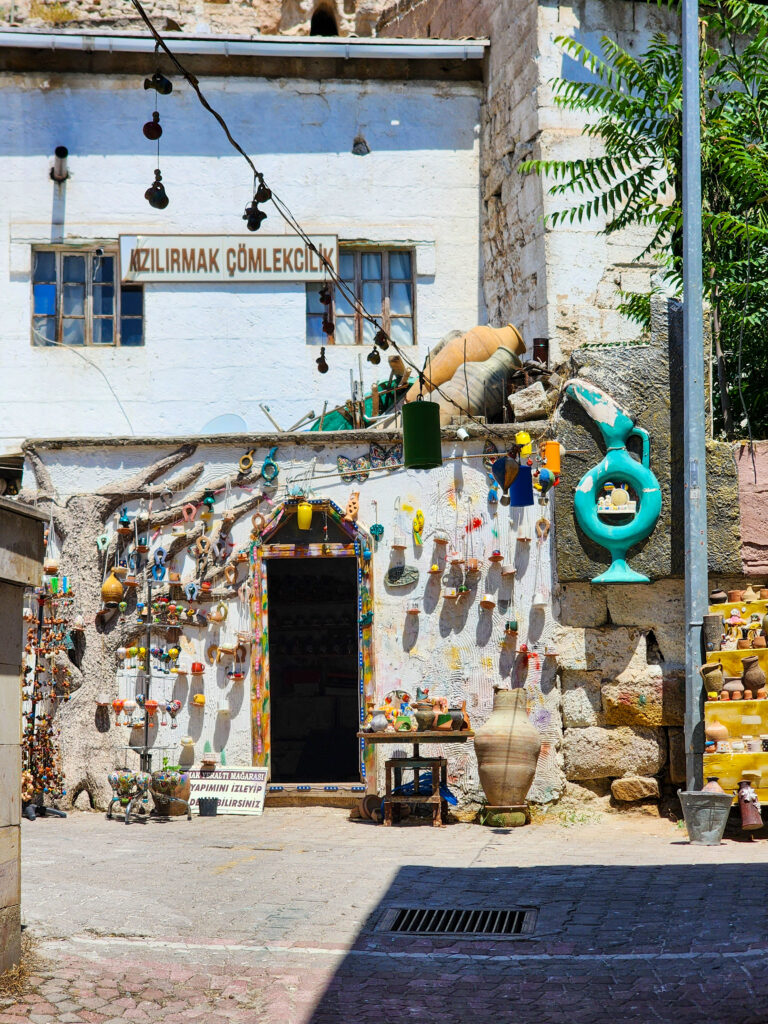
Ceramics then keep appearing throughout Old Town: beside workshops, on walls and in shop displays.
If you want to actually try the craft rather than just look at it, I wrote a separate guide to my Avanos pottery workshop experience, including what I paid, how long I spent at the wheel and what happened to the piece afterwards.

How to walk around Avanos Old Town
You do not need a complicated route.
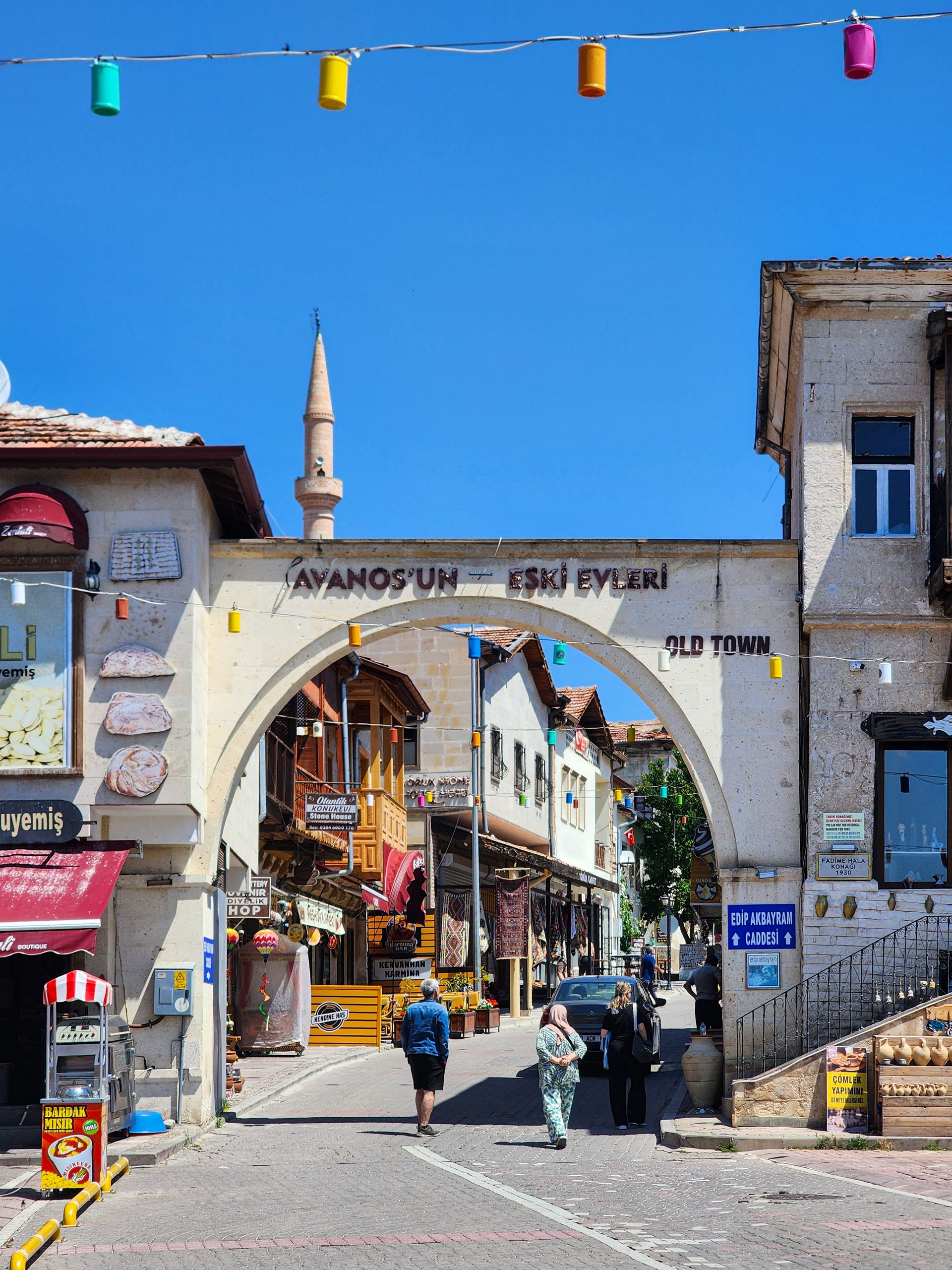
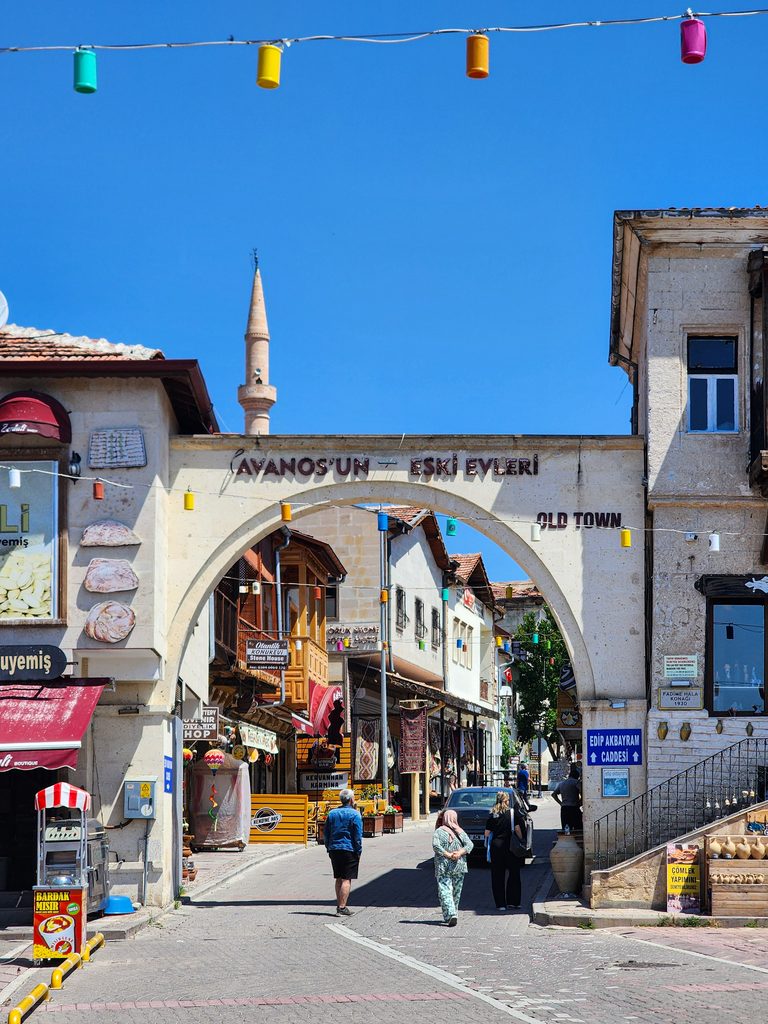
I would start near the Avanos’un Eski Evleri entrance and gradually walk uphill.
Then deliberately leave the main street occasionally.
This is one of those places where getting slightly lost improves the experience.
The historic quarter is compact enough that you are unlikely to wander very far, while the smaller lanes contain many of its best details: narrow passages, stairs, balconies and views back down towards modern Avanos.
What to look for
While walking, pay attention to:
- dates and inscriptions above doors;
- wooden balconies;
- stone arches;
- passages running beneath buildings;
- old doors and window frames;
- courtyards visible from the street;
- restored mansions;
- buildings still awaiting restoration;
- small workshops tucked into the old neighborhood.
The contrast between neighboring houses is especially interesting once you know the history of the 1968 relocation.
A fully restored property can sit only a few meters from one that still carries obvious traces of decades of neglect.
Is Avanos Old Town difficult to walk?
It is a normal urban walk rather than a hike, but there is some uphill walking.
In summer, the heat makes that more noticeable.
I visited at the end of June and naturally slowed down as I climbed, which actually suited the neighborhood because there is little reason to rush.
Comfortable shoes and water are enough for most visitors.
How much time do you need in Avanos Old Town?
For a straightforward walk, I would allow about one hour.
You can move through more quickly, but there is no single landmark you need to reach as fast as possible.
The value is in wandering.
Allow two to three hours if you want to combine Old Town with:
- the Cappadocia Living Heritage Museum;
- a pottery workshop;
- coffee or lunch;
- time inside one of the restored historic buildings.
Afterwards, it is easy to walk back down towards modern Avanos and the Kizilirmak River.
That is exactly what I did.
Eventually, my walk through town ended with me sitting behind a pottery wheel.
Is Avanos Old Town worth visiting?
Yes — especially if you want to see something beyond the riverfront and pottery shops.
There isn’t one giant monument here that justifies the visit on its own.
The appeal is the neighborhood as a whole:
its irregular layout, the stone houses from different periods, the almost empty streets and the visible contrast between restoration and decay.
During my visit, the lack of people was what initially stayed with me.
After I learned more about the area, something else became more interesting.
Old Avanos still shows the process of deciding what to preserve, restore and reuse.
You are not looking at a finished version of the past.
You are walking through a historic neighborhood that is still changing.
Avanos Old Town FAQ
How long do you need for Avanos Old Town?
Around one hour is enough for a relaxed walk through the old streets. Allow two to three hours if you also want to visit a museum, pottery workshop or stop for food.
Is Avanos Old Town free to visit?
Yes. The historic quarter itself consists of public streets and can be explored on foot. Individual museums, workshops and businesses may charge separately.
Is Avanos Old Town worth visiting if I only have one day in Cappadocia?
If you only have one very short day in Cappadocia, I would prioritize the region’s iconic landscapes first. Avanos Old Town makes more sense when you have enough time to explore beyond the major valleys and viewpoints.
Is Avanos Old Town walkable?
Yes. The area is compact and easy to explore on foot, although some streets climb uphill and there are stairs and uneven surfaces.
Why are some houses in Old Avanos abandoned?
Many traditional houses deteriorated during the 20th century, and residents of affected buildings were relocated across the Kizilirmak River in 1968. Restoration accelerated after a conservation plan came into force in 1998.
Plan your Cappadocia trip
🏨 Where to stay
Compare accommodation in Avanos, Göreme, Uçhisar and Çavuşin to find the best base for your Cappadocia itinerary.
🎒 Tours & activities
Browse Cappadocia tours and experiences on GetYourGuide, including pottery workshops, valley tours and activities around Avanos.
✈️ Flights to Cappadocia
Search flights to Nevşehir (NAV) and Kayseri (ASR), the two main airports for Cappadocia.
🚗 Rent a car in Cappadocia
A rental car gives you more flexibility for combining Avanos with valleys, viewpoints and smaller Cappadocia towns.
📱 eSIM for Turkey
Get mobile data before arrival with Yesim eSIM for maps, transport apps and staying connected while travelling around Cappadocia.
🛡 Travel insurance
Check travel insurance for your Turkey trip with EKTA.
Some links on this page are affiliate links. If you make a purchase or booking through one of them, I may earn a small commission at no extra cost to you.