Basilica Cistern Istanbul: Tickets, Medusa Heads & Tips
The Basilica Cistern in Istanbul is one of the easiest major sights to fit into a busy Sultanahmet day, but it deserves more than a quick photograph of the Medusa heads.
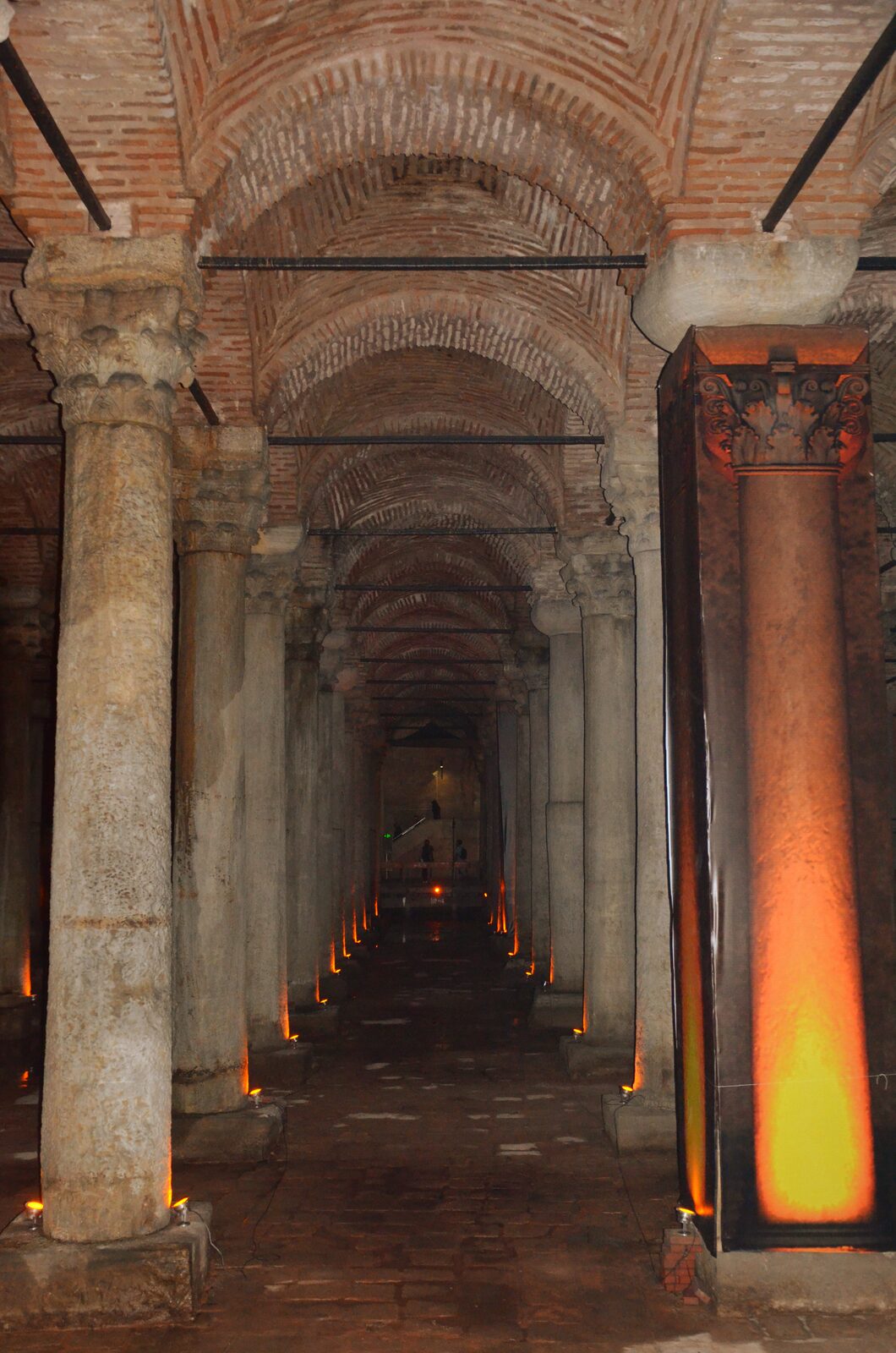
This sixth-century underground reservoir combines Byzantine engineering, reused ancient stonework, reflected light and modern exhibition design in a space that feels completely different from the mosques and palaces above ground.
It is also an attraction where old practical information can become misleading. Management and ticketing arrangements changed during 2026, and opening hours, evening access and ticket products have not always remained consistent. The site was temporarily affected during a management dispute in June 2026, so check the current arrangement shortly before visiting.
If this is your first Istanbul trip, see my 22 Best Things to Do in Istanbul to decide where the cistern fits into the rest of your sightseeing.
Visitor information was checked in September 2026. Ticketing, opening hours, evening sessions and access arrangements can change, so verify time-sensitive details before your visit.
Basilica Cistern Istanbul at a Glance
| Location | Sultanahmet, close to Hagia Sophia |
| Allow | Around 45 to 60 minutes |
| Best time | Near opening or later in the daytime session |
| Main highlights | Column forest, reflections, Medusa heads and reused stonework |
| Conditions | Dim, humid and potentially slippery |
| Evening access | Has operated separately from daytime admission, but check the current 2026 arrangement |
| Museum Pass | Do not assume it is accepted, verify current ticket rules |
Who Will Enjoy the Basilica Cistern Most?
The Basilica Cistern is particularly worth considering if you enjoy:
- Byzantine history;
- unusual architecture;
- underground spaces;
- atmospheric photography;
- engineering;
- archaeology and reused ancient materials;
- compact attractions that fit between larger sights.
It works especially well on a first visit because you can see something completely different without giving up half a day.
The main drawback is value for money.
The visitor route is relatively short compared with a palace or major museum, while foreign visitor ticket prices have increased substantially over time.
If your sightseeing budget is very limited and underground architecture does not particularly interest you, this is one of the major Sultanahmet attractions you could choose to skip.
Basilica Cistern Tickets in 2026
This is the section where old travel guides are most likely to cause confusion.
Ticketing and management arrangements changed during 2026. In June, the cistern was transferred during a legal dispute, temporarily closed while ticket-office arrangements were being handled, and was then affected by further court action.
For visitors, the practical lesson is simple:
do not plan around a ticket price, opening schedule or evening-session rule copied from an old article.
Before visiting, check:
- current daytime opening hours;
- current foreign visitor price;
- whether an evening session is running;
- whether that session requires a separate ticket;
- where tickets are currently sold;
- whether advance booking is available;
- cancellation terms for third-party tickets.
Third-party products may advertise fast-track or skip-the-line entry.
Read the wording carefully. This generally refers to avoiding the ticket-purchase queue. Capacity controls, security procedures or other mandatory entrance steps cannot necessarily be skipped.
What About the Basilica Cistern Night Shift?
The Basilica Cistern has operated an evening Night Shift session separately from daytime visiting hours.
However, because operating arrangements changed during 2026, do not assume that an older Night Shift timetable or price still applies to your date.
When evening access is available, it can offer:
- different lighting;
- a more theatrical atmosphere;
- occasional cultural programming;
- an alternative to using prime daytime sightseeing hours.
It is not automatically quieter, and it is not automatically better value.
Choose an evening visit because you specifically want the atmosphere, not simply because it sounds more exclusive.
Before booking, check:
- the current evening hours;
- whether there is a closure between daytime and evening access;
- separate ticket requirements;
- any performance or event scheduled that night.
A Short History of the Basilica Cistern
The Basilica Cistern was built during the reign of Byzantine Emperor Justinian I in the sixth century.
Its purpose was practical: storing water for the imperial center of Constantinople.
The Turkish name Yerebatan Sarnıcı is commonly translated as the “Sunken Cistern.”
The vast underground chamber is supported by 336 marble columns, many of which were reused from older structures rather than produced specifically for the cistern. Istanbul Metropolitan Municipality’s restoration material also identifies the structure as the city’s largest surviving covered ancient cistern.
That reuse is one of the most interesting aspects of the building.
Instead of expecting perfect symmetry, look for differences in:
- marble;
- column shafts;
- capitals;
- bases;
- carved decoration.
The structure was designed as infrastructure, not as an underground palace.
Its theatrical appearance today comes from the combination of ancient engineering and modern visitor lighting.
What to Look For Inside the Basilica Cistern
The Column Forest
The repeated rows of columns create the cistern’s defining visual effect.
At first they appear almost identical.
Look more closely and you will notice variations in material, proportion and decoration.
The water and modern lighting amplify the sense of depth, especially when the walkways are not crowded.
The Weeping Column
One column has a distinctive carved pattern often compared with tears, eyes or peacock feathers.
You may see dramatic explanations online about exactly where it came from or what it symbolizes.
Its precise origin is less certain than those stories suggest.
Treat it as another example of reused decorative stone rather than assuming every popular legend is established history.
The Medusa Heads
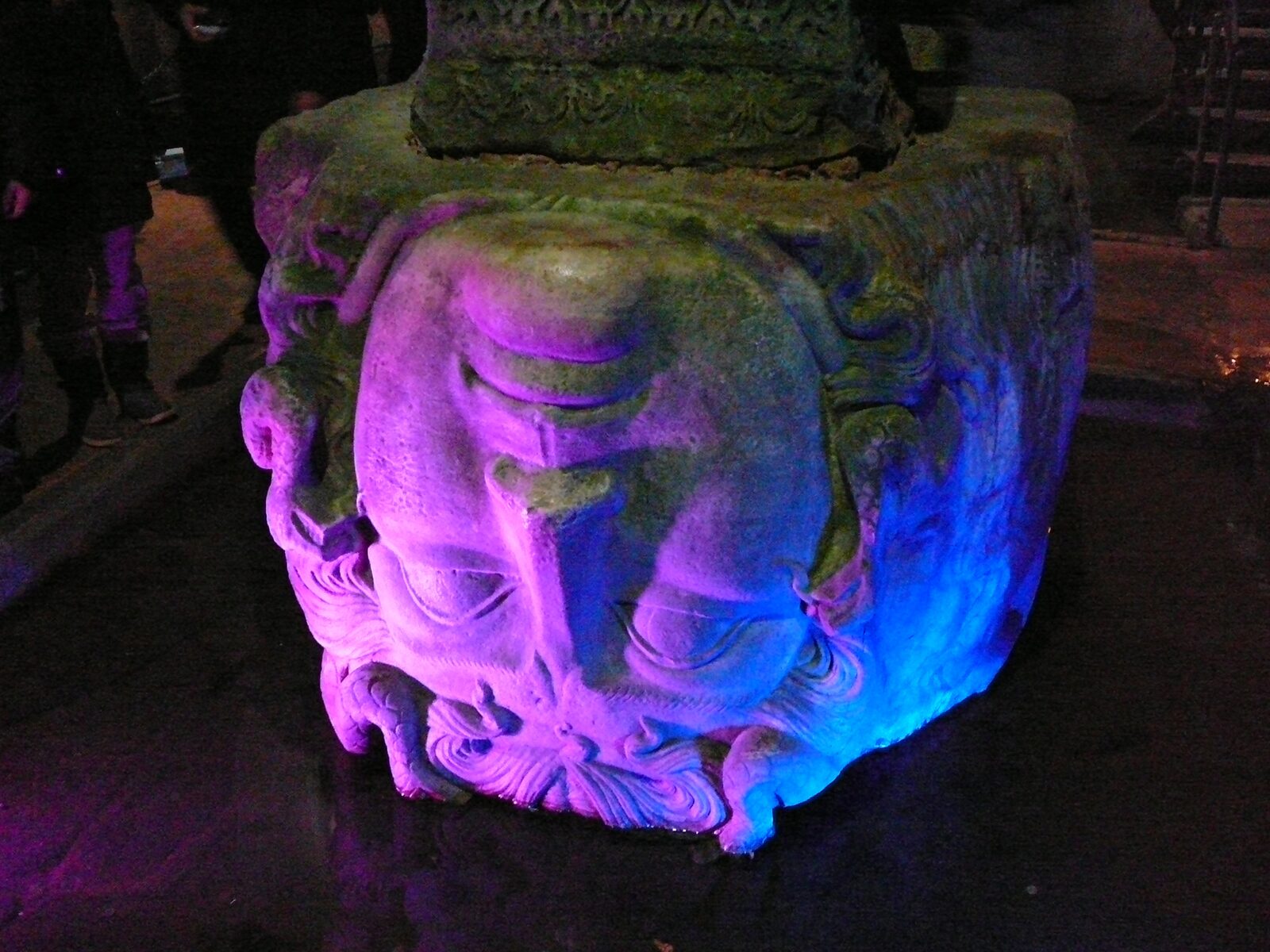
The two Medusa heads are the best-known details in the cistern.
They are reused as column bases near the end of the visitor route.
One sits sideways and the other is inverted.
Their original source is not known with certainty, and neither is the reason they were positioned this way.
You will find stories suggesting the orientation was intended to neutralize Medusa’s mythical power.
A much less dramatic explanation is also possible: builders reused available stone and positioned the pieces in whatever way best supported the columns.
Modern Art and Lighting
The current Basilica Cistern experience is not purely archaeological.
Modern lighting and temporary art installations can be incorporated into the visitor route.
That creates the visual atmosphere people associate with the cistern today, but it also means photographs from different years may look noticeably different.
How Long Do You Need at the Basilica Cistern?
Around 45 to 60 minutes is enough for most visitors.
You could move through faster, but there is little advantage in rushing.
Allow time to:
- let your eyes adjust;
- look at the different columns;
- stop at the Medusa heads;
- take photographs without blocking the walkway;
- appreciate the scale of the structure.
During busy periods, the practical visit may take longer because of queues and congestion rather than because the route itself is long.
Best Time to Visit the Basilica Cistern
The most useful strategy is usually to avoid the middle of the main Sultanahmet sightseeing rush.
Near Opening
A good choice if you want:
- clearer walkways;
- easier photography;
- fewer overlapping tour groups.
Midday
Convenient geographically, but this is when many sightseeing groups are moving between Hagia Sophia, the Blue Mosque and surrounding attractions.
The cistern can also be useful at midday during very hot weather because it provides a break from the sun.
Later Afternoon
Often easy to combine with a longer morning attraction.
Just make sure you understand the current closing time and whether daytime access stops before any separate evening session.
Evening
Consider it if a Night Shift or equivalent evening session is currently operating and the atmosphere itself is part of what you want.
Do not choose it based on an old timetable.
How to Get to the Basilica Cistern
The Basilica Cistern is on Yerebatan Caddesi in Sultanahmet.
For most visitors, the easiest public transport is the T1 tram.
Get off at Sultanahmet and walk a few minutes through the historic center.
The attraction is close to:
- Hagia Sophia;
- Blue Mosque;
- Hippodrome;
- Topkapi Palace.
If the entrance is not surrounded by a large queue, it can be surprisingly easy to walk past.
Search for Yerebatan Sarnıcı as well as Basilica Cistern on your map.
For the wider transport and sightseeing picture, see my Istanbul Travel Guide.
What to Wear and Bring
The cistern is underground, humid and darker than an ordinary museum.
Bring or wear:
- shoes with good grip;
- a light layer if you feel cold easily;
- a charged phone or camera;
- minimal bulky luggage.
The floor and visitor walkways can feel damp.
Photography conditions are also very different from the street outside.
A phone or camera that handles low light well will be more useful than trying to compensate with bright flash.
Follow the current rules regarding flash, tripods and professional equipment.
Basilica Cistern Accessibility
The modern visitor infrastructure has made the cistern much easier to experience than the original historic environment would allow.
However, this is still an underground sixth-century structure rather than a purpose-built modern museum.
If step-free access is essential, confirm the current:
- entrance arrangement;
- exit arrangement;
- wheelchair route;
- assistance options.
Do this shortly before visiting, especially because operational arrangements changed during 2026.
Do not rely solely on an older blog post stating that a particular lift or route will definitely be available.
What to Combine With the Basilica Cistern
The location makes the cistern extremely easy to combine with the rest of Sultanahmet.
Hagia Sophia
This is the most obvious pairing because the two attractions are only a short walk apart.
The cistern works well as the shorter visit before or after Hagia Sophia.
Blue Mosque
The Blue Mosque is also nearby.
Because it is an active mosque, tourist access depends on prayer times, so use the cistern as a flexible stop if the mosque is temporarily closed to visitors.
Topkapi Palace
Topkapi is geographically close but requires much more time.
Allow several hours for the palace rather than treating it as another 45-minute stop.
Hippodrome
The Hippodrome is free and easy to walk through between ticketed attractions.
It works well when you need a break from interiors.
Grand Bazaar
You can continue west through the Historic Peninsula or use the T1 tram.
Do not assume that proximity means every major sight belongs in one morning.
A realistic half-day might be:
Hagia Sophia + Basilica Cistern + Hippodrome
or:
Blue Mosque + Basilica Cistern + time around Sultanahmet
For complete day-by-day combinations, use my Istanbul itinerary.
Want Historical Context Rather Than Just Tickets?
A guided Sultanahmet tour can make sense if you want to understand how the cistern fits into Byzantine Constantinople rather than visiting it as an isolated underground attraction.
For a broader comparison of guided experiences, see my Best Istanbul Tours & Experiences.
Staying Near the Basilica Cistern
If the Historic Peninsula is the main focus of your first days in Istanbul, staying nearby makes it easier to visit the busiest attractions early.
Sultanahmet puts the Basilica Cistern, Hagia Sophia, Blue Mosque and Topkapi Palace within walking distance.
Sirkeci gives you better tram, ferry and Marmaray connections while still keeping the major historic sights close.
The trade-off is evening atmosphere.
Sultanahmet is very convenient for sightseeing but becomes considerably quieter later in the day than areas such as Karaköy, Galata or Kadıköy.
Read my full comparison of where to stay in Istanbul.
Is the Museum Pass Valid at the Basilica Cistern?
Do not assume that Turkey’s national Museum Pass or Müzekart covers the Basilica Cistern.
The cistern has historically operated under a separate ticketing system, and ticketing arrangements changed again during 2026.
Check the current pass terms and the current admission rules before relying on inclusion.
If you are buying a pass mainly for Istanbul attractions, calculate its value without automatically counting the Basilica Cistern.
Common Basilica Cistern Mistakes
- Using an old ticket price. Ticketing arrangements have changed, particularly during 2026.
- Assuming Night Shift operates the same way every day. Check the current evening schedule before planning around it.
- Expecting a two-hour museum visit. The visitor route is relatively compact.
- Wearing shoes with poor grip. Underground surfaces can be damp.
- Photographing only the Medusa heads. The reused columns and structure are at least as interesting.
- Treating the Medusa legends as established history. Their origin and unusual positioning are not known with certainty.
- Believing “skip the line” means every queue disappears. Read exactly which queue the ticket lets you bypass.
- Trying to combine every Sultanahmet attraction before lunch. Walking distance and realistic visiting time are not the same thing.
Basilica Cistern Istanbul FAQ
How Long Does the Basilica Cistern Take?
Allow around 45 to 60 minutes inside.
Add extra time for ticketing or queues during busy periods.
Is the Basilica Cistern Worth Visiting?
It is a particularly good choice if you enjoy Byzantine history, unusual architecture or atmospheric interiors.
It is also easy to combine with other Sultanahmet sights because the visit does not require half a day.
Travelers on a strict sightseeing budget may want to compare the current ticket price with their other priorities before deciding.
Is the Basilica Cistern Night Shift Worth It?
It can be if you specifically want an evening atmosphere and the Night Shift or equivalent evening session is operating on your date.
Do not assume it will be quieter or better value than daytime admission.
Check the current hours and ticket arrangement first.
Is the Basilica Cistern Included in the Museum Pass?
Do not assume so.
The cistern has its own admission arrangements, and these changed during 2026.
Check the current Museum Pass terms and ticket rules before visiting.
Are the Medusa Heads Original to the Basilica Cistern?
They are ancient carved stone pieces reused as column bases.
Their original location and the reason one was placed sideways and the other upside down are not known with certainty.
Can You Visit the Basilica Cistern and Hagia Sophia on the Same Day?
Yes.
They are only a few minutes apart and are one of the easiest major-attraction combinations in Sultanahmet.
Add one additional short stop rather than trying to fit the entire Historic Peninsula into the same morning.
Do You Need to Book the Basilica Cistern in Advance?
Not always.
Advance booking can be useful during busy periods or when you want a guided experience.
Before paying, check:
- the actual admission included;
- entry time;
- cancellation rules;
- whether the product covers daytime or evening access;
- what “skip the line” actually means.
Last checked: September 2026. Ticketing, opening hours, evening sessions and visitor arrangements can change.
Some links in this article are affiliate links. If you book through them, I may earn a small commission at no extra cost to you.