Blue Mosque Istanbul: Dress Code, Prayer Times & Visiting Tips
The Blue Mosque in Istanbul is one of the city’s defining landmarks, but visiting it is different from entering a museum or ticketed attraction.
Sultan Ahmet Mosque is an active place of worship. There is no standard admission ticket, and the most important parts of planning your visit are choosing the right time, dressing appropriately and understanding how prayer affects tourist access.
The mosque is also one of the easiest major sights to combine with the rest of Sultanahmet, sitting directly across the square from Hagia Sophia and only a short walk from the Basilica Cistern and Topkapi Palace.
If this is your first trip, see my 22 Best Things to Do in Istanbul for help deciding how the Blue Mosque fits into the rest of your sightseeing.
Visitor information was checked in September 2026. Prayer times, visitor access and entrance procedures can change, so follow current signs and staff instructions when you arrive.
Blue Mosque Istanbul at a Glance
| Official name | Sultan Ahmet Mosque / Sultanahmet Camii |
| Entry | Free; donations are optional |
| Visitor access | Outside prayer periods |
| Friday | More restricted around the main congregational prayer |
| Dress code | Shoulders and knees covered; women cover their hair |
| Shoes | Removed before entering the carpeted prayer area |
| Allow | Around 30 to 45 minutes, plus possible waiting time |
| Nearest tram stop | Sultanahmet on the T1 line |
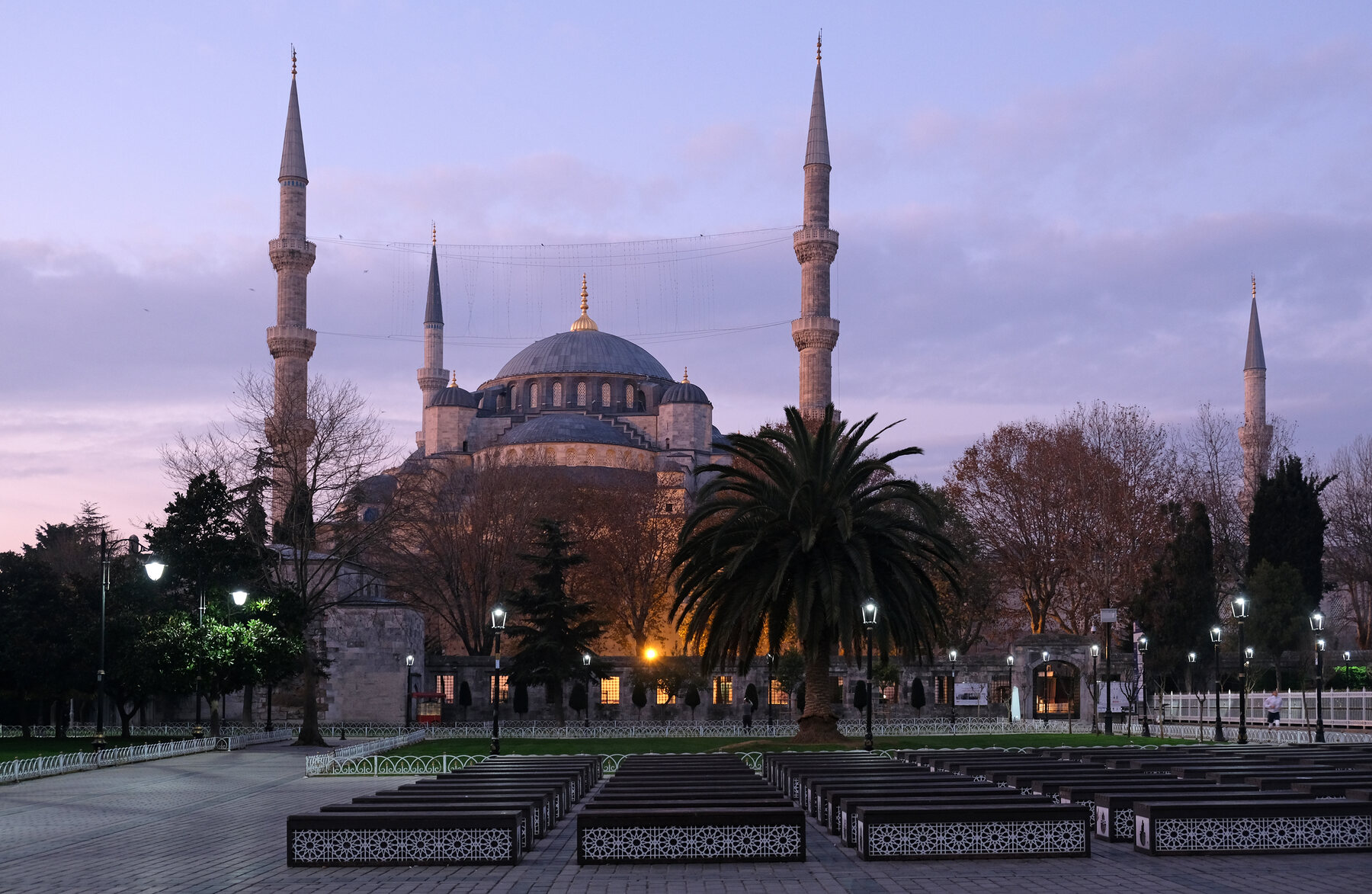
The mosque was commissioned by Sultan Ahmed I and built between 1609 and 1617. Its six minarets, cascading domes and extensive İznik tile decoration make it one of the most recognizable examples of Ottoman architecture in Istanbul. Official Istanbul tourism sources continue to describe it as both a major landmark and an active place of worship.
Is Entry to the Blue Mosque Free?
Yes.
There is no official Blue Mosque admission ticket.
You do not need to pay simply to enter during the designated visitor periods.
Paid products sold online are usually:
- guided Blue Mosque visits;
- Sultanahmet walking tours;
- history tours;
- combined experiences covering several nearby sights.
They can be useful when you want historical and architectural context, but they are not mandatory entrance tickets.
That distinction is important when comparing tour listings online.
Want Historical Context?
A guide can help explain the mosque’s architecture, İznik tiles, six minarets, imperial complex and relationship with Hagia Sophia across the square.
Blue Mosque Prayer Times and Visitor Access
The Blue Mosque remains a functioning mosque, so worship takes priority over sightseeing.
Non-worship visitors are not admitted to the normal tourist area during prayer periods.
There is no single permanent clock time that is always best because Islamic prayer times shift throughout the year.
Before going:
- check Istanbul prayer times for that day;
- leave a buffer before and after the listed prayer time;
- expect more disruption around Friday midday prayer;
- follow the current instructions at the entrance.
Do not arrive five minutes before a prayer and expect to complete a quick sightseeing visit.
Even if the doors are still open when you reach Sultanahmet Square, staff may already be preparing the mosque for worship.
What Time Is Usually Easiest?
Mid-morning often works conveniently for sightseeing, but it is not a guaranteed access window.
The better strategy is:
- check the day’s prayer schedule;
- choose a visitor period with enough time before the next prayer;
- keep another nearby attraction as a backup.
If the mosque is temporarily closed to sightseeing, simply reverse the order of your Sultanahmet route and return later.
Friday requires the most flexibility because of the main congregational prayer.
Blue Mosque Dress Code
Because you are entering an active mosque, dress conservatively.
For Women
Bring a scarf that can cover your hair.
Wear clothing that covers:
- shoulders;
- upper arms;
- knees.
Long trousers, a long skirt or a dress below the knees are practical choices.
For Men
Wear a shirt or T-shirt with sleeves and trousers or shorts that cover the knees.
For Everyone
Shoes are removed before entering the carpeted prayer area.
Keep socks on if you prefer not to walk barefoot.
A small reusable bag can be useful for carrying your shoes rather than leaving them separately in a busy entrance area.
Coverings may sometimes be available near the mosque, but bringing your own lightweight scarf is usually simpler.
Avoid transparent or extremely tight clothing even if the basic shoulders-and-knees requirement is technically met.
What to See Inside the Blue Mosque
The visitor area is relatively compact, so knowing what to look for makes the short visit much more interesting.
The İznik Tiles
The popular English name Blue Mosque comes from the blue tones associated with the mosque’s extensive İznik tile decoration.
Do not expect the entire interior to appear intensely blue.
Look closely at the lower walls and surrounding decorative surfaces.
The tiles include floral and plant motifs characteristic of Ottoman decorative art.
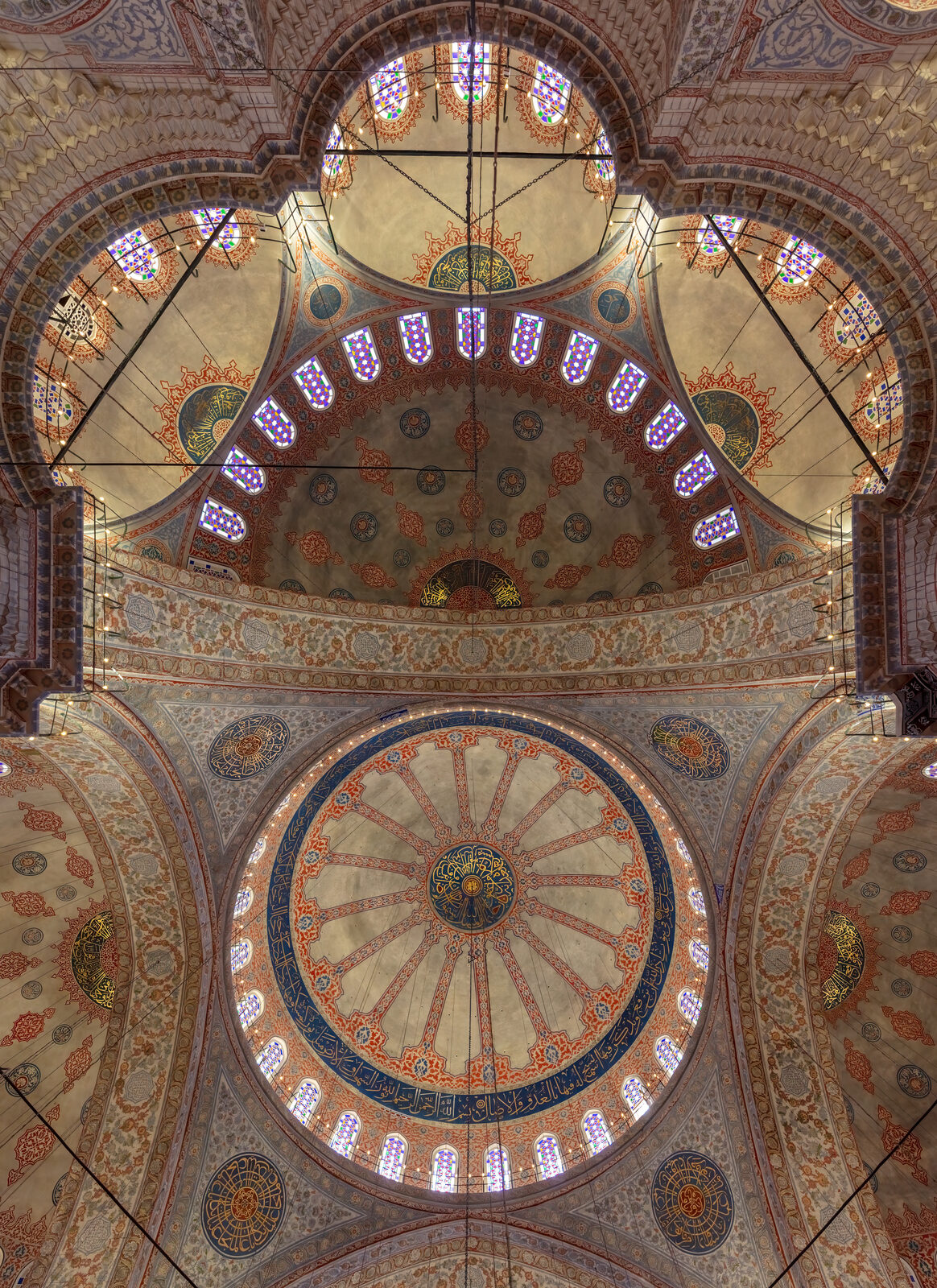
The Central Dome and Semi-Domes
Look upward from the prayer hall.
The large central dome is surrounded by cascading semi-domes and smaller domes, creating the layered silhouette that also defines the exterior.
The composition is both structural and visual, pulling attention toward the center of the prayer space.
The Mihrab and Minbar
The mihrab indicates the direction of Mecca.
The minbar is the raised pulpit used for sermons.
Sightseeing visitors remain within the designated visitor area, but both can be seen from there.
The Six Minarets
The Blue Mosque is famous for its six minarets.
You appreciate them better outside than from within the prayer hall.
Walk around Sultanahmet Square and the mosque courtyard rather than taking only the standard frontal photograph.
The changing angles also reveal how the mosque’s domes and minarets were designed as one composition.
A Short History of Sultan Ahmet Mosque
Sultan Ahmed I commissioned the mosque in the early seventeenth century.
Architect Sedefkâr Mehmed Agha designed the complex, with construction taking place between 1609 and 1617. Istanbul’s official tourism site likewise identifies Ahmed I, those dates and Sedefkâr Mehmed Agha as central to the mosque’s history.
Its location was deliberate.
The mosque faces Hagia Sophia across the historic center and formed part of a much larger imperial complex.
That complex once included educational, charitable and commercial functions rather than only the prayer hall visitors see today.
A major restoration of the mosque was completed in 2023, renewing important structural and decorative elements while the building continued its religious role.
Best Time to Visit the Blue Mosque
The best time is not defined by a fixed hour.
It depends on the prayer schedule for the day.
| Time | What to expect |
|---|---|
| Early morning | Quieter square and good exterior light; access still depends on prayer |
| Mid-morning | Often convenient, although tour groups are common |
| Friday midday | Most restrictive period for sightseeing visitors |
| Late afternoon | Attractive exterior light, but check the next prayer |
| Evening | Beautiful exterior illumination; tourist access may be limited |
The easiest strategy is to arrive in Sultanahmet with a flexible order rather than scheduling the mosque between two tightly timed tickets.
If access is temporarily closed, visit another nearby sight and return.
How Long Do You Need at the Blue Mosque?
Plan around 30 to 45 minutes for:
- courtyard;
- interior;
- architecture;
- photographs.
The actual amount of time can be longer if you need to wait for sightseeing access to reopen.
The mosque itself does not require the several hours you would normally allocate to Topkapi Palace.
That makes it useful as a flexible part of a Sultanahmet day.
How to Get to the Blue Mosque
The Blue Mosque stands in Sultanahmet Square on Istanbul’s Historic Peninsula.
For most visitors, the easiest public transport option is the T1 tram.
Get off at Sultanahmet.
From there, the mosque is only a short walk across the square.
From Eminönü
Take the T1 tram toward Bağcılar and get off at Sultanahmet.
From Karaköy
Take the T1 across Galata Bridge and continue to Sultanahmet.
From Taksim
Take the F1 funicular to Kabataş, then change to the T1 tram.
From Kadıköy
Take a ferry to the European side, then continue toward Sultanahmet by tram or on foot depending on your arrival pier.
Driving is rarely useful.
Traffic around the Historic Peninsula is unpredictable, road access is restricted in several areas and parking is inconvenient.
For more information about moving around the city, see my Istanbul Travel Guide.
How to Combine the Blue Mosque With Nearby Sights
The mosque sits in the densest sightseeing area of Istanbul.
The trick is not finding something else nearby.
The trick is not trying to do everything at once.
Hagia Sophia
Hagia Sophia is directly across Sultanahmet Square.
Geographically, this is the most obvious combination.
Because both buildings operate as active mosques, prayer schedules can affect the order.
Basilica Cistern
The Basilica Cistern is only a short walk away and is relatively compact.
It works particularly well when you want one free religious monument plus one ticketed indoor attraction.
Hippodrome
The Hippodrome area is immediately beside the mosque.
You can see monuments such as the Egyptian Obelisk and Serpent Column without adding another ticket or queue.
Topkapi Palace
Topkapi is close geographically but completely different in terms of time.
Give it several hours rather than treating it as another quick stop.
A Realistic Half-Day
One practical combination is:
- arrive at Sultanahmet Square;
- check Blue Mosque visitor access;
- enter if it is open;
- walk through the Hippodrome;
- continue to Hagia Sophia or Basilica Cistern;
- add one shorter outdoor stop.
If prayer prevents entry, reverse the order and return later.
Do not try to finish the Blue Mosque, Hagia Sophia, Basilica Cistern and Topkapi Palace in a rushed morning.
For realistic day-by-day combinations, see my Istanbul itinerary for 1, 2, 3, 4, 5 or 7 days.
Is a Blue Mosque Guided Tour Worth It?
You do not need a guide simply to enter.
The mosque is free and straightforward to visit independently.
A guide is useful for a different reason: context.
Consider a guided visit if you want to understand:
- Ottoman mosque architecture;
- İznik tile decoration;
- the imperial complex;
- Sultan Ahmed I;
- the six minarets;
- how the building relates architecturally and historically to Hagia Sophia;
- how an active mosque functions differently from a museum.
If you mainly want to see the interior, courtyard and architecture at your own pace, an independent visit is enough.
For a broader comparison of tours that can genuinely add value, see my 9 Best Istanbul Tours & Experiences.
Staying Near the Blue Mosque
If the Historic Peninsula is the main focus of your first Istanbul trip, staying nearby makes early sightseeing much easier.
Sultanahmet puts the Blue Mosque, Hagia Sophia, Basilica Cistern and Topkapi Palace within walking distance.
It is particularly convenient if you want to see the square early in the morning or after many day visitors have left.
Sirkeci keeps the historic core close while giving you better access to:
- T1 tram;
- Marmaray;
- ferries;
- Eminönü.
The main trade-off with Sultanahmet is the evening atmosphere.
It becomes much quieter after sightseeing hours than Karaköy, Galata, Taksim or Kadıköy.
Read my complete guide to where to stay in Istanbul.
Blue Mosque Photography and Respectful Behavior
Remember that people around you may be there to pray rather than sightsee.
- Keep your voice low.
- Silence your phone.
- Do not photograph worshippers intrusively.
- Stay behind visitor barriers.
- Keep active prayer areas clear.
- Follow staff instructions about photography.
- Do not treat borrowed mosque coverings as costumes or photo props.
The courtyard and Sultanahmet Square are usually better places for portraits and wide architectural images.
Inside, a wide-angle phone camera is useful for capturing the dome without moving into restricted areas.
Blue Mosque Accessibility and Practical Tips
The area around Sultanahmet Square is largely paved, although historic surfaces can be uneven.
Visitor circulation can change depending on:
- worship;
- crowds;
- religious events;
- security arrangements.
If step-free access is essential, ask staff about the current accessible visitor route before joining the normal entrance flow.
Do not rely solely on an older accessibility report.
Other useful practical points:
- carry water during hot weather, but do not eat inside the prayer hall;
- use toilets before joining a long visitor queue;
- keep valuables secure in crowded tram and sightseeing areas;
- check religious holidays when planning a visit around a specific date;
- avoid booking another timed attraction immediately after the mosque if your schedule is tight.
Common Blue Mosque Mistakes
- Looking for an entrance ticket. Normal mosque entry is free.
- Buying a guided tour because you think it is required for admission. Tours are optional and pay for context, not basic entrance.
- Ignoring prayer times. Worship takes priority over sightseeing.
- Arriving just before prayer. Access may stop before the listed prayer actually begins.
- Wearing unsuitable clothing. Mosque dress rules still apply to tourists.
- Expecting a quiet museum environment. This is an active religious space.
- Looking only for blue tiles. The domes, mihrab, minbar, courtyard and six minarets are equally important.
- Scheduling every Sultanahmet attraction into one morning. Nearby does not mean quick.
Blue Mosque Istanbul FAQ
Do You Need Tickets for the Blue Mosque?
No.
Normal entry to the mosque is free.
Paid products sold online are guided tours or combined experiences rather than required entrance tickets.
Can Non-Muslims Enter the Blue Mosque?
Yes.
Non-Muslim visitors can enter during designated sightseeing periods outside prayer, provided they follow mosque dress and behavior rules.
What Time Should You Visit the Blue Mosque?
There is no single permanent best time because prayer times change throughout the year.
Check the prayer schedule for the day and choose a visitor window with a reasonable buffer before the next prayer.
Mid-morning often works conveniently, while Friday around the congregational prayer requires more flexibility.
How Long Do You Need at the Blue Mosque?
Allow around 30 to 45 minutes for the courtyard and interior.
Add waiting time if sightseeing access is temporarily paused.
What Should Women Wear at the Blue Mosque?
Women should cover their hair, shoulders and knees.
Carrying your own lightweight scarf is the simplest option.
Do Men Have a Dress Code?
Yes.
Men should also dress modestly, with shoulders and knees covered.
Do You Have to Remove Your Shoes?
Visitors remove their shoes before entering the carpeted prayer area.
Follow the current entrance instructions regarding where or how to carry them.
Is the Blue Mosque the Same as Hagia Sophia?
No.
They are separate buildings facing each other across Sultanahmet Square.
The Blue Mosque is a seventeenth-century Ottoman imperial mosque.
Hagia Sophia was built in the sixth century as a Byzantine church and later served different religious and institutional roles across its long history.
Can You Visit the Blue Mosque on Friday?
Yes, but sightseeing access is more restricted around the main Friday prayer.
For an easier visit, go earlier or plan another nearby sight while the mosque is closed to tourists and return afterward.
Is a Guided Tour Necessary?
No.
The mosque is easy to visit independently.
Pay for a guided tour when you want historical and architectural explanation rather than because you think a guide is required to enter.
Last checked: September 2026. Prayer times, visitor access and mosque procedures can change.
Some links in this article are affiliate links. If you book through them, I may earn a small commission at no extra cost to you.