Dinh Cau Phu Quoc: Temple, Lighthouse, Sunset & What to Expect
Phu Quoc is easy to associate with beaches, resorts and sunsets. But I went into Duong Dong because I wanted to see what the island feels like once the pools and sunbeds run out.
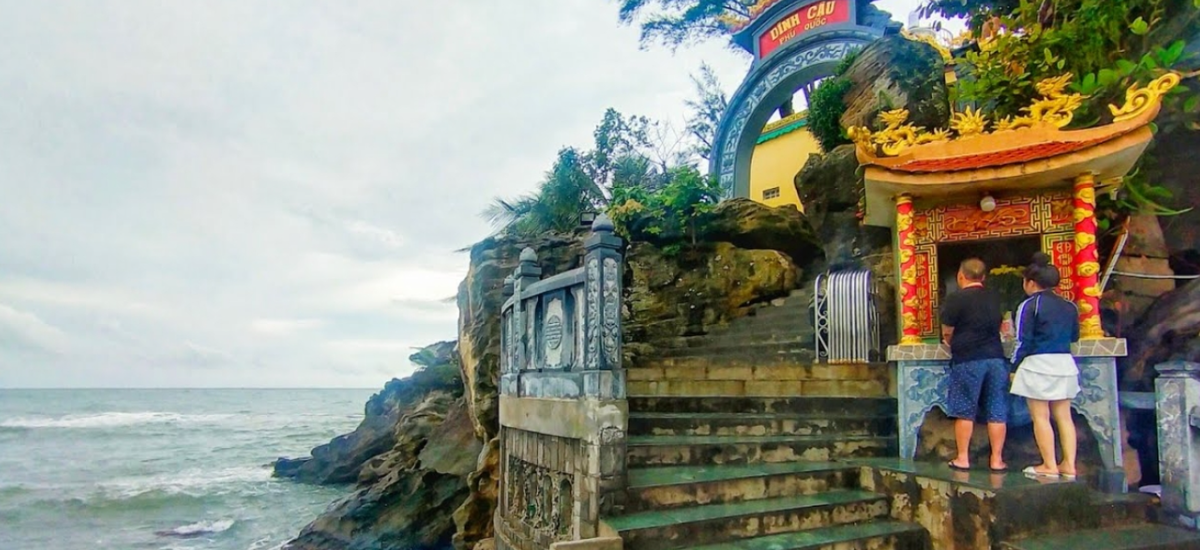
That eventually brought me to the point where the Duong Dong River meets the sea, with a small shrine and lighthouse standing on a rocky outcrop between the town and the water.
This is Dinh Cau, one of the most recognizable landmarks in Duong Dong and a place closely connected to Phu Quoc’s fishing and maritime life.
I arrived in the afternoon and ended up spending almost the entire evening around Dinh Cau.
Some people come here to pray. Some sit and watch the water. Many visitors arrive for sunset.
For me, the best part was seeing all of those versions of the place overlap.
Is Dinh Cau Worth Visiting?
Yes, if you are already spending time in Duong Dong.
I would not cross the entire island only to see the shrine for ten minutes. But combined with the waterfront, sunset and Phu Quoc Night Market, Dinh Cau becomes one of the easiest and most enjoyable evening stops in town.
The shrine itself is small.
What makes the place interesting is the setting: the rock, the sea, fishing boats, the river mouth, the lighthouse and the activity of central Duong Dong immediately behind it.
You can stop for 15 or 20 minutes.
Or you can do what I did and stay around until evening.
What Is Dinh Cau?
Dinh Cau, sometimes called Dinh Cau Temple, Dinh Cau Shrine or Dinh Cau Rock, sits on a rocky outcrop at the mouth of the Duong Dong River.
It is closely connected to Phu Quoc’s fishing communities and the island’s long relationship with the sea.
Local fishermen traditionally come here to pray for safe journeys, calm seas and a good catch.
That connection makes more sense once you see the location.
The shrine is not hidden inland behind walls. It sits directly above the water, with boats moving between the river and the sea below.
Beside it stands the Dinh Cau lighthouse, another distinctive part of the waterfront.
What You See at Dinh Cau
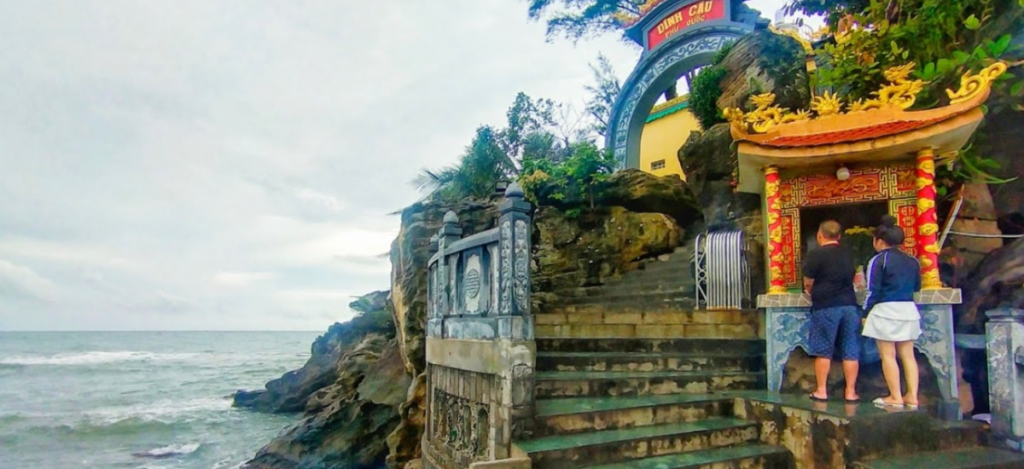
Dinh Cau is a small site, so do not expect a large temple complex.
The experience is mostly about several elements packed into one compact place:
- the rocky outcrop
- the shrine
- the stone staircase
- the lighthouse
- views over the Gulf of Thailand
- the Duong Dong River mouth
- fishing boats below
- the waterfront and town behind you
You reach the shrine by climbing 29 stone steps.
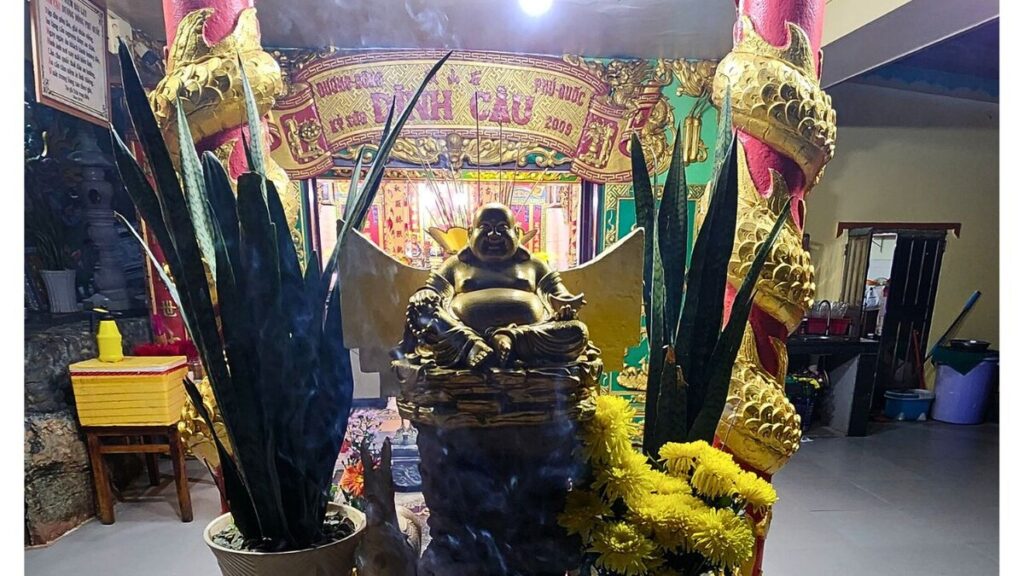
At the top, there is a small courtyard and shrine area with decorative columns, altars, incense and maritime religious imagery.
An old tree provides shade around the upper area, and this is one of the nicest places to stop rather than immediately walking back down.
From here, the town and the sea feel unusually close together.
The Temple, Rock and Lighthouse
Dinh Cau is sometimes described simply as a temple, but that does not quite explain why the place is memorable.
The rock itself is part of the identity of the shrine.
According to local tradition, fishermen once faced dangerous storms offshore and saw the rocky outcrop as a place of protection. A shrine was established here, and generations of local seafarers continued coming to pray before going to sea.
The exact early history is difficult to separate from legend.
Modern official sources also describe the religious traditions of Dinh Cau somewhat differently, but they consistently connect the shrine with the sea, protection and Phu Quoc’s fishing communities.
That is the part that matters most when you visit.
Next to the shrine is the Dinh Cau lighthouse, standing over the river mouth and fishing harbor.
Together, the shrine and lighthouse make the rocky point one of the easiest landmarks to recognize in central Duong Dong.
A Local Legend About Dinh Cau Rock
One of the best-known local stories explains why the rock became sacred.
The story says that fishermen were once caught in dangerous weather offshore and feared they would not make it back to land.
A rocky outcrop appeared as a landmark through the sea and helped guide them toward safety.
Local people interpreted it as a sign of protection and eventually established a shrine on the rock.
Whether you treat that literally or simply as folklore, the story fits the geography surprisingly well.
Stand at Dinh Cau and watch the fishing boats moving through the river mouth, and it is easy to understand why a place like this became connected with safe passage at sea.

Dinh Cau at Sunset
Sunset is when Dinh Cau becomes much busier, and for good reason.
The rocky point faces the water, giving you a clear view as the light changes over the Gulf of Thailand.
Fishing boats become silhouettes, the sea takes on warmer colors and the shrine and lighthouse stand out against the sky.
You do not need a complicated sunset plan here.
Find a place around the rock or waterfront, watch the boats and wait.
I arrived earlier in the day and stayed into the evening, and I liked having both versions of Dinh Cau rather than arriving only for the final few minutes of sunset.
During the day, you notice the shrine and its details.
Toward evening, the whole waterfront becomes the experience.

Best Time to Visit Dinh Cau
There are three useful times to consider.
Early Morning
Early morning is cooler and quieter.
This is a good time if you are more interested in local life than sunset photography. Fishing activity around the river mouth also makes more sense in the context of the shrine’s maritime traditions.
Late Afternoon and Sunset
For most travelers, this is the easiest choice.
Arrive during the late afternoon, look around the shrine while there is still daylight, then stay for sunset.
Afterward, continue into central Duong Dong for dinner or the night market.
During the Dinh Cau Festival
The Dinh Cau Festival takes place around the 15th day of the 10th lunar month.
Fishermen gather to make offerings and pray for calm seas and good catches, and the festival includes religious ceremonies as well as community activities.
If your trip happens to coincide with the festival, expect Dinh Cau to feel very different from a normal evening visit.
Opening Hours and Entrance Fee
Dinh Cau is generally listed as open from approximately 7:00 AM to 8:30 PM.
Entrance is free.
Opening arrangements can change, so if visiting at the very beginning or end of the day, check current information before going.
For most travelers, late afternoon is the simplest option because it combines the shrine with sunset and an evening in Duong Dong.
How Long Do You Need at Dinh Cau?
For the shrine itself, you do not need long.
Allow roughly:
- 15-30 minutes to climb the steps, look around the shrine and enjoy the views
- 45-60 minutes if you want to stay around the waterfront
- longer if you are waiting for sunset or combining it with a relaxed evening walk
I stayed much longer because I arrived during the afternoon and did not treat Dinh Cau as an isolated sightseeing stop.
That is also how I think it works best.
What to Do Around Dinh Cau
Do not rush up the steps, take one photograph and immediately leave.
There are a few simple things worth doing.
Look at the Shrine Properly
The interior is small, but take a moment to notice the altars, incense, decorative details and the way local visitors use the space.
This is an active spiritual site, not a decorative temple built for tourists.
Sit Near the Water
One of my favorite parts was simply stopping around the upper area and looking toward the sea.
There is enough activity below to keep the view interesting: boats, people, water and the movement around the river mouth.
Walk Along the Waterfront
Dinh Cau sits in the middle of an area that is easy to explore on foot.
Once you come back down, continue around the waterfront rather than treating the shrine as the end of the route.
Stay for Sunset
If the weather is good and you are already there in the afternoon, this is the obvious reason not to leave too quickly.
How to Get to Dinh Cau
Dinh Cau is in central Duong Dong, at the mouth of the Duong Dong River.
If you are already exploring the town center, it is easy to reach on foot.
It is also close enough to the evening activity around central Duong Dong that there is little reason to organize a separate trip only for the shrine.
If you are coming from another part of Phu Quoc, a taxi, ride-hailing service or motorbike is the simplest option.
Once you arrive, the rocky outcrop and lighthouse are easy to recognize.
How to Combine Dinh Cau With an Evening in Duong Dong
This is where Dinh Cau makes the most sense to me.
Instead of treating it as one isolated attraction, use it as part of an evening route through town.
A simple version could look like this:
- Late afternoon: walk through central Duong Dong or the waterfront
- Before sunset: visit Dinh Cau and climb to the shrine
- Sunset: stay around the rock and waterfront
- After dark: walk toward Phu Quoc Night Market
- Evening: dinner, a drink, live music or a massage
That is close to how my own evening unfolded.
Duong Dong works well when you let several small stops connect naturally rather than trying to turn each one into a major attraction.
There are also other small spiritual sites around central Duong Dong, including Dinh Ba Thuy Long Thanh Mau and Quan Thanh De Quan Temple, if you want to see more of the town’s cultural side.

Staying in Duong Dong Near Dinh Cau
If you are staying in Duong Dong, Dinh Cau is particularly easy to visit on foot together with the waterfront, restaurants and Phu Quoc Night Market.
Hotels and accommodation in central Duong Dong also work well if you want evening walks, food and local town life within easy reach rather than spending your entire trip inside a resort area.
Staying near the center makes places such as Dinh Cau easy to add spontaneously instead of planning transport across the island for every evening.
Is Dinh Cau Good for Photography?
Yes, especially in the late afternoon.
The strongest compositions are usually not close-ups of the shrine itself.
Look for:
- the shrine and lighthouse together
- fishing boats below the rock
- silhouettes at sunset
- the river mouth meeting the sea
- the shrine illuminated after sunset
- details of the altars and decorative interior
The transition from daylight to evening gives you much more variety than arriving for only five minutes.
Remember that Dinh Cau remains an active place of worship, so photograph people and religious activity respectfully.
Practical Tips
- Come in the late afternoon if you want sunset. You can see the shrine in daylight first and stay as the waterfront changes toward evening.
- Wear respectful clothing. This is an active shrine.
- Allow more time than the temple itself requires. The shrine may take only 15-30 minutes, but the setting is the main reason to stay longer.
- Bring water in hot weather. There are exposed areas around the waterfront.
- Do not worry about building an entire day around Dinh Cau. It works best as part of Duong Dong.
- Continue to the night market afterward. This is one of the most natural evening combinations in town.
Do You Need to Visit Dinh Cau?
No single temple is going to define your entire Phu Quoc trip.
If you are staying far away and have very limited time, I would not tell you to cross the whole island only for Dinh Cau.
But if you are exploring Duong Dong, it is difficult to think of a reason to skip it.
It is free, central and easy to combine with sunset, the waterfront and the night market.
More importantly, it gives you a glimpse of a version of Phu Quoc that existed long before beach resorts became the island’s dominant image.
You see fishing boats rather than infinity pools.
People come to pray for safe journeys at sea.
The river ends, the sea begins, and a small shrine sits between them.
I arrived for a look and stayed almost the whole evening.
That is probably the best way to experience Dinh Cau too: not as a box to tick, but as part of the town around it.
FAQ About Dinh Cau Phu Quoc
What is Dinh Cau in Phu Quoc?
Dinh Cau is a small maritime shrine on a rocky outcrop at the mouth of the Duong Dong River in Phu Quoc. It is closely associated with the island’s fishing communities and traditions of praying for protection at sea.
Is Dinh Cau worth visiting?
Yes, especially if you are already visiting Duong Dong. The shrine is small, but the combination of the rock, lighthouse, waterfront, fishing harbor and sunset makes it a worthwhile stop.
Is Dinh Cau free?
Yes. Dinh Cau is generally listed as free to enter.
What are the opening hours for Dinh Cau?
Current visitor information generally lists Dinh Cau as open from around 7:00 AM to 8:30 PM. Hours can change, so check current information if you are planning an early or late visit.
How long do you need at Dinh Cau?
Around 15-30 minutes is enough for the shrine itself. Allow longer if you want to explore the waterfront or stay for sunset.
What is the best time to visit Dinh Cau?
Late afternoon is the easiest choice for most visitors because you can see the shrine in daylight and then stay for sunset. Early morning is quieter.
How many steps are there at Dinh Cau?
There are 29 stone steps leading up to the shrine.
Can you see the sunset from Dinh Cau?
Yes. Dinh Cau is one of the easiest sunset spots to combine with an evening in central Duong Dong.
What can I combine with Dinh Cau?
Phu Quoc Night Market, the Duong Dong waterfront, local restaurants and several small temples in central Duong Dong fit naturally into the same evening.
Some links on this page are affiliate links. If you make a booking or purchase through one of them, I may earn a small commission at no extra cost to you.