
Kaymaklı vs Derinkuyu: Which Underground City Should You Visit?
Kaymaklı vs Derinkuyu comes down to what kind of underground-city experience you want, not which one is bigger or more famous. Derinkuyu impresses with depth, steep descents, and the engineering scale of a settlement reaching roughly 85 metres underground. Kaymaklı spreads horizontally, making everyday underground life easier to picture through its stables, kitchens, wineries, and workshops.
I visited both Derinkuyu and Kaymaklı on the same day from Göreme, and I am glad I did. They did not feel interchangeable.
Derinkuyu stayed with me for the physical sensation of going deeper and deeper below the surface. Kaymaklı made it easier to understand how an underground settlement actually functioned day to day.
If you only have time for one, choose according to the experience you want rather than simply picking the deepest city.
Kaymaklı vs Derinkuyu at a Glance
| Kaymaklı | Derinkuyu | |
|---|---|---|
| Best for | Daily life and underground layout | Depth and engineering scale |
| Overall structure | Wider, more horizontal | Deeper, more vertical |
| Known levels | 8 | 8-level underground complex |
| Open to visitors | 4 illuminated levels | Only part of the complete complex |
| Depth | Not its main feature | Approx. 85 m |
| Main impression | How people lived underground | How far underground the system extends |
| Passages | Low, narrow and sloping in places | Narrow tunnels, stairs and steep descents |
| Key features | Stables, kitchens, wineries, storage, workshops, stone doors | Missionary school, deep ventilation shaft, church, wells, storage |
| Claustrophobia | Still potentially difficult | Usually feels more intense |
| Current foreign adult ticket | €13 | €13 |
| Time to allow | Around 1–2 hours | Around 1–2 hours |
| Can you visit independently? | Yes | Yes |
| Can you reach it without a car? | Yes | Yes |
The Short Answer: Kaymaklı or Derinkuyu?
Choose Derinkuyu if the main reason you want to visit an underground city is the feeling of descending deep beneath Cappadocia.
Choose Kaymaklı if you are more interested in seeing how an underground settlement worked: where animals were kept, where food was stored, how wine was produced and how passages could be sealed during danger.
For a short first trip to Cappadocia, one underground city is enough for most travellers.
Visit both if underground architecture genuinely interests you. Seeing them on the same day made their differences much clearer to me.
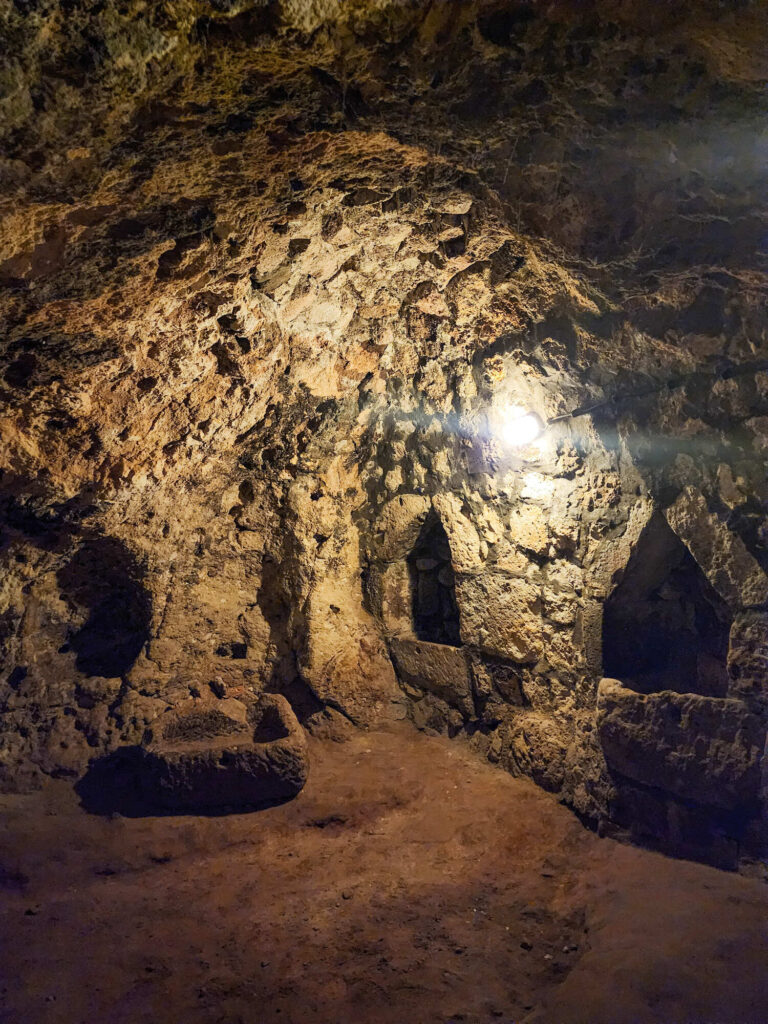
What Is the Main Difference Between Them?
The simplest comparison is:
Derinkuyu = depth and scale.
Kaymaklı = layout and daily life.
Derinkuyu descends to around 85 metres, and much of the experience comes from physically feeling that depth. Long stairways, enclosed passages and narrow tunnels repeatedly take you farther below the surface.
Kaymaklı is also enormous, but its structure spreads more horizontally. Official museum information describes it as the widest of Cappadocia’s explored underground cities.
That difference affects the visitor experience more than the number of levels.
Derinkuyu Underground City: What Is It Like?
Derinkuyu is the more dramatic choice if you want to feel just how far an underground city could extend.
What stayed with me most was the physical sensation of descending.
You move through stone stairs, tunnels and rock-cut rooms, then continue lower. In some passages, there is barely enough space for people to move through one at a time.
It feels less like walking around a conventional archaeological site and more like entering a huge underground mechanism.
How Deep Is Derinkuyu?
Derinkuyu reaches approximately 85 metres underground.
It is commonly described as an eight-level underground city, although that does not mean every part of all eight levels is open for unrestricted exploration.
Only a portion of the enormous complex is accessible to visitors today.
The number itself is impressive, but the depth makes more sense once you are inside. The repeated descents are what make Derinkuyu feel different from Kaymaklı.
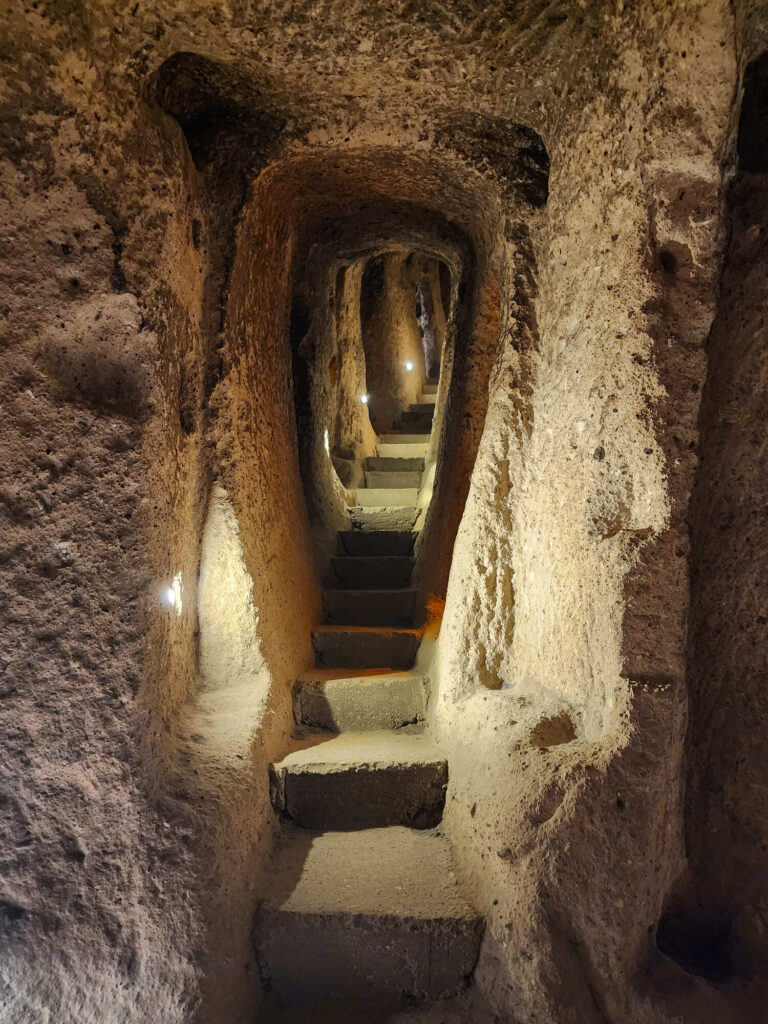
What Can You See Inside Derinkuyu?
The underground system included spaces for both survival and community life.
You will encounter or learn about:
- storage rooms;
- food preparation areas;
- cellars;
- stables;
- wells;
- ventilation shafts;
- churches;
- narrow defensive corridors;
- rooms connected across different levels.
One of the most distinctive areas is the missionary school, with associated study spaces.
Another major engineering feature is a ventilation and water shaft extending for roughly 55 metres.
There is also a cross-shaped church deeper in the complex.
These details help explain why Derinkuyu feels like much more than a network of caves.
Why Are Derinkuyu’s Tunnels So Narrow?
The cramped passages were not simply poor architecture.
They were part of the defensive system.
Long, low tunnels restricted movement and made it difficult for attackers to advance quickly or in large numbers.
In some sections, people can effectively move only one at a time.
Large circular stone doors could also be rolled across passages and closed from the inside.
Walking through these tunnels makes the defensive logic immediately easier to understand.
Kaymaklı Underground City: What Is It Like?
Kaymaklı gave me a different impression.
Instead of thinking primarily about depth, I found myself paying more attention to how people actually lived underground.
The accessible route passes spaces associated with:
- animals;
- food preparation;
- storage;
- wine production;
- workshops;
- living areas;
- defence.
It becomes easier to imagine the underground city as a functioning settlement rather than simply a refuge made from tunnels.
For more detail on the individual site, see Is Kaymaklı Underground City Worth Visiting?.
How Many Levels of Kaymaklı Are Open?
Kaymaklı has eight known levels, but four illuminated levels are currently open to visitors.
The first level contained stables.
Keeping animals closer to the surface made practical sense because moving them through narrow underground corridors would have been difficult.
Deeper sections contain living and working areas, including:
- kitchens;
- wineries;
- food stores;
- workshops;
- additional rooms;
- ventilation systems.
The third level contains one of Kaymaklı’s more unusual features: an andesite stone associated with crushing and grinding, containing dozens of openings.
The Stone Doors in Kaymaklı
One of the most memorable features in Kaymaklı is the enormous circular stone doors positioned beside tunnels.
During danger, these stones could be moved across the passage and used to block access from inside.
The narrow, sloping corridors formed another part of the same defensive strategy.
Instead of allowing a group to move quickly through the complex, the tunnels forced movement to slow down and often required people to bend.
The design becomes much easier to understand once you physically move through it.
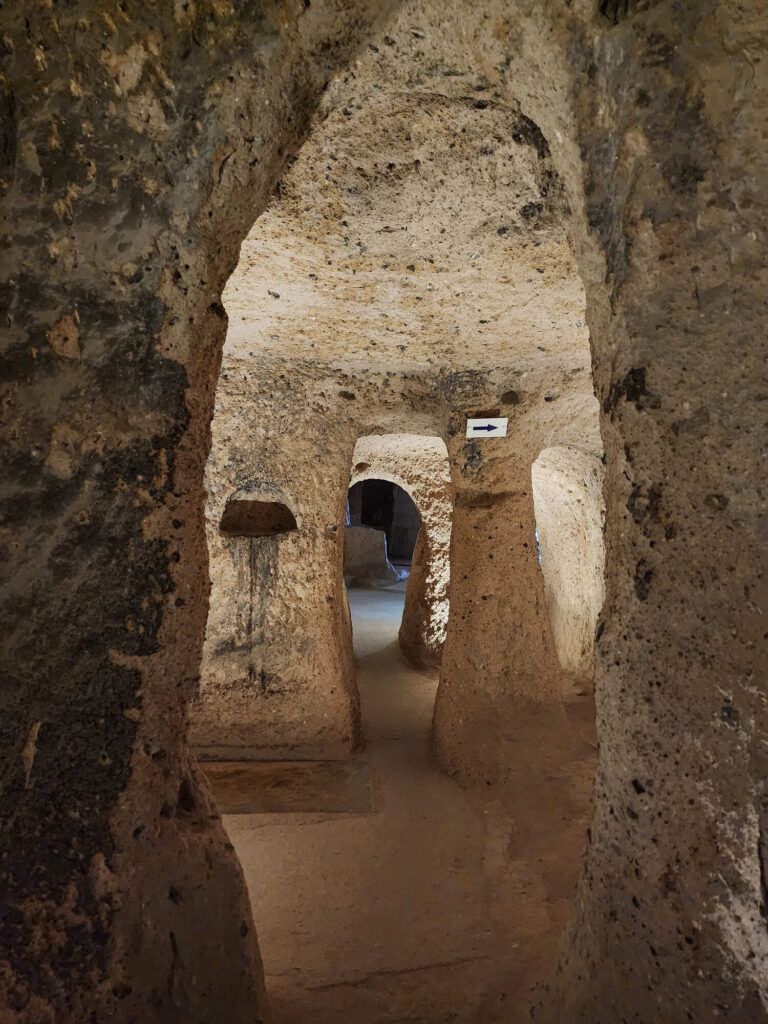
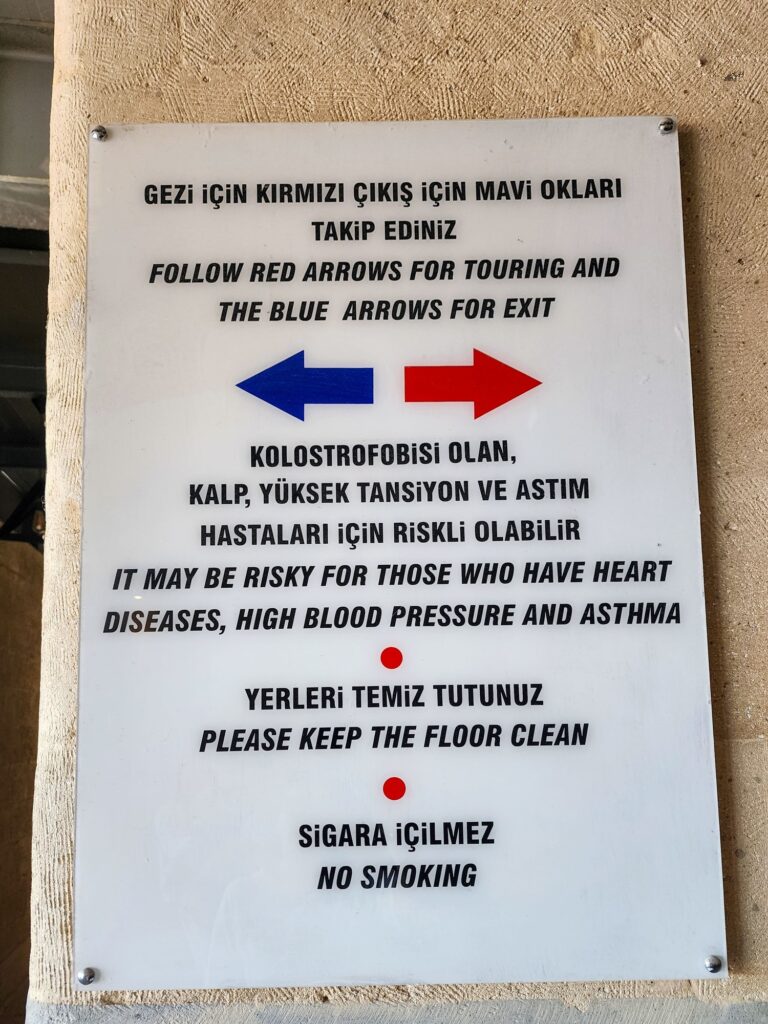
How Do You Navigate Kaymaklı?
Kaymaklı has a particularly useful visitor system.
During my visit:
- red arrows led deeper into the underground city;
- blue arrows pointed toward the exit.
That makes the visitor route relatively easy to follow even if you visit without a guide.
You still need to pay attention, but there is less reason to worry that every side passage will leave you wandering around underground.
Which Underground City Is Deeper?
Derinkuyu.
It reaches approximately 85 metres underground and has a much stronger vertical character.
Kaymaklı is notable for something different: its horizontal extent.
So asking which city is “bigger” can be misleading.
A better distinction is:
- Derinkuyu is deeper.
- Kaymaklı spreads wider.
Which Underground City Feels More Claustrophobic?
Neither should be treated as comfortable for someone with serious claustrophobia.
Both include:
- low passages;
- confined rooms;
- narrow tunnels;
- uneven stairs;
- sections where movement slows considerably.
But Derinkuyu usually creates the stronger sense of being deep underground because of its vertical layout and repeated descent.
Kaymaklı might feel psychologically easier because the visitor route is less focused on depth, but it still forces you through tight, low, and sloping tunnels. Never interpret “less vertical” as “spacious”.

Important Health Warning
At the entrances, I saw warnings aimed at visitors with conditions including:
- heart disease;
- high blood pressure;
- asthma.
Anyone with severe claustrophobia or panic triggered by confined spaces should also think carefully before entering.
If underground tunnels already make you uncomfortable before you arrive, neither city is a sensible attraction to force yourself through simply because it is famous.
Which Is Physically Easier?
This is less straightforward than saying Kaymaklı is easy and Derinkuyu is hard.
Derinkuyu
The challenge comes from:
- greater vertical movement;
- stairs;
- long descents;
- enclosed passages.
Kaymaklı
The challenge comes from:
- low tunnels;
- sloping corridors;
- crouching;
- irregular stone floors.
So Kaymaklı is less vertical, but not necessarily effortless.
Anyone with knee, back or mobility problems should consider the actual tunnel conditions rather than only comparing the number of stairs.
What Should You Wear?
For both underground cities, wear comfortable closed shoes.
Sneakers were enough for me.
Expect:
- uneven stone steps;
- rough floors;
- narrow passages;
- areas where you need to bend;
- potentially slippery surfaces.
You do not need serious trekking equipment.
The temperature also becomes cooler as you descend.
During my visits, I was still comfortable in a T-shirt, but that does not mean everyone will feel the same. A light layer is easy to carry if you tend to get cold.
Which Has the More Interesting History?
Both belong to a much larger Cappadocian tradition of underground settlement.
Ignore neat online summaries claiming a single civilization “built” these cities from start to finish.
Their earliest origins are debated, and these underground spaces developed and expanded across multiple historical periods.
Roman and especially Byzantine communities later used and enlarged underground systems as places of shelter and protection.
That long development helps explain why the cities contain such a mixture of:
- domestic spaces;
- religious areas;
- storage;
- animal shelters;
- water systems;
- ventilation;
- defensive architecture.
They were not designed as modern cities underground in one construction campaign.

Did 20,000 or 30,000 People Live Underground?
You will see very large population figures quoted online for both cities.
Treat them as estimates rather than exact historical headcounts.
Museum and tourism sources give differing capacity estimates, sometimes reaching tens of thousands of people.
The more important point is that these complexes were built to support large communities together with animals, water and food supplies during periods of danger.
That is more useful than pretending we know exactly how many people occupied every level at one time.
Are the Two Underground Cities Connected by a Tunnel?
The idea that Kaymaklı and Derinkuyu are connected by a 9 km ancient tunnel is frequently repeated online, but it should not be treated as a settled archaeological fact.
The two underground cities are indeed only around 9 km apart by location.
For trip planning, that is the useful part: they are close enough to visit consecutively in one day.
Can You Visit Both in One Day?
Yes.
I did exactly that.
My route was:
Göreme → Nevşehir → Derinkuyu → Kaymaklı → Nevşehir → Göreme
Because the two underground cities are relatively close to each other, visiting both is logistically straightforward.
The real question is not whether you can see both.
It is whether you need to.
Visit Both If:
- underground architecture genuinely interests you;
- you want to compare horizontal and vertical layouts;
- you have enough time for a full underground-city day;
- you enjoy archaeological sites;
- visiting the second city will not force you to skip something you want more.
Choose Only One If:
- you have only 2–3 days in Cappadocia;
- you mainly want one representative underground-city experience;
- you already have a packed itinerary;
- confined spaces are tiring for you;
- you would rather spend the remaining time hiking or visiting open-air museums.
For a short first trip, sacrificing Rose Valley, Zelve or another major Cappadocia experience just to tick off a second underground city usually does not make sense.
See my 3 Days in Cappadocia itinerary for how to balance the major sights.
My Experience Visiting Both in One Day
Seeing Derinkuyu and Kaymaklı consecutively made the differences much easier to notice.
Derinkuyu stayed with me for its depth, steep descents and hidden scale.
The repeated movement downward constantly reminds you that an enormous protection and survival system existed far below the surface.
Kaymaklı made everyday underground life easier to picture.
The stables, kitchens, wineries, storage rooms and workshops give the site a different kind of context. Instead of concentrating mainly on how deep you are, you start thinking about how the settlement functioned.
Together, the two cities gave me a fuller picture of underground Cappadocia.
I am glad I visited both.
Can You Visit Without a Car?
Yes — and this is one area where many Cappadocia itineraries make the logistics sound harder than they need to be.
I visited both underground cities from Göreme using public transport.
My route was:
- Göreme → Nevşehir: 60 TL
- Nevşehir → Derinkuyu: 120 TL
- Derinkuyu → Kaymaklı: 70 TL
- Kaymaklı → Nevşehir: 70 TL
- Nevşehir → Göreme: 60 TL
Total transport: 380 TL
Treat these as a snapshot of my late-June 2026 trip, not permanent prices. Dolmuş fares and schedules change, so always verify the return times locally before starting your day.
The important point is that you do not need a rental car or organised Green Tour to visit Kaymaklı and Derinkuyu.
If you are deciding whether to rent at all, see Do You Need a Car in Cappadocia?.
Is Göreme a Good Base for Visiting the Underground Cities?
Yes.
I made the entire trip as a day trip from Göreme and returned there afterwards.
That is one reason Göreme works particularly well for travellers exploring Cappadocia without a car: accommodation, restaurants, tours and transport connections are concentrated in one base rather than requiring you to move hotels for individual attractions.
If you are still choosing where to stay, see my Where to Stay in Göreme guide.
Should You Take a Green Tour Instead?
A Green Tour can simplify the day considerably if you do not want to deal with transport yourself.
However, “Green Tour” does not automatically mean one specific underground city.
Current itineraries vary.
Some visit Kaymaklı.
Others visit Derinkuyu.
Before booking, check:
- which underground city is included;
- whether the entrance ticket is included;
- how long you actually spend underground;
- the other stops;
- group size;
- lunch;
- whether there are shopping stops.
Do not book based only on the words “Green Tour”.
See Cappadocia Red Tour vs Green Tour before deciding whether an organised day makes sense.
You can also compare current options in my Best Cappadocia Tours & Activities guide.
Do You Need a Guide Inside?
No.
Both underground cities can be visited independently.
Kaymaklı’s arrow system makes the main visitor route particularly straightforward.
However, this is one attraction where historical context adds noticeable value.
Without explanation, some sections can become:
room → tunnel → another room → another tunnel.
A good guide can explain:
- which areas were used for animals;
- how kitchens and storage worked;
- why the corridors were deliberately narrow;
- how circular stone doors operated;
- ventilation;
- water access;
- churches and religious spaces;
- how residents could survive underground.
So a guide is useful, but not necessary for navigation.
How Long Do You Need at Kaymaklı?
Allow approximately 1–2 hours for most visits.
Your time will depend on:
- crowd levels;
- how much you stop to inspect individual rooms;
- whether you use a guide;
- how quickly you move through low tunnels.
Do not rush simply to finish every accessible level.
The underground spaces become more interesting once you start looking at how individual rooms connect.
How Long Do You Need at Derinkuyu?
Again, approximately 1–2 hours is reasonable for most travellers.
Allow longer if:
- you are using a guide;
- the tunnels are crowded;
- you stop frequently;
- you need to move slowly on stairs.
Because Derinkuyu is more vertical, the visit can feel physically longer even if your actual time inside is similar.
Crowds Matter More Underground
Crowds change these sites dramatically.
An open-air attraction can absorb several tour groups reasonably well.
A low tunnel cannot.
If a group stops ahead of you while a guide explains a room, everyone behind may have to wait — sometimes while crouching in a confined passage.
That can turn a fascinating historical tunnel into an intensely claustrophobic bottleneck in seconds.
If possible:
- arrive near opening;
- avoid obvious tour-bus peaks;
- allow groups to move ahead;
- do not squeeze into a tunnel immediately behind a large guided group.
For visitors sensitive to enclosed spaces, crowd timing can matter almost as much as which underground city you choose.
Ticket Prices
During my visit, admission was €13 per underground city for international visitors.
As of September 2026, the official foreign-adult price remains €13 for Kaymaklı and €13 for Derinkuyu.
There is no price advantage to choosing one over the other.
If you visit both, budget for two separate admissions.
Because admission policies and prices can change, check the official museum information shortly before visiting.
Opening Hours
During my late-June 2026 visit, both were operating from 08:00 to 20:00.
Opening hours can change seasonally.
Current official schedules may also differ between the two sites, and Derinkuyu has operated seasonal evening or night-museum hours in 2026.
For an evergreen itinerary, the safest rule is:
check the official opening and last-ticket times shortly before your visit rather than planning around old blog hours.
This is especially important if you are visiting both cities late in the day.
Which Underground City Should You Visit?
Choose Kaymaklı If:
- you want to understand daily underground life;
- stables, kitchens, wineries and storage interest you;
- you prefer a less vertically intense route;
- you want to see the underground defence system in context;
- this is your first underground city and depth is not your main priority.
Choose Derinkuyu If:
- depth is the main attraction;
- you want the strongest underground sensation;
- engineering interests you;
- the 85 m scale appeals to you;
- you want to see the missionary school and huge ventilation system;
- you do not mind repeated descents and confined passages.
Choose Both If:
- underground cities are one of your main Cappadocia interests;
- you want to compare two different layouts;
- you have enough time;
- you are comfortable underground.
Choose Neither If:
- you have severe claustrophobia;
- enclosed tunnels trigger panic;
- stairs and crouching are difficult;
- serious mobility limitations make narrow passages unsafe.
FAQ
Which is better, Kaymaklı or Derinkuyu?
Neither is universally better.
Kaymaklı is stronger for understanding everyday underground life. Derinkuyu is stronger for depth and engineering scale.
Which is deeper?
Derinkuyu, reaching approximately 85 metres underground.
Which is bigger?
It depends on what you mean by bigger.
Derinkuyu is much deeper, while Kaymaklı is officially described as the widest explored underground city in Cappadocia.
Which is less claustrophobic?
Kaymaklı may feel less vertically intense, but it still contains narrow, low and sloping tunnels.
Anyone with serious claustrophobia should be cautious with both.
Which is easier to walk?
Kaymaklı involves less dramatic vertical descent, but its low passages may require considerable bending.
Derinkuyu involves more stairs and deeper movement underground.
Neither is a flat museum visit.
Are Kaymaklı and Derinkuyu connected?
The idea of a 9 km ancient connecting tunnel is frequently repeated online, but it should not be treated as a settled archaeological fact.
The two sites themselves are roughly 9 km apart geographically.
Can you visit both in one day?
Yes. Because they are close to each other, visiting both in a single day is logistically straightforward.
I did exactly that using public transport from Göreme.
Is it worth visiting both?
Yes if underground architecture genuinely interests you.
For a short first Cappadocia itinerary, one is usually enough.
Which underground city is included in the Green Tour?
It depends on the operator.
Some Green Tours visit Kaymaklı; others visit Derinkuyu. Always check the actual itinerary.
Can you visit without a tour?
Yes.
Both can be visited independently, including by public transport.
Are they suitable for children?
That depends on age and comfort with confined spaces.
The narrow passages, stairs and uneven floors make both inappropriate for pushchairs and potentially difficult for very young children.
Final Verdict: Kaymaklı or Derinkuyu?
Choose Derinkuyu for depth. Choose Kaymaklı for a clearer picture of everyday underground life.
Derinkuyu’s strongest feature is the feeling of scale: steep descents, narrow passages and the knowledge that the complex reaches roughly 85 metres beneath the surface.
Kaymaklı tells a slightly different story. Its stables, kitchens, wineries, storage areas, workshops and defensive passages make it easier to imagine how a community could actually function underground.
I visited both in one day and found the contrast valuable—they do not feel like duplicate attractions.
But if your Cappadocia trip is short, choose one and keep time for the landscapes above ground.
Whichever you visit, wear proper shoes, expect tight passages and do not underestimate how different a narrow underground tunnel feels when a tour group is standing inside it.
If you are building your itinerary around one convenient base, Göreme makes both organised and independent underground-city day trips straightforward. See Where to Stay in Cappadocia before choosing your base.
Plan Your Cappadocia Trip
🏨 Where to Stay
Compare hotels and cave stays across Cappadocia.
→ Trip.com
🚐 Airport Transfer
Compare private airport transfers in Cappadocia.
→ Kiwitaxi
🎒 Tours & Activities
Browse Cappadocia tours and experiences.
✈️ Flights to Cappadocia
Compare flights to Kayseri and Nevşehir.
→ Trip.com
🚗 Rent a Car in Cappadocia
Compare rental options if you want more flexibility.
📱 eSIM for Turkey
Get mobile data before arrival.
→ Yesim
🛡 Travel Insurance
Check travel insurance options.
→ EKTA
Some links on this page are affiliate links. If you make a purchase or booking through one of them, I may earn a small commission at no extra cost to you.